
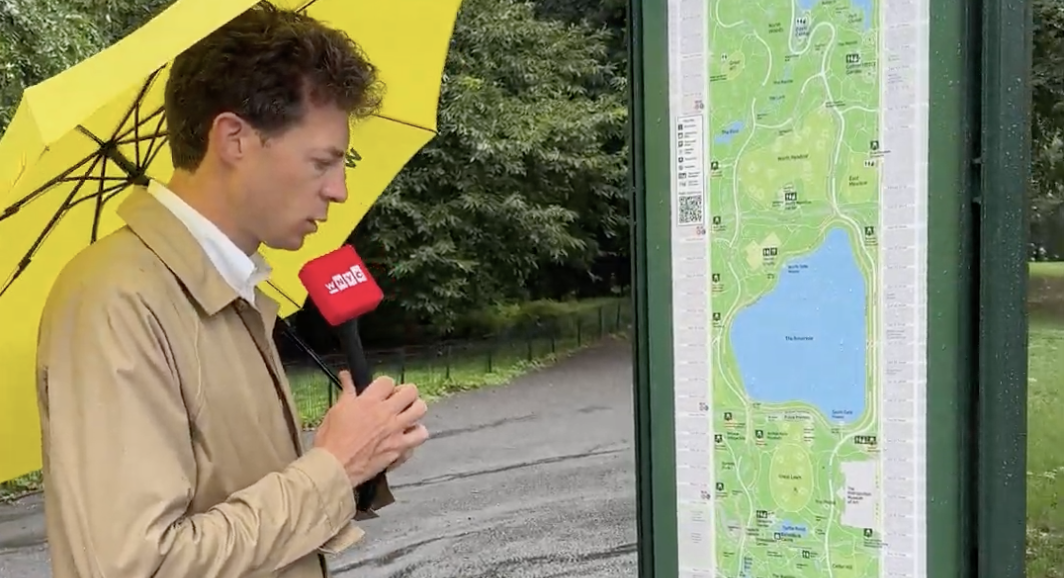
As the article explains:
In 1808, an engineer named John Randel Jr. was tasked with a monumental responsibility. He was to travel around New York City and plant metal bolts at nearly 1,000 proposed intersections … and those bolts and intersections were famously used to create Manhattan’s grid system.
In 2004, surveyor Lemuel Morrison and geographer Reuben Rose-Redwood … eventually discovered one of Randel’s bolts in [Central Park]. It is considered the only authentic bolt from the early 19th century in Central Park.
If you do happen to know where the bolt sits, please do not comment with that information … If you’re up for the challenge, spend the day traversing Central Park searching for the historic artifact.
Challenge accepted. But without the aid of the internet, is there any way one could find this bolt in a 900-acre park?
Apparently, yes. Gus Saltonstall, the managing editor of the Rag, told me he wrote the story after one of his friends, Louis Dzialo, stumbled on it and texted a photo to their group chat.
During our phone conversation, Saltonstall conceded that, yes, it’s possible to poke around online and find the bolt’s location. But the effort to keep it a secret isn’t just for funsies.
“The Central Park Conservancy and the parks department have given statements at different points also reiterating, like, ‘We don’t wanna give the location away. We’re worried somebody will come and try to steal it or, you know, break it,’” he said. (The parks department did not respond to our request to confirm this before publication.)
My colleague Dana Binfet and I had a two-hour window when we could leave our desks, so we set out for Central Park, armed with nothing but Dzialo’s photo.
Given the source of our inspiration, we initially decided to stick to the west side of the park … and inspect every rock we could find.
At the one-hour mark, feeling sweaty and a bit dejected, we decided to bend the rules. While we wouldn’t consult any search engines, what would be the harm if someone offered us a hint?
Since a rainstorm had just wrapped up, the park was mostly empty except for people running or smoking weed. But a friendly walker named Ellen Braude agreed to help — and told us that, in fact, she knew about the bolt.
“Only what I read in the Rag,” she said. “I have not stumbled on it. I’d like to know where it is, though.”
Braude, who told us she’d been a Central Park walker for some 40 years, said that based on the close-up image of the bolt sticking out of the rock, she had an idea where to look: [redacted].
So we went. No luck.
Around the two-hour mark, I started noticing how many landmarks we’d blown past: the Belvedere Castle, the Bethesda Fountain, the Turtle Pond. (We accidentally abandoned the stick-to-the-west side strategy). It also dawned on me that amid these beautiful, historic and extremely photogenic scenes, we were searching for — and filming a video about — what essentially amounted to … a little metal rod poking out of a rock.
Who would care? Well, we would.
When I think about our Midtown bus terminal, about our humble buffet scene, and about the kinds of things you experience when you take an absurdly long walk, a theme that emerges is that although New York City may be “iconic,” it’s not a museum of itself.
It’s a constantly changing, largely functional city that, if you allow it, offers a million things to appreciate without being precious or sentimental. That Includes a funny metal stick that was once part of crafting the greatest streetscape in America, and is now just hidden in a stone in Central Park, virtually impossible to find.
Or is it?