
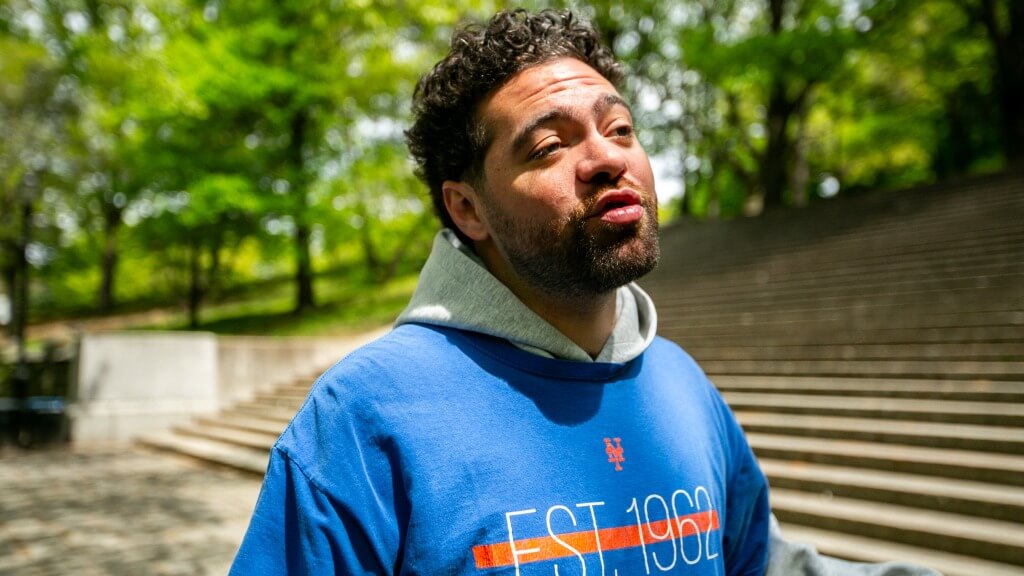
Canal Street is cloaked in a layer of smog, hanging hazy in the air like mist from a river bubbling through a canyon of limestone buildings on either side of the street. On the sidewalk, people pull their shirts up over their noses so as not to breathe in the chemical mixture carried in from the Canadian wildfires that has turned New York’s skyline yellow-gray. I put on Ratking’s “Canal” in honor of the location and the occasion—how many times have I walked down this street, how many times have I yelped along—“Canal, Canaaaaaaal!”? I was halfway through high school when Ratking, a rap group of New York City kids just a little older than I was, dropped So It Goes, their only album. Over a decade later, I’m on my way to talk to the trio’s breakout MC, Wiki (government name Patrick Morales), at the apartment where he was living at the time of So It Goes’ release.
I meet Wiki at Ancient History’s vinyl release party, which doubles as the opening of an installation featuring the work of multimedia artist Esteban Jefferson, whose paintings serve as the record’s cover art. The event takes place at Market Gallery, an apartment-turned-studio space where Wiki used to live. Market Gallery is unassuming from the outside, looking like any other scaffolding-shrouded prewar apartment building in Two Bridges. I clatter up to the tenement-style second-floor walkup and through its dark red front door. Outside on the roof, smells from the grill mingle with the smoke hanging in the air, while people mill about by the picnic tables. A mural of the Puerto Rican/Irish flag that appears on various album covers across Wiki’s discography is splashed across the brick wall of a neighboring building, probably a room or two wide and well over eight feet tall. In a standalone room on the rooftop, Jefferson’s paintings—including the portrait he did of Wiki for Ancient History’s cover—hang on the walls. A small, boxy television plays a loop of archival footage of Wiki and his friends from the years they called this place home.
“It was the first place I lived outside my mom’s,” the Upper West Side-raised rapper says of the Chinatown apartment. It’s where he made his earliest solo works, like his 2015 debut mixtape Lil Me and his 2017 album No Mountains In Manhattan. We’ve found a relatively quiet spot in a far corner of the roof to talk while Wiki puffs on a loud as hell and fast-canoeing joint. Elevated trains rumble over the Manhattan Bridge every couple of minutes throughout our conversation, momentarily muffling the recording—a frustration that feels especially fitting when we end up on the topic of “IHNY,” an Ancient History track where Wiki’s love/hate relationship with the city admittedly skews a bit more toward hate than love. We’ve all been there, waiting for the thing that snaps us back; something always does. “Hate gon’ make me take this city, make it mine,” he raps on “IHNY.” “That’s a go for anyone from the city at any time.
It’s a New York thing, but apparently it’s not just a New York Thing. “So many people were hitting me up from Melbourne and Sydney and shit, and they were like ‘We love ‘IHNY,’ this is how we feel about Sydney!’” This is far from the only city that is constantly changing, whose history feels too vast and varied for even those of us who’ve spent our entire lives here to wrap ourselves around tightly enough, far from the only city that’s hard to explain to outsiders in a way that doesn’t read as fiction. “A lot of out-of-towners be not realizing that it’s our home,” Wiki points out. To grow up and live and probably die in New York is to mourn the city over and over again and cling to the vestiges of it that still feel like the place that raised you—to know that even the places that feel like home to you once replaced the homes of another generation of New Yorkers. (“Before it was Broadway it was Lenape Lane / Had to be a wall in the block before it was the stock exchange / El barrio was Italian before the papis came,” goes Wiki’s history lesson that opens “IHNY.”)
It’s something I find myself thinking about when our conversation lands on the brief few years where independent music venues dominated the Williamsburg waterfront. “Vice bought that whole block. It had Glasslands, it had 285 Kent,” Wiki reminisces. “285 Kent was my favorite venue ever—well, I don’t know ever, but I loved playing at that venue. You could smoke in there; it was chill. There was some legendary shows.” If you were coming up in any pocket of the city’s DIY scene in the 2010s, those were the kinds of places where you cut your teeth—grimy, all-ages warehouses riddled with fire and health code violations where kids who’d seen the right Facebook event pages arrived armed with $10 cash for the door and nips stuffed in their boots, testing just how much abuse the sagging floors and paint-peeled walls could withstand. When we got tired from moshing, we sank into mysteriously stained and potentially bedbug-ridden couches. Genre was a suggestion at most; rappers shared stages with hardcore bands, ambient noise artists, and bedroom pop stars alike.
It was through that scene that Wiki met some of his longtime collaborators, all of whom appear on his latest record: Brooklyn-raised Ukrainian-American rapper Your Old Droog, who hops on “All In The Lining”’s spine-tingling minor key piano for a verse; Queens singer duendita, who laments the rising rents and considers leaving the city for “a softer life” from the Q54 bus on “Bloom”; MIKE, who collaborated with Wiki on 2023’s Alchemist-produced Faith Is A Rock, lends his own production skills to Ancient History under his dj blackpower moniker. Elsewhere on the record, beats come courtesy of other Wikiverse recurring guests like Lil Ugly Mane and Navy Blue. “It’s some comic book shit,” Wiki says. “Like when you see Spiderman and the Fantastic Four linking up.”
From the looks of his wide net of collaborators, Wiki’s reach is further than he lets on. It’s a classic yet contradictory story of the hyperlocal hero: the city opened him up to the world. “It’s chaotic. You never get a break, but that’s also what I love about it. There’s always new people to meet, there’s never a dull moment.” His description of the city and its music scene is an equally apt one for his twenties, which Ancient History documents—“from 18 to now. Getting signed [to XL], touring, and just being thrown into it all.” The songs are the result of over four years of writing and recording, a process that’s left him feeling more clear-headed and focused. “Ancient History is also about moving on and burying the hatchet.”
I ask Wiki if there’s any advice he’d give to his younger self. “I’d say chill on the drinking, ’cause that shit made me way more depressed,” he says with a good-natured grin. “You’re gonna get through it. Shit can be tough; there’s ups and downs in life. Life isn’t meant to be easy.” There’s no trace of bitterness in his voice, a far cry from the mid-album self-intervention “Bourbon”—the grimmest cut on Ancient History, maybe even in Wiki’s entire discography. Its confrontation of Wiki’s escape from a cycle of alcoholism and depression made his peers question whether he should even include it in the tracklist. For him, though, the song’s rawness was what made him know for sure that it belonged: “The more vulnerable it is, the more I’m like ‘Put that shit on the album.’”
Ancient History came together slowly, taking the time it needed. Though it bears plenty of the hallmarks of a so-called “mature” album—it’s an introspective survey of Wiki’s tumultuous young adulthood and the city that bore witness to it—there is no doubt that even in its darkest and most trying moments, he was having fun figuring out how it would all come together: “Find the joy in the process. Everyone’s like, ‘Yo, once I drop it’s gonna be lit!’ Nah bro, the best part is making that shit. Feel the glory in that, the confidence in that. You think you’re gonna get it from other people, but you’re gonna get it from yourself from just making it. Fuck if anyone even sees it, just enjoy making it.”
You’d be hard-pressed to find any coverage of Ancient History that doesn’t mention that the record dropped early in the summer, Mayor Zohran Mamdani’s first in New York, between games four and five of the Knicks’ historic championship run. I’m sure that when the ten-year anniversary retrospectives are written about Ancient History, those points will be punched into every single one—provided that this city isn’t underwater or swallowed up in smoke by then. Even if that’s the case, leave it to New Yorkers to still be talking about how Wiki provided the soundtrack to one of the greatest sports comebacks in the city’s history.
It’s key context, but incidental—or serendipitous. The album was supposed to be released a few weeks earlier, but got delayed: “Look how the world works!” Wiki exclaims. “It worked perfectly. We dropped it; the Knicks won the next day—Sunday, Puerto Rican Day Parade. It was the illest weekend ever.” Wiki plans to keep the celebration going through the summer into fall with a tour of exclusively outdoor venues. “I try to be outside as much as possible. My office is Seward Park.” After you visit him at Seward—one of many shoutouts in Ancient History’s ode to New York’s abundance of public parks, fittingly titled “Park”—the Ancient History art installation at his former home is just a short walk away.
Before I know it, the Gallery is shutting down for the evening. Everybody shuffles downstairs and up Market Street. I walk until I’m back on Canal, this time with “IHNY” queued. The combination of smog and sunset has blotted out the bridge, blurring its angles. I watch a pair of young lovers pull off their N-95 masks to make out in the wildfire runoff, pressed up against the outdoor dining structure of some hip little wine bar masquerading as a hole-in-the-wall. In my headphones, Wiki sighs, “This fuckin’ city.”
Grace Robins-Somerville is a writer from Brooklyn. Her work has appeared in Pitchfork, Stereogum, The Alternative, ANTICS, Marvin, Swim Into The Sound, and her “mostly about music” newsletter, Our Band Could Be Your Wife.