
Read it and weep.
More than half of 3rd- to 5th-grade students in the Empire State failed their reading proficiency state exams this year, according to shocking new data.
Preliminary results released this week by the state Education Department that 57% of 3rd graders, 52% of 4th graders and 57% of 5th graders failed to make the grade on their 2025-26 English Language Arts tests.
A 2026 state exam showed a “significant decline” in ELA performance, the state DOE said. Getty Images
City kids in grades 3-8 saw a 6% drop in their ELA scores from last year, with just about half overall rating proficient.
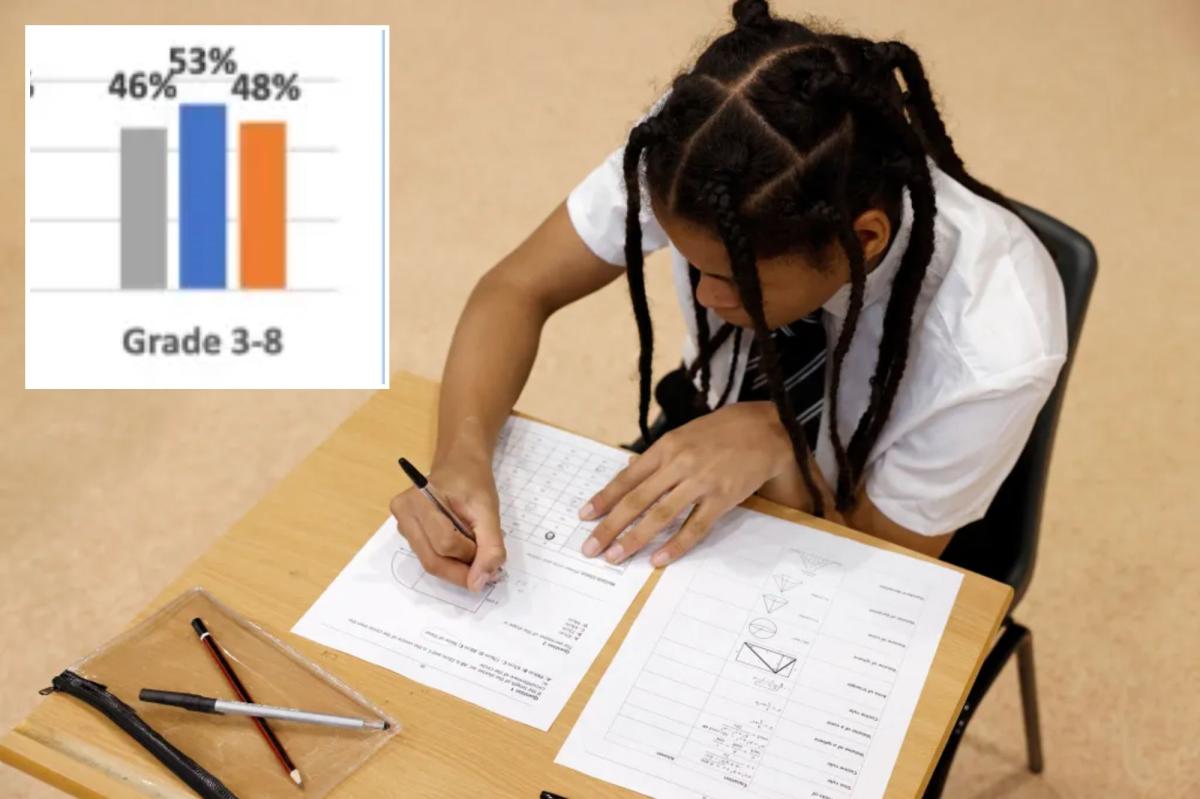
Overall, just 48% of students in the testing grades, 4th-8th, rated proficient on the ELA — a “significant” 5% plunge from the previous year, the department said.
Fifth graders saw the largest drop of any grade level, with those students’ reading proficiency declining by an incredible 14 points, according to the results.
In New York City — where about 40% of the state’s public school students are enrolled — the decline was even more concerning.
In 2025, about 56% made the grade on the reading test, which had been a 7% increase from the previous year, data shows.
Big Apple 3rd graders were the poorest performers on the ELA, with scores for that age group plummeting 13.8% from the previous year as only about 44% ranked proficient. Fifth graders followed behind with a 13.1% drop, according to the data.
While the results don’t make clear what exact ELA areas students are lacking in, experts said the blame can be placed on state officials throwing more money on public education year after year without changing teaching models.
“If the amount of money spent alone determined the results, New York should be on top of the world,” Zilvinas Silenas, the president and CEO of the Empire Center for Public Policy, told The Post.
Reading scores plummeted between 2024 and 2025 for third- through fifth-grade students. New York State Education Department
“I’m not trying to say that all of New York’s education system is bad. On average, it’s very mediocre, but we have some islands of excellence,” Silenas said. “Why aren’t we copying these islands of excellence on what they’re doing in order to improve?”
New York is spending about $37,000 per student — the highest of any state in the nation on public education and about double the national average of around $17,619, according to data tracked by the Empire Center.
In New York City, the largest public school district in the US, that spending goes up to about $44,000 per student.
At the 5th-grade level, students should be able to “comprehend and analyze text,” including the central idea, style elements, character and plot development and vocabulary, according to education officials.
In New York City, the largest public school district in the US, that spending goes up to about $44,000 per student.
One such question on the 2026 exam asked students to pick which answer included the definition of the phrase “going live,” as it was used in a story about a student-run blog. The multiple-choice answers included:
A) making the content available to all
B) announcing the project to the school
C) requesting feedback from others
D) accessing the new computer system
The 5th graders were also asked to write short-form responses identifying the effects of tone in poems, the themes of a story and more.
Charter schools — publicly-funded institutions that operate independently — have consistently outperformed public schools, despite fierce opposition from the teachers unions.
For instance, one of the largest charter networks, Success Academy, had a 92% pass rate for the English test in 2025 in New York, second only to the public schools in Scarsdale.
Public school students fared better on the math exam, with about 57% in grades 3-8 passing the test, a slight increase from last year.
The state DOE warned that the results were preliminary, but admitted that the “significant decline” in ELA performance was clear.
“The Department takes this decline seriously and will conduct a detailed analysis to better understand where students are experiencing challenges, which student groups and communities have been most affected, and where additional support and resources are needed,” said JP O’Hare, a spokesperson for the department.
New York State Governor Kathy Hochul speaks at a press conference in the Bronx, New York, on August 4, 2026. Andrew Schwartz / SplashNews.com
“We will not minimize or attempt to explain away what the data tell us. When scores increase, we report that progress. When they decline, we report that as well,” O’Hare said. “Our responsibility is not to create a narrative around the results, but to understand them, identify where students need additional support, and act accordingly.”
The middling scores come as Gov. Kathy Hochul dedicated the largest budget yet to the state Education Department.
A record $39.3 billion will be funneled toward schools for the 2026-27 academic year, with investments dedicated to training teachers in “evidence-based math and reading instruction.”
A spokesperson for Hochul’s office claimed the governor “has made improving student literacy a policy priority for her administration.”
“She specifically directed the State Education Department to place a heavy focus on reading proficiency, improve literacy instruction, and ensure schools have the tools and resources needed to help students succeed,” the rep said.
Michael Mulgrew, president of the United Federation of Teachers speaks in Hell’s Kitchen Park on May 30, 2026. Bloomberg via Getty Images
“The governor will continue pushing for measurable improvements in literacy outcomes statewide because every New York student deserves a strong foundation in reading.”
Nick Tampio, a political science professor at Fordham University who has published books on national education standards, said New York should “stop throwing good money after bad” programs.
“Hire skilled teachers. Provide schools with libraries. Give children time to read the books they want. Make reading a joy,” he told The Post.
Start your day with all you need to know
Morning Report delivers the latest news, videos, photos and more.
Thanks for signing up!
“New York’s approach is failing—as evidenced by the fact that over one fifth of SUNY students are failing their first English class.”
Controversial education initiatives enacted in recent years, like the NYC Reads literacy program launched under former Mayor Eric Adams, have stunted students’ growth, argued Eric Nadelstern, deputy schools chancellor under then-Mayor Michael Bloomberg.
“There is no one-way for all kids to learn how to read,” Nadelstern told The Post.
The middling scores come as Gov. Kathy Hochul dedicated the largest budget yet to the state Education Department. Getty Images/Maskot
“If you try a one-size-fits-all in a city as diverse as New York, — where students have such different needs and ways of learning and teachers have such different needs and ways of teaching — you’re gonna wind up alienating the staff and they’re gonna implement the program poorly,” he said.
“If you allow them to do what they do best — that is to determine how the students they know by name and family and neighborhood can learn best — they will do whatever is necessary to make sure their kids succeed.”
Both Mayor Zohran Mamdani and his Schools Chancellor Kamar Samuels touted NYC Reads in statements accompanying the paltry city test scores.
New York City Mayor Zohran Mamdani, New York State Governor Kathy Hochul and New York City Schools Chancellor Kamar Samuels spoke at a press conference in the Bronx, New York, on August 4, 2026. Andrew Schwartz / SplashNews.com
“As we review these initial statewide results, and what they mean for our students, we will focus on better understanding the scoring process to use this data with confidence and make the best decisions for our students,” Mamdani said.
Mary Vaccaro, vice president of education for the United Federation of Teachers union, also blamed changes in curriculum and teaching strategies, like “NY Inspires” – which allows students to graduate through avenues other than passing standardized tests like the Regents.
“We have to refocus on what we know works in literacy – a clear plan, a tailored science of reading curriculum, and meaningful professional development for educators. That recipe yields results,” Vaccaro said.
“This past school year, the system abandoned that approach and, with no real plan in place, simply piled on additional programs, assessments, consultant’s recommendations and curriculum in the hopes that ‘more’ would equal better, and we lost ground.”