
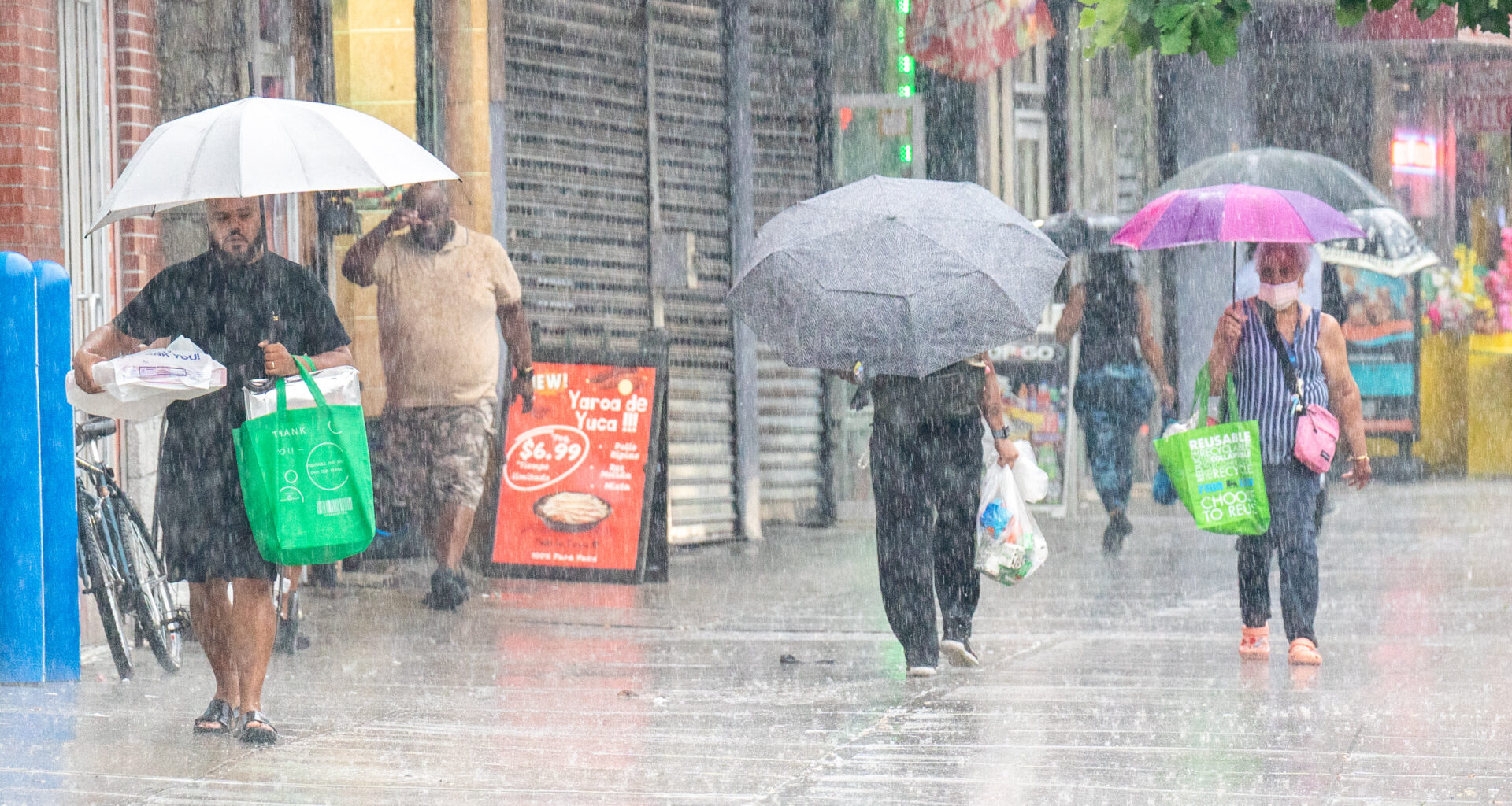
On a recent Saturday afternoon, shoppers in SoHo waded through flooded streets with trash bags tied over their legs. Firefighters pulled stranded drivers from the Brooklyn-Queens Expressway in Woodside. In Newark, streets disappeared under water in a matter of minutes.
Meteorologists have a name for this kind of storm: a cloudburst, which is an intense downpour that delivers inches of rain in less time than it takes to finish lunch. By my count, the New York area has now been hit by four of them in four weeks. The cloudburst has arrived in our region as a recurring fact of summer, and our cities and towns need to start planning and paying for it with the same seriousness we bring to snow.
The pattern is no longer subtle. The recent storm on July 18 dropped 2 to 4 inches of rain on parts of the city by early afternoon and put all five boroughs under a flood watch, with warnings reaching into northeast New Jersey.
Two weeks earlier, over the first weekend of July, a slow-moving system broke a brutal heat wave with wind gusts near 80 mph and knocked out power to nearly 300,000 New Jersey customers.
June delivered more of the same. Last summer reads like a preview: in July 2025 alone, New Jersey and New York each declared states of emergency as flash floods closed subway lines and stranded drivers on major highways. The physics behind the trend is simple. Warmer air holds more water, and when it lets go, it lets go all at once.
What makes these storms so expensive is the mismatch between the rain and the recovery. Most of the region’s sewers were engineered generations ago to drain well under 2 inches of rain per hour, and a cloudburst can deliver double that amount.
When rainfall outruns drainage, water pours into basements and subway stairwells because it has nowhere else to go. Add high winds over saturated ground and trees begin falling on power lines, which is how a few hours of weather in early July turned into days of outages and debris removal across North Jersey.
The bills land on budgets built for a different climate. FEMA estimates that a single inch of floodwater can cause up to $25,000 in damage to a home, which means a few dozen soaked basements can hand one small town a seven-figure cleanup in an afternoon. Spread costs like that across hundreds of towns, several times a summer, then add rising insurance premiums and less dependable federal disaster aid, and the result is a structural budget problem that arrives without warning and repeats without apology.
The encouraging news is that cities already know how to blunt these storms, and I have watched it work up close. In Hoboken, where I served as mayor for eight years, we stopped treating parks as separate from the sewer system and started designing them as reservoirs. ResilienCity Park, which we opened in 2023, holds roughly 2 million gallons of stormwater both beneath and above its ball fields and playgrounds, and intersections that once flooded in a routine storm now stay passable through far worse.
New York City is scaling the same concept through its cloudburst hubs in Corona, Kissena Park, Parkchester and East New York, where sunken basketball courts and rain gardens are built to fill during a downpour and drain once the sewers catch up. The city completed its first pilot at the South Jamaica Houses last year.
Copenhagen wrote the original playbook after a single 2011 cloudburst caused roughly $1 billion in damage, and it has been executing a citywide cloudburst plan ever since. China has pushed the idea to national scale, designating dozens of “sponge cities” engineered to absorb heavy rain instead of channeling it away.
The engineering is available to any town that wants it. The scarce resources are money and follow-through, and that is where the region should focus. First, map cloudburst risk street by street and adopt a design standard, as New York has done by building its hubs to handle a storm that drops 2.3 inches of rain in an hour.
Second, create dedicated revenue. New Jersey authorized stormwater utilities in 2019, giving every town the power to fund drainage improvements through modest fees tied to pavement and runoff, yet almost no municipality has created one. That is a financing tool sitting unused in a flood zone.
Third, treat resilience as capital investment rather than emergency expense. Projects backed by mapped risk and dedicated revenue can be bonded and blended with state and private capital, and investors have begun to treat resilience as core infrastructure worth funding.
The strongest objection is the one every mayor hears at budget season, and it deserves a straight answer. Local budgets are stretched, the argument goes, and spending millions to defend against the worst hour of the year looks like overbuilding when schools and roads need money today. The trouble with that logic is that we are already paying for cloudbursts.
We pay through emergency overtime, ruined inventory, flooded basements and lost business days, and we pay retail prices after the damage instead of wholesale prices before it.
The National Institute of Building Sciences estimates that a dollar spent on hazard mitigation returns about $6 in avoided losses. Adaptation can also be phased. Risk maps and early warning systems cost relatively little, and a storage park pays a dividend every dry day as ordinary public space. The truly expensive choice is treating each cloudburst as a fluke.
Every town in this region already runs a sophisticated response to snow. We budget for plows and salt before a single flake falls, and we consider that basic governance rather than alarmism. The cloudburst has earned the same standing in our budgets and infrastructure investments. The rain over this region has changed faster than the systems beneath it, and the gap between the two is measured in flooded homes and seven-figure cleanup bills.
Another cloudburst is already forming somewhere over the horizon. Whether it becomes a disaster or an inconvenience is the part we still control.
Bhalla is a managing director and co-head of infrastructure finance at Dundon Advisers, LLC. He served two terms as mayor of Hoboken and represents the 32nd Legislative District in the New Jersey General Assembly.