
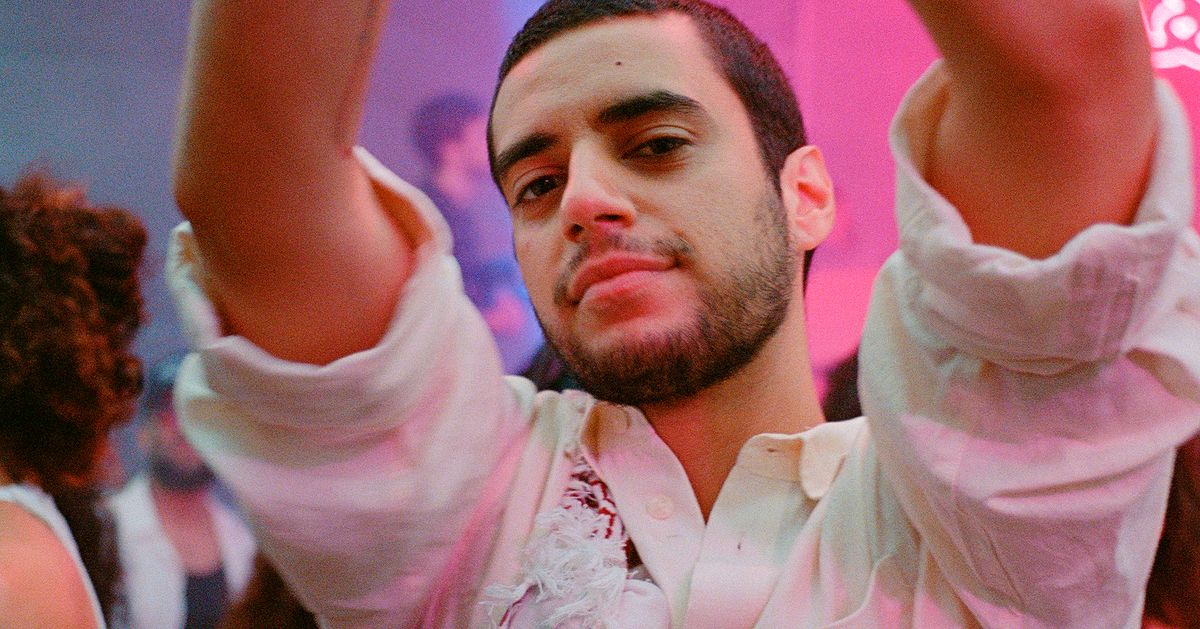
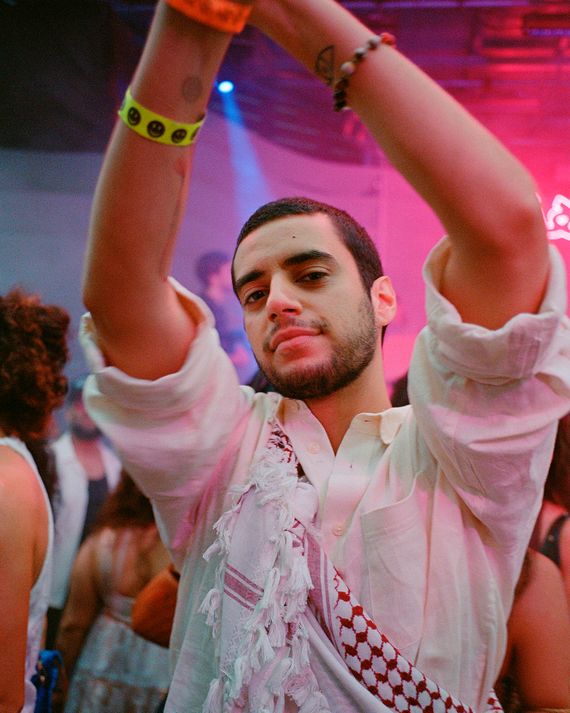
Saam Niami at Haza’s Summer Jam at Elsewhere.
Photo: Dean Majd
It first hit me in February 2025. I was in North Brooklyn, where I had taken my older daughter to a bookmaking workshop for kids at Storm Books & People, an independent bookstore for Middle Eastern culture founded by Lebanese curator Nour Sabbagh. I ran into two friends, Ken and Youmna, who were there with their daughter. Later that day, I read at a fundraiser for Gazan journalists at Brooklyn Poets sponsored by Lammeh NYC — a women-run Syrian supper club, the name of which means “gathering” — and Youmna happened to be going too, along with Rhea Karam, the Lebanese American artist who taught the workshop that morning. There was an ease to hanging out; as opposed to catching up, we were just together. “Like in the blād,” I kept insisting — back home, overseas, but actually in New York. And not in someone’s living room or on a fire escape. We were together in Greenpoint. Together in Brooklyn Heights, in reputable bookstores. It wasn’t just us — people of all backgrounds, curious to learn about our culture, were also there.
This was new. Fifteen years earlier, I’d been a student of international affairs at Columbia University. Back then, it felt safer as a Middle Easterner to make yourself smaller, to gather in the privacy of someone’s home or in one of a handful of culturally aligned establishments. This was the era of the “ground-zero mosque,” when an initiative to build an Islamic center near the site of the fallen Twin Towers was lambasted as insensitive to the families of victims. Foreign-policy experts were publishing books with titles like The Closing of the Muslim Mind. A self-proclaimed Islam critic named Daniel Pipes had created Campus Watch, an organization that compiled a list of faculty “to avoid,” whom it deemed critics of Israel. I was part of both the Arab Student Association and Students for Justice in Palestine (now suspended by Columbia as an officially recognized student organization). On weekends, we danced and threw ASA fundraiser parties at Le Souk, a Moroccan club on 4th Street at Avenue B in the East Village, where we alternated Saturdays with reggaeton and Latino night (we were happy to share). Mona Khalidi, Professor Rashid Khalidi’s wife, was an assistant dean of student affairs, and she befriended all the Arab students. On occasion, we dined at the Khalidis’ home. We arrived from all across the university: Lebanese Ph.D. students, SIPA party boys from Ramallah, Arab Americans who had grown up in Bay Ridge or New Jersey. We would sit around their dinner table and Professor Khalidi would talk, sometimes about Edward Said, his dear friend and the namesake of his endowed chair, all of us trying to impress him with our knowledge.
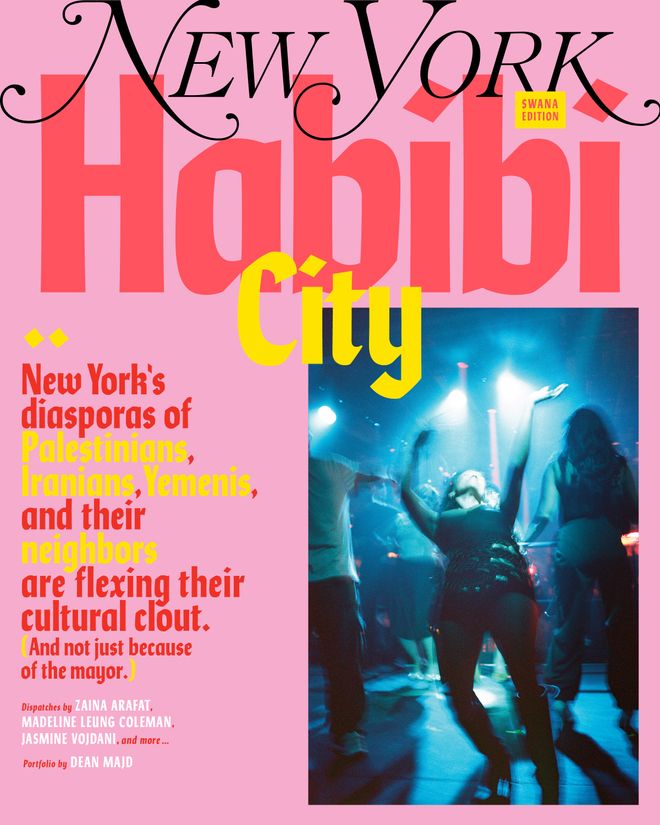
Habibi City
During these years, I would get a ping of excitement each time we came together, like when a crush texted. It was unusual for someone outside our specific communities to vocally champion our causes and take an interest in our culture. We were legible mainly to ourselves and in prescient publications like Bidoun, a literary magazine from both the diaspora and within the Middle East founded in the early post-9/11 years. Bidoun itself means “without” and is meant to evoke existing without the concreteness of space.
In the months after October 7, however, we were increasingly spilling into view, desperate to be close to people who knew what it felt like to pretend everything was normal when your family — not just blood relations but people who looked like you and spoke like you — was living under the threat of annihilation. So we protested, we boycotted, we wrote op-eds. And slowly, out of that resistance, a cultural ecosystem started to bloom. Protests led to friendships led to dinners led to new creative outlets. There was Kan Yama Kan, a reading series that began in Palestinian American author Hala Alyan’s lantern-lit Brooklyn backyard, evolving from a traditional open-mic crowd into a predominantly Arab and North African lineup. When Syrian American chef Gehad Hadidi opened Huda, his East Williamsburg restaurant, in November 2023, it became a hub of activity, hosting the artist Sabri Sundos’s tatreez workshop in October and, more recently, an Arabic storytelling hour for kids on Sundays. In February the following year, Barzakh Café opened in Crown Heights and quickly grew into the Platonic ideal of a third space, giving a platform to up-and-coming and established oud players and North African jazz musicians and single-handedly reviving the qawwali scene in New York. It could feel as if every gathering doubled as a fundraiser with QR codes placed on tables and slapped against walls. By March 2024, the now-annual Eid-al-Fitr Banquet put on by the nonprofit Pillars Fund — an occasion for Muslim journalists, artists, and creators to come together and celebrate the holiday — felt like the formation of a new center of gravity in the city. The first year, Zohran Mamdani arrived late from Albany as an assemblymember and had to stand against the wall until the hosts found him a seat next to his father. This year, he came as the mayor.
Many of these gatherings had a label attached: SWANA. An acronym for Southwest Asia and North Africa, the term has existed since the 1990s but only around a decade ago did it begin taking shape as a cultural and political force, one that has become almost synonymous with much of the current scene. SWANA includes countries from Palestine to Iran to Sudan. But there are ways in which no one label can capture the overlapping shared identities through which people feel kinship — so much so that letters keep getting added to the acronym to account for them all: SSWANA, for example, to include South Asians, many of whom have been crucial to building Muslim clout in the city, their causes and communities interwoven with those from the Middle East. “There is a widening understanding of what it means to be Arab, Muslim, or South Asian,” Kashif Shaikh, a Pakistani American and a co-founder of Pillars, tells me. “We’re expanding what it means to belong to our community and, as a result, building power.”
If you took the term in its most spiritual sense, it could be seen as a way of uniting people whose lives have been defined by American foreign policy in the region. To be in SWANA community meant embracing a set of shared beliefs: that Palestinians deserve human rights. That what happened in Gaza in the aftermath of October 7 constitutes a genocide. That social justice and social welfare override capitalist concerns. That to care is nonnegotiable. Unlike Muslim, it was not defined by religion. And unlike Middle East, a term coined by an American and popularized by the British to define our countries and identities in relation to them, SWANA suggested a decolonial framework and a way of moving through the world. (Middle Eastern, though imperfect, remains in common usage and I will use it occasionally here.)
Perhaps no stronger testament to New York’s SWANA-ssance is the fact that on November 4, 2025, a Ugandan-born Indian American Muslim man married to a first-generation Syrian American woman, both vocally pro-Palestine, took office as mayor. Zohran Mamdani is not technically from the SWANA region, but he is deeply embedded in its culture and reflected it back throughout his campaign, dining in SWANA-owned establishments, meeting with SWANA leaders, supporting the work of his wife, Rama Duwaji, and generally making it look fun to be SWANA adjacent — less like a chore for dutiful liberals and more like a party you wish you were invited to. It wasn’t just okay to be visibly SWANA anymore; it was cool. And like that of other New York ethnic groups who had cultivated a sense of cool in response to oppression — Blacks and Latinos particularly — the cultural energy was audacious, subversive, and increasingly covetable by others.
People began referring to New York as “Mamdanistan,” which was first used as an Islamophobic slur by his opponents and later reclaimed and popularized by his supporters. There was a ring of truth to the moniker. Mamdani had made accessible a history that had always been there along Atlantic Avenue and in Astoria and Bay Ridge. “Ana minkum, wa aleykum,” he said in a campaign video filmed inside a restaurant and a bodega on Steinway Street. He speaks Arabic with an impeccable accent, his pronunciation enviable even to a native speaker. “I am from you,” he was saying, “and with you.”
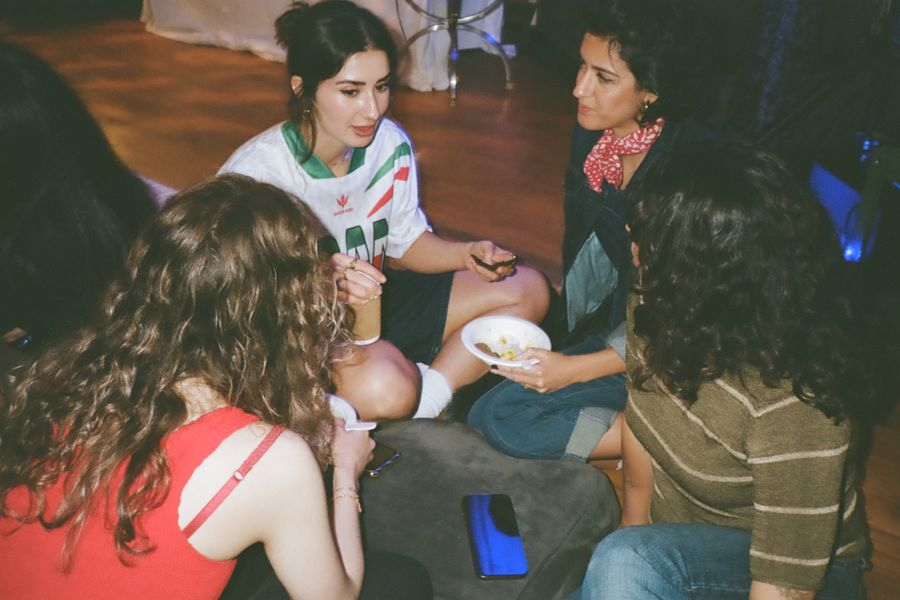
A Farsi Club meetup at a loft in Bushwick this past spring.
Photo: Taraneh Tajdini
“We’re in a time right now that is inconceivable to a younger version of myself,” Kimia Zakerin tells me. We’re eating crispy rice bowls at Little Ruby’s in Murray Hill, a neighborhood that holds significance for Zakerin. Her father’s Persian-carpet import-export company’s warehouse was once a block away. Zakerin is dressed in jeans and running sneakers; her main flourish is a tooth gem that gleams every time she smiles, which is often. Along with her clothing line, LEBĀS, Zakerin has been at the center of a thriving Iranian community, primarily through the meetups she organizes: Ketab Club, a SWANA-themed book club, and Farsi Club, a place for Iranians to practice their Persian speaking skills away from the judgmental ears of their elders.
Zakerin, who is 33, spent her adolescence in Chappaqua. In 2003, three days after the U.S. invasion of Iraq, she told her fourth-grade teacher she was worried. “This doesn’t affect you,” her teacher responded. Even as a child, she sensed that it did. Twelve years earlier, in 1991, I had participated in my own fourth-grade school assembly in the suburbs of Washington, D.C., and watched my father in the audience with headphones on, listening to ABC News as the U.S. entered Kuwait during Operation Desert Storm. After 9/11, my father learned his phone line had been tapped; he changed his name from Fawaz to Frank when making dinner reservations.
“The first decade after 9/11 was a fucking mess,” the actor Arian Moayed tells me. “Back then, the idea that we would have narrative power felt impossible.” Moayed arrived in New York from the Midwest on September 11, 2002, with a U-Haul and a beard. He had come to the city to build Waterwell, the theater company he and his roommate, Tom Ridgely, founded at Indiana University around September 11, 2001, with the mission of fostering socially conscious theater. On his first night in Manhattan, Moayed walked to Times Square around 2 a.m. He could feel the patriotism everywhere; we were months away from war, and the level of tension was palpable. “My first thought was, This is never gonna happen for me.”
It could be lonely, even in a city as diverse as New York, if you weren’t already plugged in to one of the Arab or Muslim enclaves that had existed here for decades: tightly knit communities built by Syrians, Yemenis, and Palestinians that were often insular or else mostly confined to certain neighborhoods. There was a beauty to the intimacy. Places like Yemen Café & Restaurant operated as social clubs for immigrants, helping them find housing and jobs. When its co-owner Sideeq Nassir arrived in New York with his family in 1986, his father would drive to the airport to pick up fellow immigrants and bring them to the restaurant on Atlantic Avenue for a free meal on their first night in the city. Our diasporas largely remained fragmented and scattered, however, too busy maintaining a low profile to seek out one another, and in our parents’ generations, Iranians and Arabs were often cast more as enemies than friends.
Not until 2017 did the tenor begin to shift, when, in one of Trump’s first executive orders, he banned travel to the U.S. for 90 days from seven predominantly Muslim countries and suspended the resettlement of all Syrian refugees. The response was immediate. The next day, New Yorkers of all backgrounds, including those from SWANA countries, headed to JFK airport to demand the release of recent arrivals who had been detained by U.S. Customs and Border Protection. By targeting seven countries, the ban had the unintended consequence of creating unlikely bedfellows. “The administration got what they didn’t want, which is that we all came together across nationalities,” Zakerin says. Yemenis were standing alongside Iranians. “We were all in the shit together, and that was very unifying.”
Arabs and Muslims were drifting away from the villain-victim binary in the eyes of liberal Americans. Suddenly, Hollywood was interested. In 2019, Ramy, a TV series from Egyptian American comedian Ramy Youssef, pitched in the months following the Muslim ban, debuted on Hulu. Shot in Queens and set in and around New Jersey and New York, it depicted the split life familiar to immigrants: the everyday one — at school, with friends — and the one at home. But, uniquely, it wrestled with how to reconcile the two rather than assimilate. With its Arabic-script opening and Habibi Funk soundtrack, it also helped popularize a growing SWANA aesthetic. Around that time, Zakerin was dabbling in streetwear design. She printed a T-shirt on a whim that said NEW YORK on it in Persian letters, which closely resemble those of Arabic. She printed 36 more and sold them all in two days. “It was the right time for people to feel comfortable wearing our alphabet on their chests,” she says. Designers like Zeynab Izadyar, of Vvork Vvork Vvork, were creating wearable art out of words written in Persian and Arabic. In Brooklyn, a series of SWANA-themed parties was starting to get off the ground — Laylit, Disco Tehran, Haza, Yalla! — catering to the diaspora and playing Arabic pop. Soon, non-SWANA partygoers began to join too.
This scene was largely led by a second generation less encumbered by tradition or the baggage its parents carried. More than 3.5 million people in the U.S. identified as Middle Eastern or North African in the 2020 Census, with a broader estimate of 5 million owing to underreporting — because people from those regions are categorized in the Census as white, it is difficult to come by accurate numbers. (In 2024, the Census approved a MENA, or Middle Eastern North African, category, which is currently slated to appear on the 2030 Census for the first time.) New York holds the third-largest population of SWANA residents, and it is among the fastest-growing Arab populations in the country: Those who claim Arab ancestry in the state have more than tripled since 1980, and per the most recent data from 2022, highlighted by the Arab American Institute, now sit at over 300,000 residents (which doesn’t include Iranians, Afghans, and many other ethnic groups). “We’re a very young community,” says Shaikh. “Now a 20-year-old is growing up in a world where they saw Muslim creatives on TV.”
Young people were also turning away from mainstream media, fueling the rise of magazines like Acacia, launched in January 2024 by Hira Ahmed and Arsh Raziuddin and billed as a home for the Muslim left, and Equator, founded in 2025 in direct response to the Israeli assault post–October 7 and where Negar Azimi, the editor-in-chief of Bidoun, is on the masthead. “Magazines can offer a community for people who might not know they belong together,” says Azimi. “A home for the spiritually disenchanted.” All share a global perspective and an embrace of subjective truth. Last year, Bidoun published a piece titled “House Arab,” by Ismail Ibrahim, a former fact-checker at The New Yorker whose frustration over trying to secure what he called “the most basic changes” in articles to “reflect the horror of what was happening” in Palestine after October 7 eventually led him to quit his job. It would become one of the most popular pieces in Bidoun’s history. “I think part of the spread is that the mea culpa I predict at the end of ‘House Arab’ has begun,” Ibrahim speculated, referring to his belief that news organizations would eventually get around to calling Israel’s aggression a genocide.
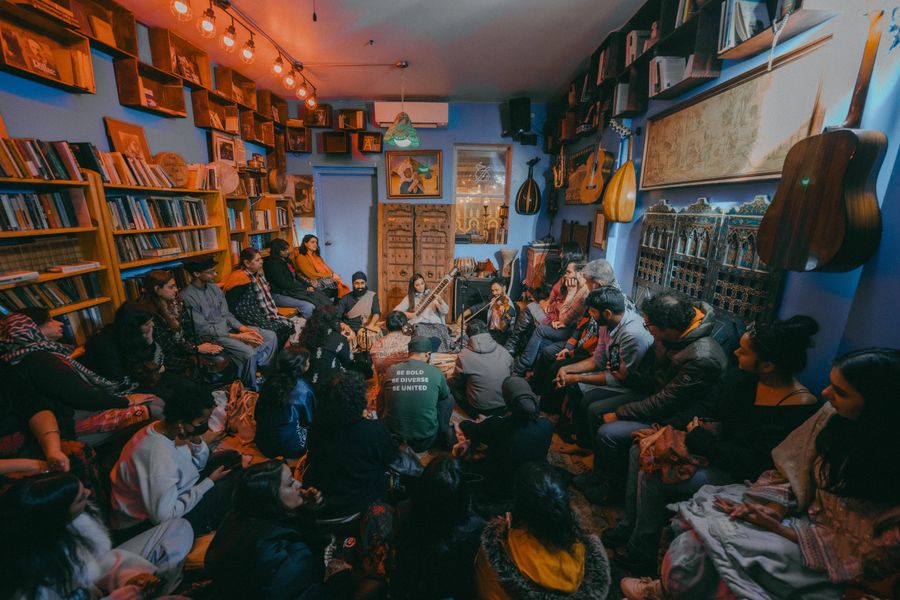
An evening at Barzakh Café in December 2025.
Photo: Haseeb Amin
When the SWANA scene reached a critical mass depends on whom you ask: For some, it was around the murder of George Floyd and BLM in 2020 or the evictions in Sheikh Jarrah and the ensuing war in Gaza in 2021. And, of course, October 7 and its hellish aftermath. For Zakerin, the moment came a year before. Many Iranians in the city had begun to find one another for the first time during the Woman Life Freedom protests in 2022, marching in Washington Square Park and down Madison Avenue to demand a world in which Iranians could thrive within Iran. That was around the time Zakerin started thinking seriously about creating Farsi Club. She had already felt a vacuum in her life after her parents’ deaths — her father’s in 2017 and her mother’s in 2020. “I couldn’t passively absorb my culture anymore,” she tells me. In December 2023, she posed a question to her Instagram followers: “My Farsi’s going haywire, anyone wanna practice?” The response was overwhelming. Hundreds of people filled out a Google sign-up sheet. At the first meeting, Zakerin felt like she was floating on air: “We all kept wondering, Where the hell were all these people? ”
There were versions of Farsi Club everywhere. Duwaji and Zakerin had met after Duwaji followed Ketab Club on Instagram. After seeing each other around at events, they became friends. Zakerin invited Duwaji to join a panel of speakers at a SWANA women’s networking event about how to support one another’s work (it happened to coincide with the U.S.-Israel 12-day war on Iran and ended up doubling as a place to collectively mourn). Each connection had a multiplying effect, like an expanding SWANA-verse where people were one or two degrees removed from one another.
If there is a physical embodiment of the new SWANA scene in New York, it’s Barzakh Café in Crown Heights. Following an epic late-spring downpour, I arrived there for a sold-out tawla, or backgammon, night hosted by two Palestinians, Mona Yasin and Aziz Kaddan, since September 2025. “I don’t think I would’ve had the courage to start something like this if I didn’t know there was already interest,” says Yasin, who grew up in Ramallah and came to the U.S. to attend Georgetown University before moving to New York in 2016. In the back room of the café, pairs of people sat at small tables, a game board between them, drinking tea or wine. Outside, a group settled on plush cushioned couches beneath tarps as the rain hammered down, smoking cigarettes. It reminded me of one of my favorite spots in Ramallah: Snobar, named for the pine-nut trees that surround its outdoor terrace.
Barzakh’s owner, El Atigh Abba, spent the summer of 2023 building it. “I had a mattress on the roof because it was so hot outside,” he tells me over iced hibiscus tea. Abba has an easy warmth, an enviable collection of loose-fitting linen, and a slightly upturned mustache reminiscent of an imperial pasha. A 38-year-old Mauritanian exile, Abba arrived on Canal Street on a bus from Athens, Georgia, in 2013. He is unable to return to Mauritania because of a fatwa issued after he’d left in retaliation for his activism and writing during the Arab Spring. For years, he worked in Yemeni-owned bodegas in Brownsville, as a French tutor in Sunset Park, and as a dishwasher in Crown Heights restaurants. He spent his free time with friends — some of them fellow restaurant workers, Uber drivers. But they could never seem to find places to comfortably hang out. “We got fed up with not being able to hear ourselves at bars,” he says. Between his signing the lease for 147 Utica Avenue in the spring of 2023 and opening Barzakh the following February came October 7. “It took me six months to fully process what was happening,” says Abba. Some of the café’s initial events were fundraisers for families in Gaza and the West Bank, and all of them sold out. “If you’re looking for a craft cocktail, go to Nostrand Avenue,” he says.
Walking into Barzakh, which in Arabic means “the liminal space between worlds,” feels like entering an Ottoman-era living room with its patchwork of art, donated instruments and books, pottery, impressive record collection, and hanging scarfs reflecting the pastiche of cultures. While a lot of SWANA gatherings can be Arab- or Iranian-specific, Barzakh is unique in that it feels like a place for everyone. At the same time, Abba makes a point of emphasizing the specific culture of each community that passes through. Laura Elkeslassy, an Arab Jewish singer, has led a yearly Mimouna at Barzakh — a dinner that marks the return to eating leavened bread after Passover. On Easter weekend, the café held an Armenian and Ethiopian Christian dinner. So much of Barzakh’s mission is to bring together people who might otherwise never meet and who, in other contexts, might be enemies: Palestinians from Gaza and Jews, including anti-Zionist Israelis.
On occasion, this openness has led to backlash. While Israel is geographically part of the region, the question of whether Israelis can claim a connection to it, particularly given the political framework of terms like SWANA, is complicated — and it gets more so depending on a person’s ethnic background. At Barzakh, one of the first sources of tension was over whether to allow a group of Palestinians from the pre-1948 borders to perform with Israeli peers. “Of course, they’re not Zionists, but these were tensions we had to reckon with,” Abba recalls. Last year, Barzakh hosted a Hebrew-Arabic language exchange. After the event was posted on Instagram, a heated debate unfolded in the comments section. “Consider how many Arabic speakers are forced to learn Hebrew as a means of survival,” one user noted. “This is hope,” said another. Some called on Abba to cancel, but he didn’t budge. “There is within the Arab young generation, the kids who were born here in U.S., an idea that you cannot sit with an Israeli in the same room,” he said in an interview at the time. “I’m the owner of this place, and I say this is not the case. But you do lose business.” Most recently, in July, Barzakh hosted a performance by the Palestinian singer Nour Darwish and the Israeli musician Noam Helfer. They were part of Feel Beit, an anti-Zionist, pro-dialogue artistic partnership. Reactions were mixed. One of the local DJs took issue with the use of the word dialogue. “I stood by it,” Abba tells me. “Words like dialogue and conversation should never become taboo. I also felt it was important to say that an Arab born in New Jersey doesn’t get to tell a Palestinian in Nazareth who they can share a stage with or how they should conduct their own struggle for liberation.”
When you enter Barzakh, you’ll find the café’s “Rules of Engagement.” Inclusion is based on attitude and values such as “Let us celebrate our shared humanity and respect each other’s boundaries.” His vision for Barzakh is rooted in Sufi principles of openness and love. The underlying rule is to welcome artists and strangers with respect, dignity, and, most important, curiosity. “People make fun of the idea of coexistence these days as an ideal, but it happens here,” he tells me. He’s especially proud of what goes on at Barzakh during Ramadan. “You have Iranians drinking wine at one end of the bar and hijabis at the other having tea,” he says. “And you can’t find that in Tehran, in Casablanca, in Jeddah or Nablus.”
It wasn’t called “soft power” at the time, but it’s not hard to see how a decade of cultural exposure helped New Yorkers feel comfortable with a Muslim leading the city. “I think we were able to have a successful campaign because the cultural renaissance expanded New Yorkers’ imagination of who could lead the city,” Zara Rahim, a senior adviser on Mamdani’s campaign and a host of the Eid al-Fitr Banquet, tells me. “Before people vote for someone, they have to be able to imagine them in that role. By the time he ran for election, New Yorkers had been eating in Muslim restaurants, reading Muslim writers, watching Muslim comedians, and working alongside those colleagues.” Shortly after Mamdani’s victory, Hanna Askarpour, a 22-year-old Iranian American law student at New York University, told GQ Middle East, “The white boys saying mashallah vibe has really been at an all-time high over the last two years.”
What Mamdani did was expand the reach. This year, Arsh Raziuddin, the creative director of Acacia, designed the city’s official World Cup jerseys, which instantly sold out at around $50 apiece versus the $375 official FIFA jerseys. (They’re now going for hundreds on Facebook Marketplace.) In her time as First Lady, Duwaji has intentionally worn SWANA designers, including a brown faux-fur–trimmed coat by Palestinian Lebanese designer Cynthia Merhej’s label, Renaissance Renaissance, at the mayoral inauguration and an olive-and-gold gown by Palestinian label Reema Dahbour at the Institute for Middle East Understanding’s banquet this spring. Meanwhile, Mamdani has made a point of documenting himself engaging in Muslim rituals, attending iftars and breaking fast with the inmates at Rikers Island. In February, he and Duwaji surprised Saud Khan and the Saami Brothers by showing up at a qawwali night held at Kaafi, a café on the Lower East Side. The following month, Moayed co-hosted a party at Masquerade, an Iranian-owned bar in East Williamsburg. It was a Chaharshanbe Suri, held the Wednesday before the start of the Persian New Year, when celebrants jump over bonfires to leave all the bad energy from the past year behind. Guests stretched across diasporas. Mamdani came and jumped over a fire in the backyard.
While it has all been beautiful to witness, none of this means SWANA New Yorkers don’t still face xenophobia, Islamophobia, and Zionism — along with the repercussions of speaking out against them. The New York Post publishes near-weekly reports criticizing Duwaji (a recent headline: “NYC First Lady Rama Duwaji’s Anti-Israel Spotify Playlists Included ‘hungry but sexy for Palestine’”). As we approach the 25th anniversary of 9/11, a petition is circulating, led by some family members of victims, to ban Mamdani from attending the memorial commemoration. (Other 9/11 families defend his inclusion.) How vulnerable one is as an individual varies depending on socioeconomic status and the degree of distance from one’s homeland. And there has always been tension between those on the outside and those on the inside, those who witness the horror from afar and those who live with bombs, shelling, famine, chemical warfare, and other atrocities. It’s a tension heightened by the reality that our visibility and clout increases alongside suffering, trauma, and despair in our home countries.
What can we do about it? At the very least, a kind of vigilance is required. In her 2012 essay collection, Black Cool, the writer and activist Rebecca Walker describes ancestral West African qualities that are often excluded from modern understandings of Black coolness: traits such as “cultivated reserve,” “coded resistance,” “intentionally disruptive eccentricity.” For SWANA’s diasporic communities, cool is also in some ways coded and inseparable from its origins. In Arabic, it’s known as sumud, a grassroots concept that emerged in Palestine after the Six-Day War partly as a means of survival. Sumud is steadfastness. It is perseverance and a quiet refusal to disappear. No matter what we’re up against — occupation, displacement, annihilation — we can’t afford to lose our cool.
Thank you for subscribing and supporting our journalism.
If you prefer to read in print, you can also find this article in the August 10, 2026, issue of
New York Magazine.
Want more stories like this one? Subscribe now
to support our journalism and get unlimited access to our coverage.
If you prefer to read in print, you can also find this article in the August 10, 2026, issue of
New York Magazine.
More From This Issue