
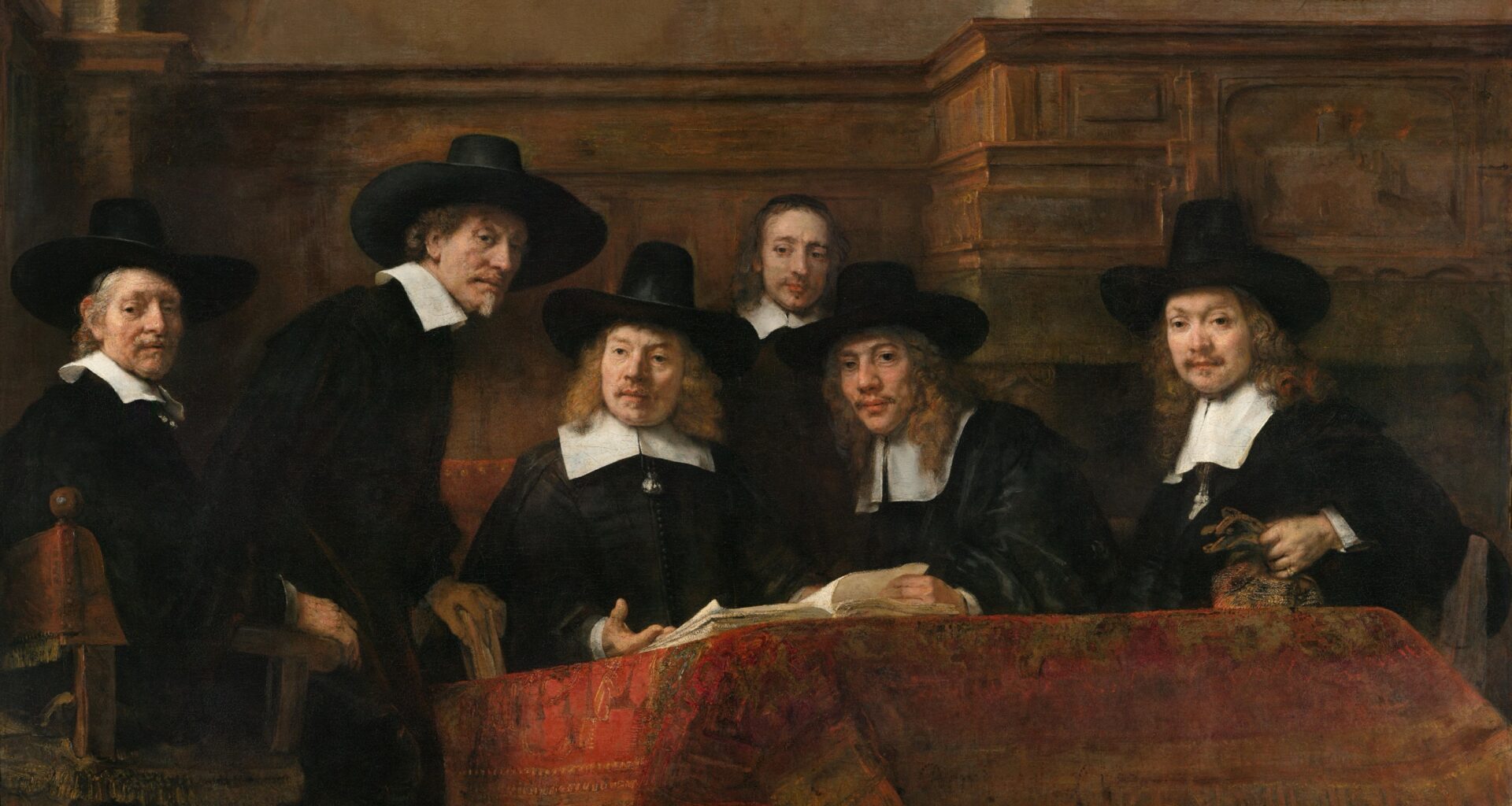
I referred to their “Calvinist” hats, but they are in fact two Catholics, a Mennonite, a Remonstrant and a Reformed Protestant: five men divided by mostly minute matters of conscience, but united by a faith in culture, geography and the flow of capital. The guy on the far left, the oldest and wariest, looks like he’d have us turfed out of the building if it was up to him; the man next to him, rising to his feet, seems sceptical but keeping an open mind. Then the man in the centre with his crinkly orange tresses, the honorary chairman with his right hand decisively on the ledger containing all those critical figures, the only one not meeting our gaze, looking off-camera, so to speak, as though referring in detail to those numbers. Then the guy leaning eagerly in from his left with the lively brown eyes and Charles II ringlets, who definitely seems pleased to see us, or to see Rembrandt, and the guy on the right with a barely perceptible half-smile on his strangely mask-like features, holding a pair of leather gloves, a classic indicator of wealth and sophistication. Even the servant in the background looks more than receptive to our presence.
Five successful Amsterdam businessmen, like Rembrandt himself. Why would he want to view them in a light that was anything other than benign?
The Staalmeesters isn’t the most immediately lovable of paintings; hardly something you’d imagine invoking on the darkest night to convince yourself to go on. It’s not offering a big message, or any message, beyond a glimpse of five people you’d likely find you had nothing in common with, that you actually disliked, if you met them in real life. But you can’t argue that they’re not there—palpably present in the perfectly judged application of the paint with which they’re brought before us. And this being the later side of Rembrandt, seven years before his death, in what has been described as his “last great group portrait,” that application is on the looser side, with an earthy richness to the colour and texture, in that typical Rembrandtesque palette of rich browns and reds which might seem a shade kitsch to some these days. But it’s the animating life in the liquidescent-colored earth, that marks this painting out from hundreds, even thousands of others of its kind—in the so-called “regents’ group” genre—by artists of the stature of Frans Hals and Ferdinand Bol, most of which feel painfully stiff and lifeless in comparison with this one.
I mentioned the “mask-like” features of the figure on the right. All six of the faces are masks. Rembrandt gives us the illusion of getting both the hypnotic surface that embodies and conceals the enigma of the other, and the enigma itself, in an encounter with five of our fellow humans over a gap of nearly four hundred years—in a work that’s remarkably free of bullshit, of any trace of the romantic or the mythic. And in 1945, when these paintings were being retrieved from caves and bunkers where they’d been put for safety during the war and put back on the museum walls, and the survivors of the camps and the armies and the bombed out cities were emerging blinking into the light, did people need an escape from the mythic, after a war in which between seventy and eighty-five million people had been killed in the name of “blood and earth?” And do we need one now when it feels like we’re sleepwalking into another global conflagration on much the same premise—though it’s far less clearly defined this time. And it seems an appropriate moment to be staring into the face of the human other, in the form of a bunch of random, middle aged men from four centuries ago, on the grounds not of their “relevance,” but their human vividness, in a moment when we’re given ever more reason, from our catastrophic impact on the planet to our voluntary replacement of ourselves with technology, not to believe in the human.
Before getting Eurostar back to London, I went to see Cockie’s daughter Sonja in a small town not far from Amsterdam. Her house was simple, but light and airy in a post-war utilitarian style that seems designed to transcend history. She’d taken up painting since retiring, and the place was filled with paintings of her grandchildren and other younger relatives. Among them were two larger paintings each devoted to one of her parents, who divorced when she was still young: symbolic representations of their histories and her relationships with them. In one she walked hand in hand as a small child with the father who had been in Buchenwald, though he never talked about it, but would lie on his bed for days on end without speaking. In the other she was held in the arms of her mother who was in Ravensbrück, but never stopped talking about it. “There came a point where I had to ask her to please stop talking about the war. I think she was very hurt by that. It was the most important part of her life.”
In the background of the painting, alongside the Communist fist and what looked like bodies in some kind of railway truck, she pointed out the Ravensbrück Memorial on the Museumplein.
“My mother didn’t like to go to the meetings there,” said Sonja. It brought back too many memories. She preferred to go to the houses of the other prisoners. She took me with her once, when I was quite young, and I felt very uncomfortable in the presence of this older woman I did not know, in this unfamiliar area, who had this strong bond with my mother I would never understand.
Cockie liked to talk about the times they outwitted the guards. I felt they had never been able to break her spirit. Then when it was announced that the last three German war criminals imprisoned in Holland would be released, she went into a decline. She kept the curtains closed, didn’t clean her apartment and never left the house. Then she disappeared. My younger sister and I were worried sick. One day I got a phone call from the wife of the captain of a ship heading for South America. They had a single passenger on board, a woman with the same name as me. They wanted to know if there was a connection. My mother had a great holiday in Brazil and came back refreshed and restored. I was so angry with her.
When people asked me about myself, I would always talk about my parents’ experiences. They would say, but what about you? It took me until I was thirty-five, when I left my first husband and started training as a psychotherapist to realize I had a personality of my own.
As I was leaving, I asked Sonja if she liked Rembrandt. “Of course I like Rembrandt. The people are so present, so alive. I like Johannes Vermeer too. But he’s more stylized, more abstract. Rembrandt is more human. Why do you ask?”