
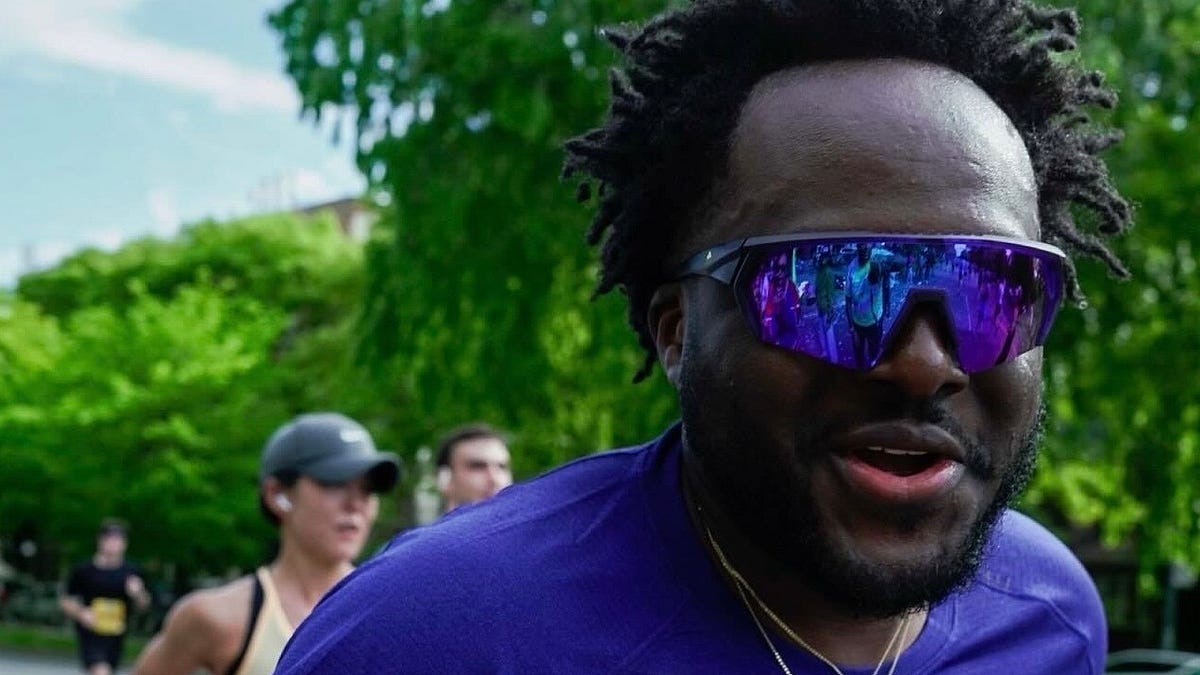
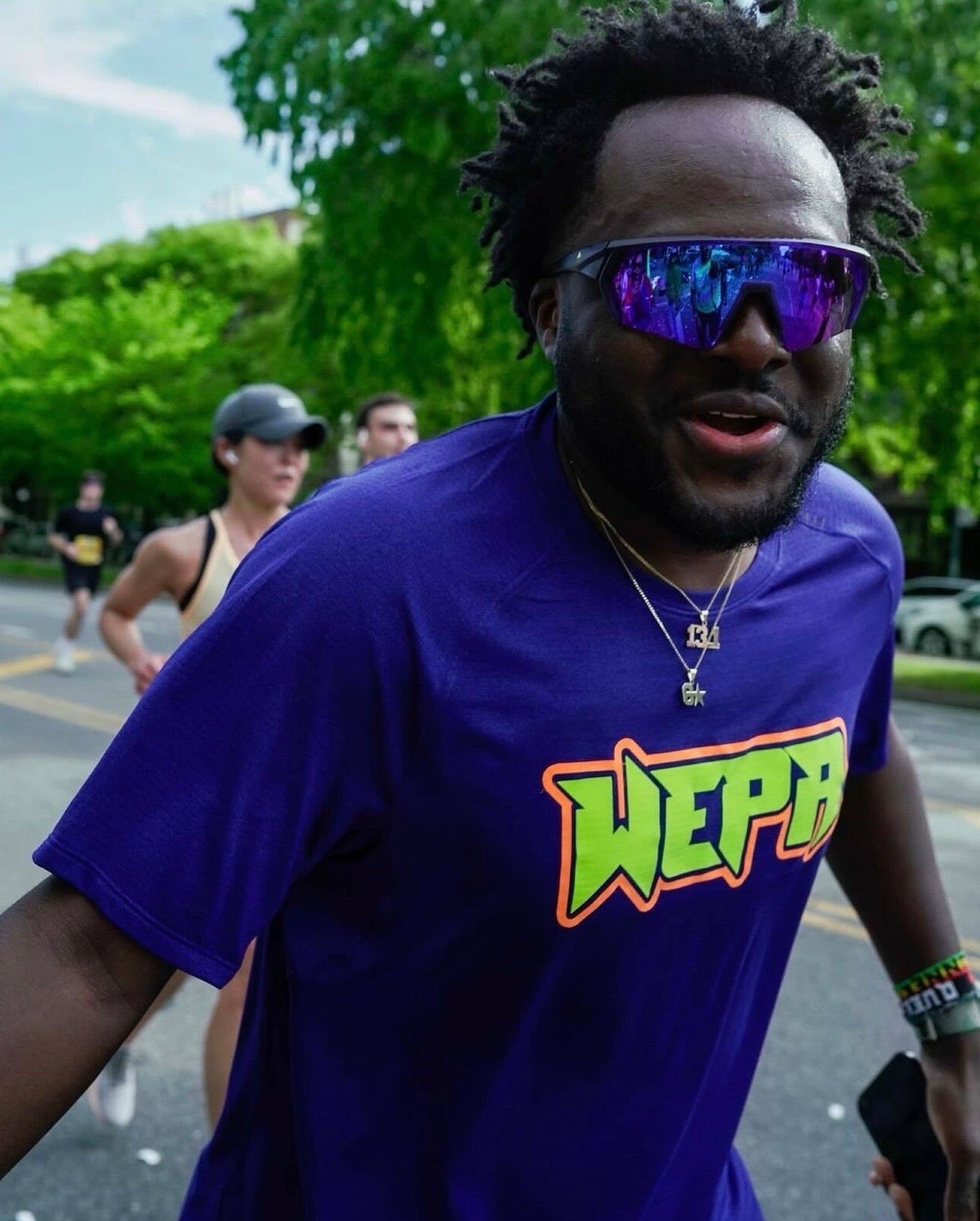
Les Boadu’s current running goals all revolve around building community in his home borough: Queens.
Part of that is helping new runners navigate their early journeys in the sport, similar to his own running origins. After he ran his first half in 2015 on no training and with no idea what to expect, Les says it was exploring New York City run crews that introduced him to races across the country—and later convinced him to become a pacer with Adidas Runners and captain for Team WEPA.
Through his work with Team WEPA, Les has also helped organize the Queens Running Collective, which formed in 2020 with the mission of connecting all the run crews across Queens. It’s an initiative that’s especially important for the city’s largest borough, and also one that feeds into another of Les’s goals: growing awareness for local racing options in people’s own backyard.
We spoke with Les to discuss what makes Queens special to him, how he got involved with Adidas Runners and Team WEPA, helping introduce running to the youth and more.
This interview has been edited for length and clarity.
Can you give an intro of where you’re from and what brought you to New York City if you’re not from the city originally?
My name is Les. Right now, you are speaking to me from The World’s Borough, Queens. Queens is home. Queens has been home for the last I want to say 20 years. I was born in Virginia, moved to New York City when I was two years old. My parents were mostly in the Bronx and Yonkers. Went to school in Yonkers, migrated to Queens for undergrad in 2007, and Queens has been home since. So everything I do is for the borough of Queens right now.
What makes Queen special to you?
I’m a Johnnie. I’m a St. John’s alumni. Queens to me exemplifies diversity, and I think for me that’s very important. I have a background in education, I love traveling, I love learning about all cultures. Queens has over 138 languages, probably more than that. And what makes Queens unique is the people, and the food, and the culture. There are parts of Queens that I’ve been to that have always made me feel like home…. I’m West African, I’m from Ghana. So I can meet people from Ghana in Queens. I can meet people from all over the world in Queens. And that’s what makes Queens special.
“Queens to me exemplifies diversity…. I can meet people from all over the world in Queens. And that’s what makes Queens special”
It’s literally the melting pot of diversity, that’s why we say The World’s Borough. I think right now, if you Google the most diverse place, it’s top five easily, if not number one.
I listened to a couple podcasts where you get into the origin story of that friend who convinced you to sign up for a half marathon, and that’s how you got into running. But if you want to quickly go through that story?
That story lives forever. I’ll shout out his name. It’s actually my old roommate from college, his name is Hakiem Simmons.
Funny enough, my mother worked for Goodwill…so my mom used to volunteer at the New York City Marathon. And what her company would do is when people throw their clothes, Goodwill will pack those throwaway clothes, put them in boxes and donate them to different centers all around New York City. So my mom, I want to say 2012, 2013, she volunteered year after year, and Goodwill would give her a bib to run the New York City Marathon. But those were like my late teenage years, my early 20s. She would say, ‘You want to run it? You want to run it?’ And I would say no…. That wasn’t my lifestyle at that moment. By the time I actually got into running, which was late 2015, she had already parted ways with that company, and then I was like, ‘Oh my goodness, the opportunity.’
It wasn’t until my friend, who was Hakiem Simmons, convinced me to sign up for my first half marathon in 2015, which was the Rock ‘n’ Roll Half—and I was convinced that it was one of these Eventbrite color parties that you go, you run, and you throw paint and nonsense, and there’s music. But no, it was actually a half in Brooklyn.
What hooked you after, where you wanted to keep [running]?
After that first experience, I realized that I need to train for this. Leading up to the half, I did not train at all. I was too focused on how I looked, what shoes to wear. After that half, in the fall of 2015, I simply started finding urban running crews in New York City. And when I started going to these urban run crews, they would tell me about different races. So I made it a point in 2016 to do more races…. Somebody was like, ‘Yo, you got to go do this race in Philly…. You get these big old medals. It’s called the Stallion Challenge.’ And I was like, ‘Wait, what? There are other things besides the New York City Marathon?’….
I ran around the country in 2016, I did races in D.C., Virginia, all over. And those were all mainly half marathons…. I think just people—meeting people and then just vibing led me to want to continue to run.
It wasn’t until the pandemic that you joined Team WEPA and became a captain there. What were those early crews [you ran with] before that?
After running the New York City Marathon in 2017, I started to meet people in the urban scene. And in 2017, I was approached by a friend who told me, ‘Bro, Adidas is getting ready to launch a run crew, club, something, and I noticed you wear a lot of Adidas.’ So in 2018, Adidas Runners did a beta.
Nike Run Club was New York City. Everybody ran with Nike Run Club. I myself, when I started running, went and ran with Nike Run Club. But 2018, Adidas Runners arrived in New York City, and they were looking for crew runners, kind of like pacers. And I was approached to be a pacer. So before switching and joining my friends over at WEPA, I did Adidas Runners for about three years.
Can you talk through your introduction to Team WEPA? What convinced you to become a captain there, and why is that group so special to you?
So Team WEPA’s connection was funny. The founder’s name is Gerardo Rodriguez. I’ve known him since I’ve started running basically. We’d seen each other, we said hello every race I ran past, he shows a lot of love. When the pandemic hit, everything was on pause. My pacing duties at Adidas were on pause. I was essentially stuck in Queens. I had wanted to start my own run crew after the pandemic, and Gee from WEPA was the first person I called. Because I knew when you hear Queens, WEPA was the crew that ran Queens. And I respect checking in. I love checking in. If I go to your borough, if I go to Lower East Side, Tribeca, wherever, I’m the person that does my background research. If there’s a crew that exists, I want to check in before I do anything.
So I called Gee, and the universe just clicked. Gee was like, ‘Bro, I just lost one of my captains, I’m by myself, and I could use a lot of help. I know you want to start your own thing, which is fine, I support it. But if you want to build and connect, we can build and connect and do this together.’ So I thought about it, and I was like—I’ve known him for a few years, he already has a lot going on with WEPA, and we both just happen to be in the field of education. We had a lot in common…. And he’s always shown me love. So it was a no-brainer.
What’s it been like seeing the Queens running scene grow over the years…. And how have the different crews and clubs worked together to some extent?
I love that question. So when I came, one of the reasons I also joined WEPA when Gee approached me—Gee felt that although the urban running scene is phenomenal, he felt in Queens that we were all separated. Queens is the largest borough. He felt that the running crews were phenomenal, but what was missing was there weren’t too many collaborations around 2020, 2021. So in 2020, Gee founded the Queens Running Collective. But then he was like, ‘Listen, Les, I want you to run it, and the reason I want you to run it is because’—we’re two opposites in the sense where I’m more social and extroverted, and he’s a mixture of introverted and extroverted. So when I came on, my mission was to find a way to bring all the Queens crews together.
In 2020, 2021, there was a lot of social injustice, a lot of voting rights, the country was just in a wild place. A lot of hate…. So the Queens Run Collective started roughly around 2021, 2022, and we did things like run to vote, voter registration, the importance of doing the primary elections. We did things like Black Lives Matter. We did things like Asian Lives Matter…. We used the sport of running to just spread love and positivity. Now connecting all the Queens run crews—we had local run crews down the block doing the same thing, and we just didn’t know that they were doing the same thing, because the borough is that large. So all the run crews eventually were like, ‘Oh my god, you guys run this path on Wednesdays, we do the same path on Thursdays.’
“I think sometimes run crews forget that we are better when we connect and build”
The Queens Running Collective today—for Global Running Day, we came together, 15-plus crews…. At the end of the run, each crew went up and shared their mission and vision, they shared where they run in the borough, and they shared what they offer, and any upcoming events. And then they also shared their why. And I felt that was phenomenal, because it let others know that, ‘I don’t have to always go run with WEPA on this day. There are 15-plus other crews that I can go and explore.’ And I think sometimes run crews forget that we are better when we connect and build. And Global Running Day, although it was just that one day, it was 400-plus runners out there from all backgrounds, all walks of life, all paces, all races. All love was spread through miles.
What are your short and medium-term running goals? Or even long term, how do you think about goals when it comes to running?
As a West African from Ghana, my next big goal—I haven’t run a marathon in the continent of Africa. I know Cape Town is one of the new [World Marathon Major] cities. It doesn’t have to be Cape Town, just a marathon in Africa. Ghana actually has a marathon called the Accra Marathon. Long term, I’m still working on running the New York City Marathon every year. That goal is still going….
But short-term goal, it’s just building community. I’ve been doing this for 11 years now. I literally started in 2015, 2016, building community, allowing others to help others, like better us, better world. So for me, right now is helping WEPA grow, helping new runners learn how to navigate the journey, how to run some of these races, how to pay for some of these races and how to get opportunities to keep going. Just leading by example and hoping the next runner helps the next runner. And also getting the youth to love the sport. If I had running, if I ran in high school, I’d be a different person right now.
As running has exploded since the pandemic and within the last couple years in particular, I’m curious how that’s impacted your role as a captain for Team WEPA and your goal of growing community in this very changing running space?
And then how has that influenced you in terms of trying to get more kids involved in the sport, and trying to translate this recreational running boom that seems to be super popular for adults more toward the youth in New York City?
I’ll start with the youth, so I’ll start backwards. So I’m a teacher, right now I teach fifth graders. For me, it’s doing the little things. Starting a run crew at work, getting the kids involved. At WEPA, we have a leader that does something called WEPA Kids. Sometimes they call me to show up to do workouts with them or just different drills, and we show love to them. The youth for me is very important, because they have access to so much that we didn’t have access to. And I think now there are so many training apps, they have AI—for me, it’s using the tools to properly navigate the sport in the right way. So if you’re going to use the internet to build your training plan, making sure that works and is unique and is tailored to you, and explaining to them that coaches and all that still matter.
But also doing it for fun. My biggest thing is always, comparison is the thief of joy. You join a running scene, the first thing someone says is you haven’t BQ’d yet. When you finish a race, the first thing somebody says is, ‘What is your time?’…. Early on, I was more so forced in the competitive aspect of it, like every race has to be a PR, oh my god, you didn’t beat your last time. Now I’m okay with the fun part of it as well. And I love the people that do the competitive. It’s no disrespect to them. Go for it, if that’s what your goal is. But I also want to send some love to the people that are doing it for health, or they’re doing it for people that have family conditions that aren’t able to run. I think that’s the beauty of it.
In terms of running and navigating the running space now as a captain of WEPA: knowledge, knowledge, knowledge. Our borough has so many local races that are phenomenal that people just overlook. We love Central Park. We love Prospect Park. Queens has parks also. Queens has so many local race orgs. They are the least expensive. And a lot of them, if you refer a friend, you get $5 off. For us, by us is the goal in Queens right now, for all the Queens run crews. We put on a race in July called 9 For 9…. We have our friends and other run crews putting on races.
“For us, by us is the goal in Queens right now…. You don’t always have to leave your borough or your neighborhood to get a medal”
So the goal for us right now is to build our own races, our own 5ks, our own 10ks, and keeping things in our borough. You don’t always have to leave your borough or your neighborhood to get a medal. There are beautiful medals in Queens. There are beautiful PRs made in Queens. There are beautiful records broken in Queens. And that’s the goal. And I think trying to teach runners—the London Marathon had over a million lottery signups. Queens races, you wake up, you can sign up for them. If it’s meant to be for you to get in London, I’m not discouraging them. I’m just saying, keep it in our backyard…. Sometimes people get put in a box that all they could do is run in Central Park, all they could do is run in Prospect Park. I feel like race orgs need to do more races in people’s backyards. New York City has nine million people here now. The gridlock to getting to Central Park is not always easy.
But I think the most important thing is, you gotta have some fun in this sport, man. Because it’ll humble you, it’ll do all the things. So you gotta have some fun with it for sure.