
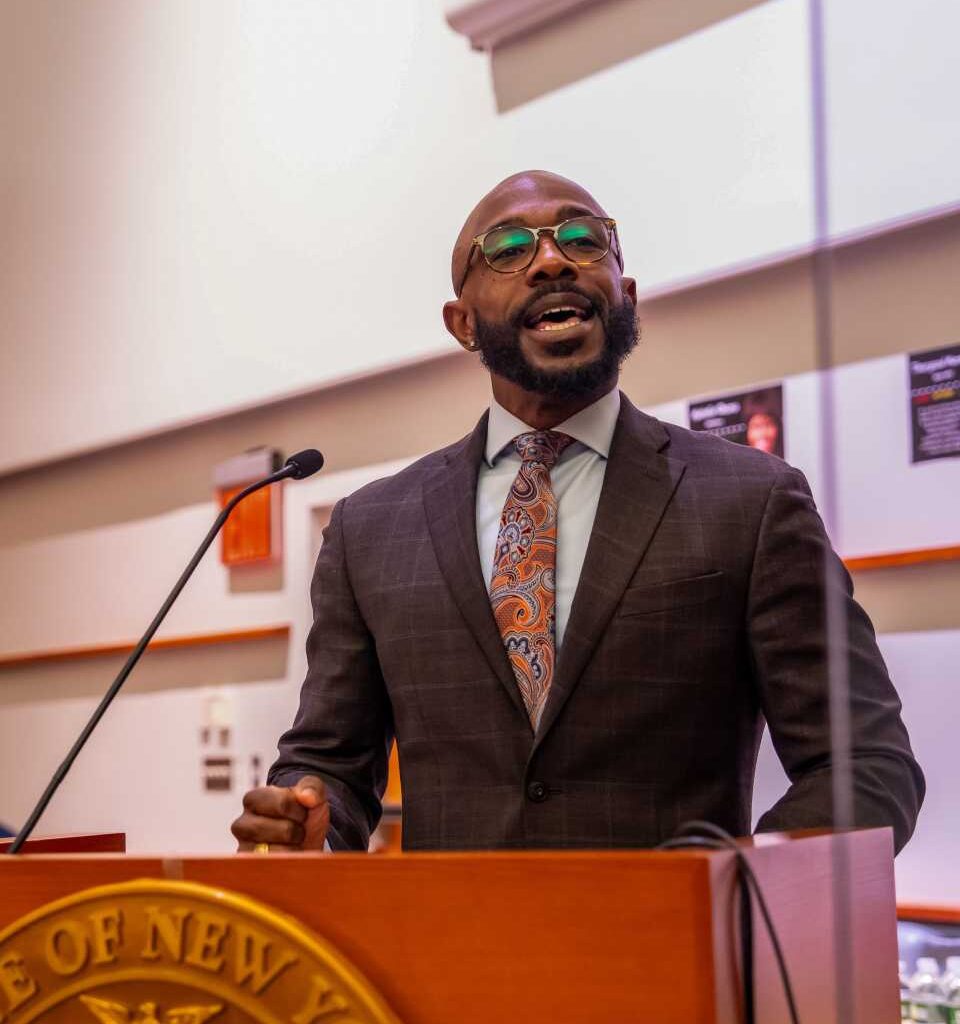
Attorney Ronald Sylvestre says his career has been made by people just a little further along than him, making the choice to turn back and offer him a helping hand. Now 38 — arguably still a young lawyer himself — he’s taking the first chance possible to do the same for others on a broader scale as he steps up to chair the Brooklyn Bar Association’s Young Lawyers Section.
“I am the product of the people who have reached back and pulled me up,” Sylvestre said. “I have many mentors. I have many people who have poured into me. I’ve had people who have told me things that made me feel that I can do anything that I wish to accomplish, and I think that that’s had a meaningful impact on who I am today as a lawyer.”
“Having someone believe in you and want to help you can really, truly make the difference in how you perform,” he added. “I want to make sure that more people have mentors.”
Sylvestre said he believes that’s what the field of law is predicated on: If established lawyers don’t help build the next generation, law stagnates. It requires new ideas from new people, meaning the health of the profession rests on whether cohorts of young, diverse attorneys are able to find a foothold, Sylvestre said.
“If people don’t support those that come after them, I feel like there’s a lack of growth. There’s a lack of diversity of ideas,” Sylvestre said. “In order for the legal profession to grow, you have to get different perspectives. By reaching back and giving someone a hand and helping them become a more productive member of the profession, you’re able to introduce their ideas and their perspectives and the things that they’ve learned over their life. You just make the profession more well-rounded.”
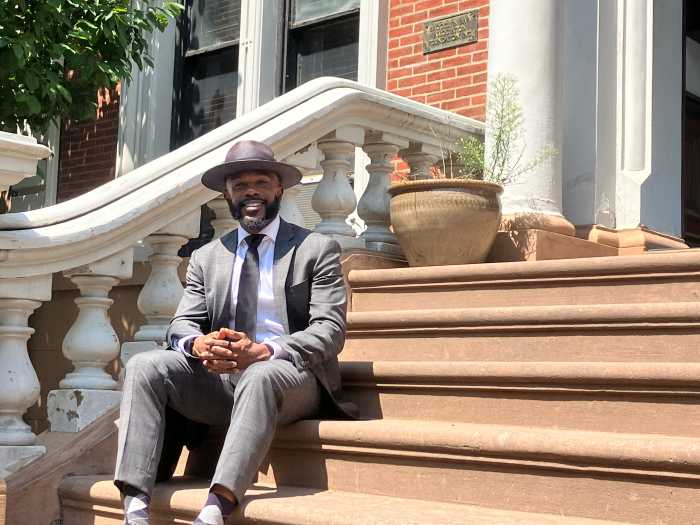 Ronald Sylvestre sits on the steps of the Brooklyn Bar Association.Photo by Isabella Gallo
Originally from Brooklyn’s East New York neighborhood, Sylvestre said he had always known he wanted to be a lawyer and worked extremely hard. He graduated from Hofstra Law School, where he interned as much as he could, notching experience at the Bronx District Attorney’s Office and the Legal Aid Society’s Nassau chapter while still a student. That internship turned into a paid position he’d work in the mornings, he said, after which he’d attend his Hofstra courses, then work at a local restaurant.
Even while in school, supporting those a bit younger than him and his peers was pivotal to him: he served as the community service chair of the university’s law student fraternity. And he received a gold pro bono certificate for completing the most pro bono hours among attorneys at his level after law school.
After law school, he spent nearly a decade working as a public defender in the city’s criminal courts for the Legal Aid Society, a role he stuck with because he thought it was one of the clearest cut ways to use his law degree to help others.
“I wanted to go into a career where I could help people. That was what I was always passionate about,” the attorney said. “I enjoy being there for people, especially during the difficult moments in life. I thought that [the people I defended at Legal Aid] were the people in greatest need, as they were people who could not afford lawyers.”
Brooklyn lawyer Ronald Sylvestre adds perspective behind the bench
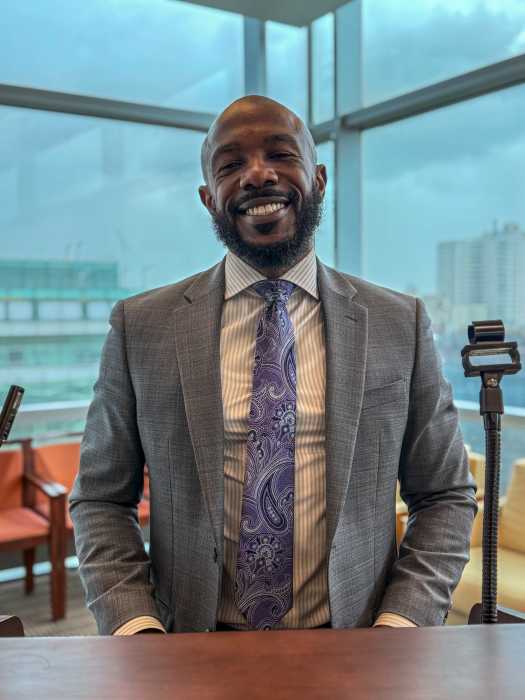 Ronald Sylvestre stands in an office building.
In 2018, he made the choice to pivot, taking up a position as a court attorney to a Bronx Criminal Court judge. It was a way to gain a bit more stability and gain a new perspective, Sylvestre said, and a way to bring a public defender’s perspective to the work that goes on behind the bench — an area typically filled with the perspectives of former prosecutors.
“It was nothing that I had ever envisioned for myself. But the position came up, and it was an opportunity to deepen my legal analysis and really understand the case law better, and also to gain a new perspective,” he said. “Working for the courts has given me a deeper appreciation for all the roles of the members of our criminal justice system — not just defense lawyers, but prosecutors, judges, and court staff and how we all play a part in this justice system.”
“I think that my work as a public defender translates into my work as a court attorney working for the courts. It’s about protecting the rights of the defendant, and I ensure that within my work that I make sure that I do that, making sure that I double check the case law,” Sylvestre continued. “When I miss being a public defender … I remember that in this position I believe I’m helping the wheels of justice move in a broader sense.”
Seeing how bringing a different perspective to the bench also helped shape Sylvestre’s opinion that the law benefits from a wide range of people being involved in it.
“I think it’s important for there to be different perspectives,” Sylvestre said. “I think it’s important to have different viewpoints and different starting points when you’re having those internal discussions because it’s important to consider all the avenues and different ways of looking at a case.”
That inspired Sylvestre to help co-found the Equal Justice in the Courts Committee in the judicial district he served in the Bronx. In the role, he helped run programming that brought the community into the courts to learn about the law, judges, and elected officials — including the Bronx borough president and district attorney — who are tasked with upholding it.
“We would hold events and advertise them in hopes that people from the community would come to these events – and they did – because we wanted the court not to just be a place that people associated with bad things,” he said. “Most, if not all, of the people that we had come to talk to our audience came from regular, everyday backgrounds. I think that people seeing and hearing from them can be impactful because if you can see it, you can do it.”
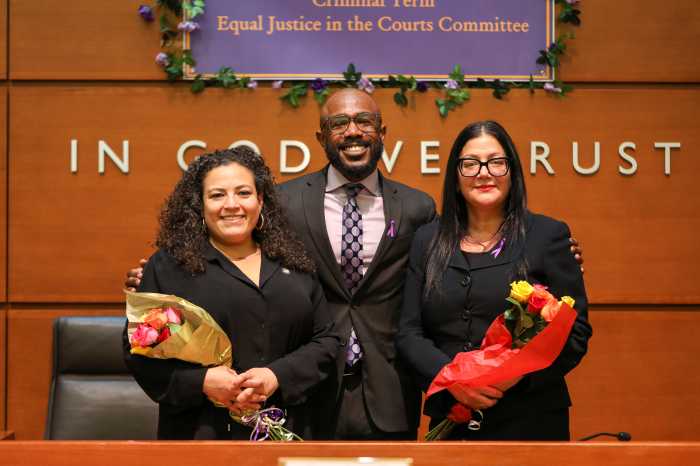 Ronald Sylvestre working in the Bronx courts.Photo provided by Ronald Sylvestre
“If you see people that look like you and talk like you and have similar backgrounds as you, you know that you can be those people, or you can be greater,” he added. “I think that’s very important. I grew up wanting to be a lawyer, and I ended up being the first lawyer in my family, and I never saw anyone up close that looked like me who was a lawyer. Allowing people the opportunity to have that, I think, is invaluable.”
The drive to be a mentor
Sylvestre also began mentoring a young Black man who was considering going to law school while working in the Bronx.
The first in his family to become a lawyer, he said he knows firsthand how daunting the process can be when so many aspiring attorneys are following in their family’s footsteps. He wanted to ease that anxiety and stress. Now, that man is about to start as a law student at Fordham Law School in the fall.
Two years ago, the court attorney returned to his home borough of Brooklyn to serve as a principal court attorney to a judge in that borough’s criminal court. It was a shift he found incredibly meaningful, as he wanted to give back to the community that raised him.
As he stepped into a professional position in his home borough, he said it felt important to get involved with the Brooklyn Bar. After attending a few meetings, Sylvestre said he was hooked. He saw the bar’s leadership shared a similar sense of conviction around engaging the community and pushing forward networking and mentorship programs for lawyers of all ages and he wanted to jump in.
“I wanted to make sure that I had the ability to impact people at home,” Sylvestre said. “When the opportunity came up for me to chair the young lawyers section of the Brooklyn Bar Association, I jumped on it. I think that the connections that lawyers make in the first few years of their lives or their professional lives can make such an impact that can be felt all the way through their career.”
“I believe strongly in mentorship,” he added. “I believe that people, especially young lawyers, shouldn’t stumble into mentorship by luck. I believe they should be able to go to a place and find mentors, people who are willing to invest in them, people who want to see them grow and succeed.”
As the new chair of the Young Lawyers Section, Sylvestre says that’s exactly what he’s planning to create. To do so, he’s going to ramp up the bar’s outreach. Ideally, he said, he aims to recruit an attorney from each field of law to both visit law schools and recruit students to attend the bar association’s events, as well as to turn to their current firms and networks to invite the newer attorneys to attend the events as mentees and experienced lawyers to lend their expertise as mentors.
“I want outreach coordinators. I want someone from the prosecutor’s office. I want someone from a public defense office. I want someone who’s in private practice,” he said. “I want them to talk to young lawyers and engage with them and get the consensus about what’s important to them, what kind of events do they want to be a part of, what type of events will get them excited about coming out to the Brooklyn Bar.”
He also plans to put together social events, like bowling nights and happy hours, to facilitate natural connection and networking between young attorneys and more experienced ones, alongside more formal seminars, like talks about what older attorneys wished they knew when they were younger and how to prepare to vie for a judge position, if that’s something they anticipate seeking.
The plan will require buy-in from the bar, and Sylvestre knows well that taking the time to support the next generation and the broader community as he has is no easy task as an attorney. Many lawyers — bogged down by managing extremely long hours and working dozens of complicated cases at a time — shy away from mentorship programs like this, but Sylvestre hopes he can lead by example.
“I have to decide, ‘What am I going to do after work? Am I going to go to a committee meeting? Am I going to go to a bar association event? Am I going to join one of my cycling groups for a nice evening ride?’” Sylvestre said. “When I’m trying to balance all of that, I try to remember how important it is to give back, and how important it is to pay it forward.”
 Ronald Sylvestre biking, one of his hobbies.Photo provided by Ronald Sylvestre
He hopes other attorneys see the value in reaching out and infusing the profession with more perspectives. He is also going to get the young lawyers he’ll be working with giving back early: Part of his work as Young Lawyers Section chair includes a vision of young attorneys holding their own community outreach events across Brooklyn to help educate the community on different aspects of the law it might be helpful for them to know.
That will look like public sessions meant to teach people what to do, for example, if they see ICE officers in their neighborhoods, or a friend is hit with criminal charges or they need help with their taxes.
“I want to find the community that needs it most in Brooklyn, and have lawyers, and I go out there and see what we can do using our profession, using our knowledge, using our combined experience to do something in the community and help,” he said. ‘That’s my dream.”
Planning for all of this is still in the works, Sylvestre said. But, more than anything else, he wants to increase engagement, get people excited and get young lawyers the support they need.
“The young lawyers section is about building community. I don’t just want to build an event calendar. I want people to be able to email a lawyer in a different section of the law who knows just a little bit more than they do in a particular area, and for them to have an outlet,” Sylvestre said.
What he wants most, Sylvestre said, is for the momentum he builds to live beyond him.
“I’ll measure my success as the chair based on whether we increase engagement [and] on whether or not the section continues to succeed after I’ve left that position,” Sylvestre said. “I think that that really will show if I’ve had an impact. I want this section to grow, to be re-energized, and I want that momentum to carry on past me.”