
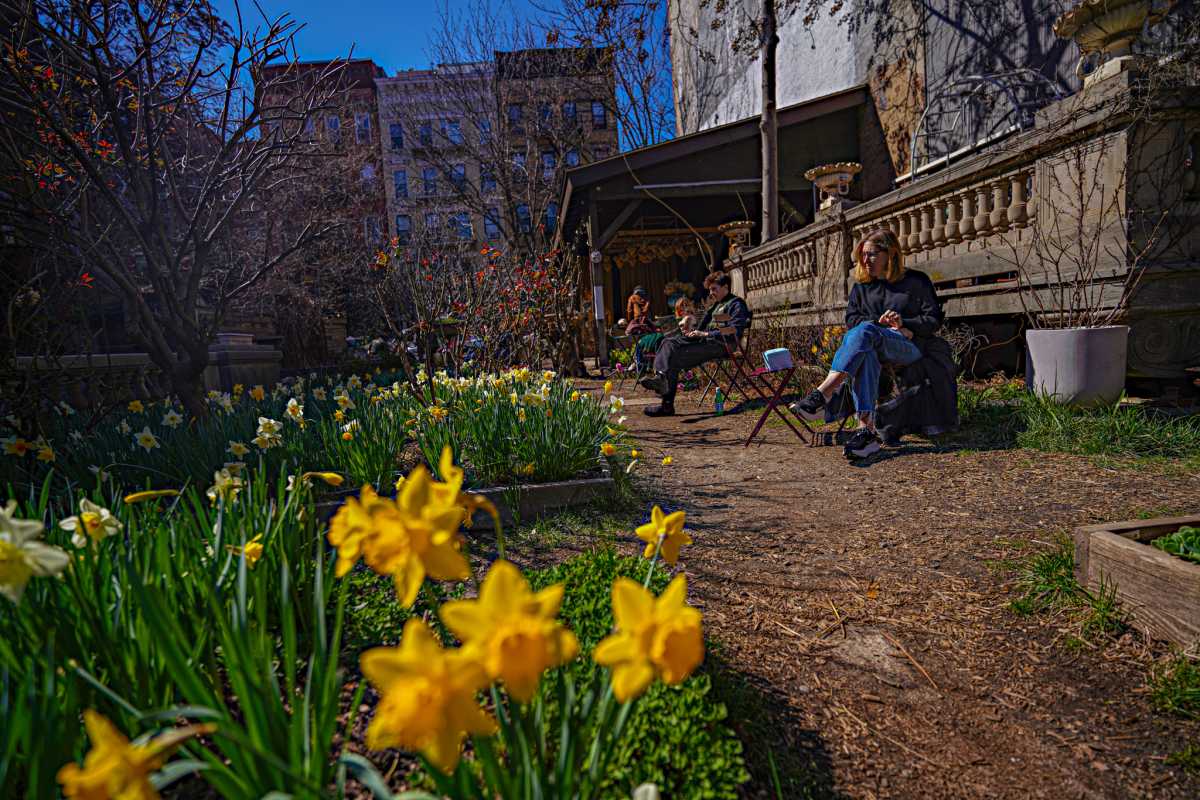
After a long battle and litigation filed over the future of the Elizabeth Street Garden, the Mamdani administration said it is moving forward with housing elsewhere and hopeful of resolving litigation that still hangs over the garden.
The site has become a longstanding green location in Nolita, between Spring and Prince Streets, and a flash point, as one of the few plots of unbuilt land downtown where developers, including Pennrose Development, Habitat for Humanity and RiseBoro have sought to build housing.
Although the project has support among some housing advocates, residents rallied against it during the final days of the Adams administration, which transferred the property to the Department of Parks and Recreation, leaving the garden’s future in limbo after the developers filed a lawsuit.
Mayor Zohran Mamdani, a staunch supporter of the need to build more affordable housing, had said he would support construction on that and other sites, although it now seems his focus has shifted to building on other city land.
Mamdani spokesperson Matt Rauschenbach on August 10 said “as part of our commitment to building the affordable housing New Yorkers urgently need,” the city is planning 180 affordable units at 22 Suffolk Street.
“We are continuing to work toward a resolution of the lawsuit initiated under the previous administration concerning the Elizabeth Street Garden site,” he added.
New York City, which already sought extra time after the developers filed a lawsuit, has until Thursday, unless the litigation is settled or it is granted more time, to submit papers explaining why a preliminary injunction should not be ordered.
 Two men enjoy lunch at Elizabeth Street Garden.Photo by Dean Moses
The City in a July 14 filing, before New York State Supreme Court Justice Lyle E. Frank, said the “parties are hopeful that an amicable resolution is achievable in the near future.”
They indicated that they are hopeful “that the matter will be amicably resolved before the proposed return date.”
While extensive coverage cited unnamed sources indicating they believe a deal will be reached, attorneys for the Elizabeth Street Garden said they are still waiting for the final word that the garden has been saved.
“Whatever they say about the garden affects us,” said Norman Siegel, a partner at Siegel, Teitelbaum & Evans, representing the garden, which sought intervening status. “My goal is to save the garden. It’s an iconic place, the hub, heart and soul of the community.”
Siegel, who as executive director of the New York Civil Liberties Union had worked on numerous cases involving civil rights and other causes, and McLaughlin & Stern are representing the nonprofit running the garden.
“I love being a lawyer for the people. The garden is the people. It’s a wonderful place,” Siegel said. “You can have affordable housing and open green space. They’re not mutually exclusive.”
The case involves numerous law firms facing off, as housing clashes with a community garden, in an issue that at once has led to celebrities speaking out, and been caught up in a transition between administrations.
Hogan Lovells Cadwalder US represents Habitat for Humanity, Cozen O’Connor represents Pennrose NY and Perkins Coie represents Riseboro. The Corporation Counsel of the City of New York Steven Banks represents the city.
New York City in 2017 selected the developers for 123 units of affordable senior housing, which Adams initially supported.
The City planned to sell the land to Haven Green (Pennrose Properties, Habitat NYC, and Riseboro) for $1, developing 13,300 feet of the 20,000-square-foot garden as senior affordable housing with retail and offices.
The 11,200 square foot below market rate office space would be used by Habitat NYC, one of the partners.
Amid uproar and opposition in a groundswell of support for the garden, Adams changed course and supported leaving it as green land, which was transferred to the Department of Parks and Recreation.
Supporters of the garden, run by a nonprofit, say it attracts 200,000 visitors annually and hosts hundreds of programs.
They point out that Washington Square Park 0.7 miles away and Hudson River Park is 1.3 miles away.
The developers, however, argue the property provides an opportunity to turn the land into much needed affordable housing.
They also argue that under Mayor Eric Adams, it was transferred improperly from the Department of Housing Preservation and Development to the Department of Parks and Recreation, contending it should go through the ULURP process.
The developers argued they were seeking to “prevent an outgoing administration from destroying an urgently needed affordable-housing project through an act of naked executive power.”
“They don’t have any valid claims for a lawsuit. You only need ULURP to transfer to a private developer,” Siegel said. “The city transfers from one city agency to another all the time.
He added that Pennrose and its partners didn’t have a contract with the City, further distancing the company from the property.
The garden has found itself caught up in a flurry of activity regarding building new housing, with little land available.
The Elizabeth Street Garden, Councilmember Christopher Marte (D-Lower East Side) and the Adams Administration, all identified alternative development sites including 22 Suffolk.
“It belongs to the city. It’s an empty lot,” Marte spokesperson Simon Kostelanetz said of 22 Suffolk instead of the garden. “This is a win-win deal.”
The Adams administration, spearheaded by First Deputy Mayor Randy Mastro, at that time also identified other city-owned properties for housing such as 156 Bowery and 100 Gold Street.
“The Bowery site is continuing to move along,” Kostelanetz said. “That was supposed to be one for one replacement for units in Elizabeth Street Garden with 123 units of permanently affordable senior housing.”
Kostelanetz said plans also are under way to build hundreds of units of affordable housing at 100 Gold Street, the third site as part of Adams’ plan to build while saving the garden.
The Mamdani administration, meanwhile, said it is continuing to move ahead with plans to develop housing while also strengthening neighborhoods.
“We will keep fighting to create more affordable homes, stronger neighborhoods, and public spaces that make New York the greatest city on earth,” Rauschenbach said.