
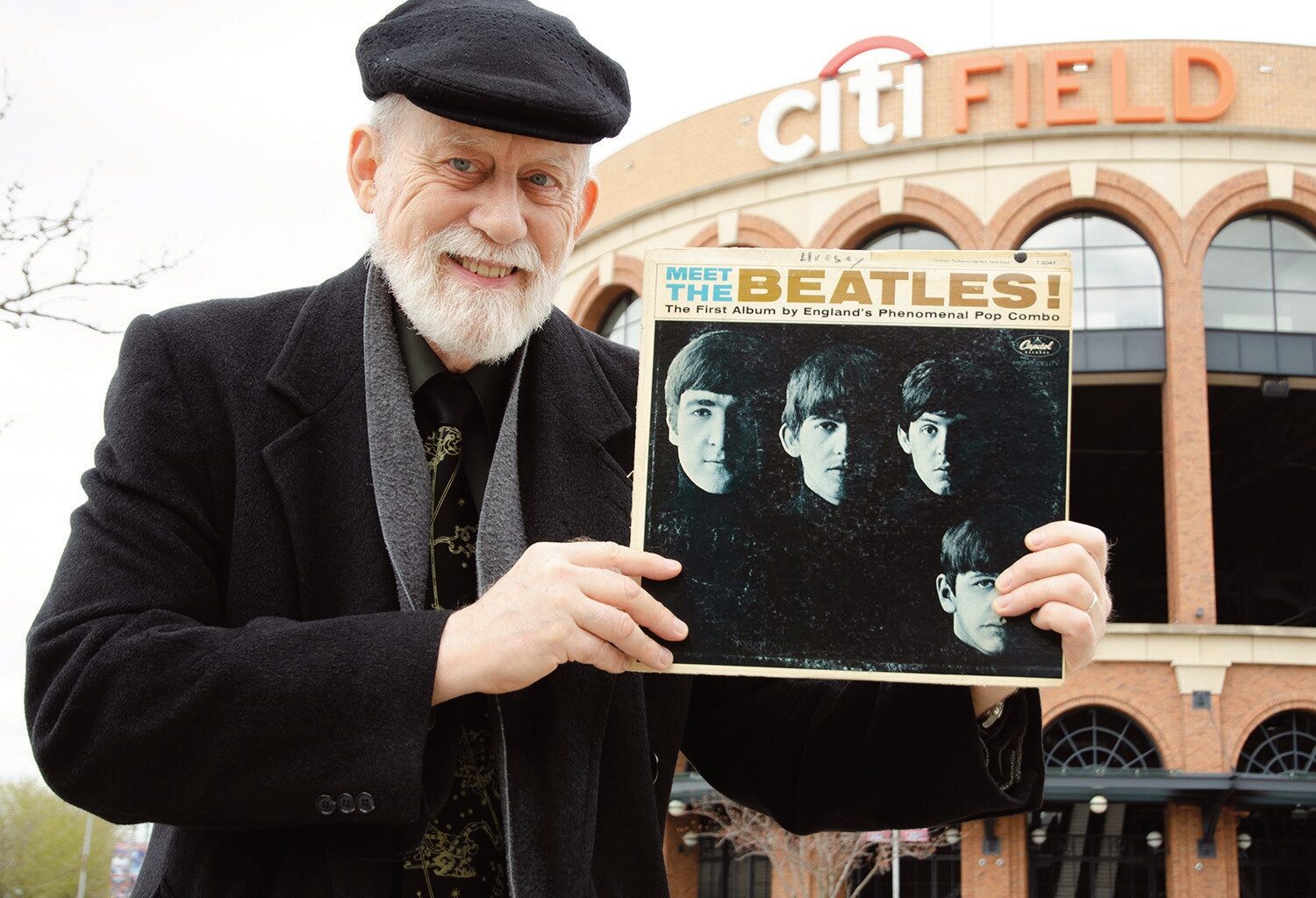

Dennis Livesey holds his vintage “Meet The Beatles!” album cover at the former location of Shea Stadium, currently the parking lot of Citi Field. Photo: David Paone
Ask any Baby Boomer who was a teenager in 1965 – especially one from New York City – and he’ll be sure to remember The Beatles’ landmark concert at Shea Stadium in Flushing. It was a historical, musical and cultural event, as well as the very first stadium concert. Not only did The Beatles sell out the place, but they also broke all existing box office and attendance records in show business history.
But what many people don’t know is The Beatles returned to Shea the following year for a second show. Next Sunday marks its 60th anniversary.
When The Beatles first gained popularity in their home country of England, an inexplicable social phenomenon started. Young girls literally screamed. They literally cried. They literally fainted when in the presence of The Beatles. Mass hysteria erupted wherever they went. A British newspaper named this baffling behavior, “Beatlemania.” It wasn’t strictly for the girls; boys got swept up in Beatlemania, too.

The Shea Stadium second base marker in the Citi Field parking lot. The stages for both concerts were on second base. Photo: David Paone
At the time, Dennis Livesey was a 13-year-old sixth grader living in Rye, New York.
“The catchy tunes, the beat, the energy and the look of these guys with the mop-top[s] and the peg-leg pants and so forth, was just so completely different from the ‘moon- June,’ do-woppy stuff that we were used to,” Livesey said. “I couldn’t get enough of these Beatles,” he said. “We were all just nuts about these guys.”
Livesey started buying their records, with the first being the single, “Twist and Shout,” followed by “Meet the Beatles!”, which was their first US album.
Since a major stadium concert had never been done before, the technology needed for the music to reach the far corners of the venue hadn’t been invented yet. The Beatles depended on the stadium’s primitive public address system. That, coupled with tens of thousands of screaming girls, made it impossible for anyone to hear anything The Beatles performed. This went for both concerts.

Dennis Livesey’s snapshot of The Beatles’ second concert at Shea. Photo: Dennis Livesey
While the second concert on August 23rd has lived in the shadow of its predecessor all this time, it still holds a special place in the memory of those who were there.
So what was it like to attend the show?
“The guys come out and of course the girls started screaming and didn’t stop,” said Livesey. “And they started with “Rock and Roll Music,” which was terribly disappointing to me because it wasn’t a Beatles’ song.”
“It was so gosh-darn primitive, if you compare it to a concert like you’d see today,” said Livesey, who’s been a Manhattan resident for several decades. “I had the foresight not only to bring my camera, but I borrowed my father’s binoculars,” he said.
Patty Minerva was 14 and living in East Harlem in 1966. Her best friend, Linda, had an aunt who worked for The Merv Griffin Show. The company had season tickets for Shea Stadium, and this included both Beatles concerts.
While Minerva missed out on the first show because her father wouldn’t let her go, he relented and let her attend the second with her two sisters and Linda. They had field-level, box seats, with an excellent view of The Beatles. So did she scream? “I wasn’t a screamer. I just remember literally sitting there in awe,” she said, and described the experience as “surreal.”

Patty Minerva’s ticket stubs. Photo: David Paone
“I felt almost detached, like I was on a different dimensional plane, because I couldn’t believe I was looking at them,” said Minerva, who’s been a Queens resident for over 50 years. Not only could she see them, but she could hear them. “[I was] actually getting annoyed at the girls who were near me who were screaming because I wanted to hear them,” she said. Minerva still has her ticket stub and those of her two sisters.
Queens resident Liz Schmidt has two remarkable Shea-related stories.
The first is that she had a third-row seat at the 1965 show and had an interaction with all four Beatles. She was 19 at the time and went with her cousin, Terry. She purchased a pair of third-row seats and took Terry for her 16th birthday.
As The Beatles made their exit from the infield, the cousins looked down into an alleyway and saw the Fab Four. Terry screamed, “GEORGE!” (her favorite). “And they all looked up… and waved,” Schmidt said. Schmidt and her cousin got a look and a wave from all four Beatles.
But it was a year later when she had an even more memorable encounter.
When Schmidt learned of The Beatles’ return to New York for the second Shea concert, she did a little investigating and found out what hotel they were staying at. Naturally, she booked a room for herself and her gal pal, Alice. “We go in the elevator and we’re in there first,” Schmidt said.
Then Paul McCartney and John Lennon walked in, and Alice started to cry. “I said, ‘You’ll have to forgive her. Her mother just died,’” said Schmidt. “And Paul says, ‘Oh, I’m so sorry,’ he goes, ‘My mum died, too.’”
Schmidt had a conversation (albeit a short one) with Paul McCartney.
Shea Stadium has since been demolished and replaced with Citi Field, built in what was Shea’s parking lot. The sight of Shea is now Citi Field’s parking lot.
In 1966, The Beatles were experiencing political backlash, Beatlemania was winding down, and The Beatles themselves had grown weary of touring. Plus, they had embraced studio recording techniques that couldn’t be replicated in a concert.
Regardless, the second show still holds its place in the memories of those who were there for the rest of their lives.
“I remember thinking, ‘Did that really happen?’” said Minerva. “It was almost like an out-of-body experience that I was there, because I couldn’t believe I was really there.”