
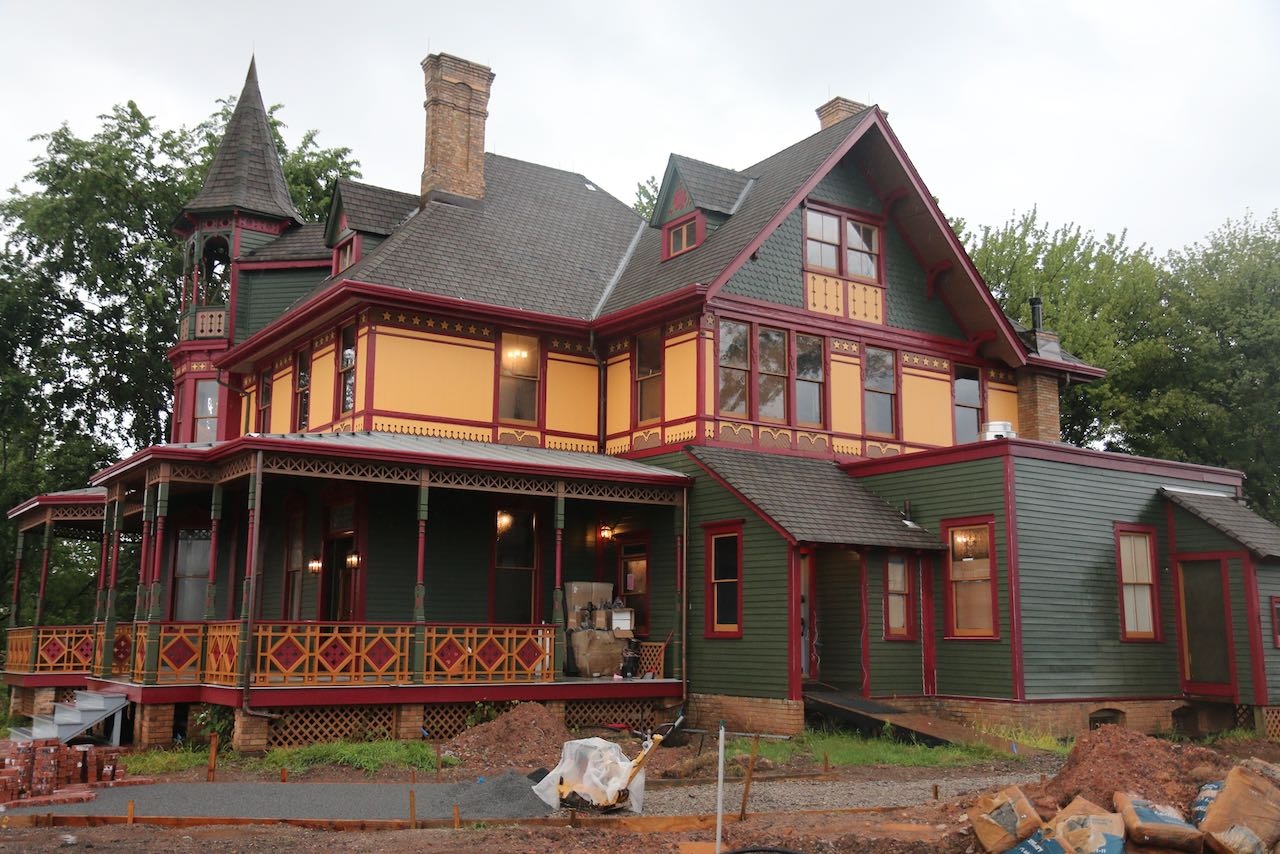
After years of deterioration and failed development attempts, new ownership has launched a comprehensive restoration aimed at preserving the historic Kreischer Mansion on Staten Island’s South Shore while transforming it into a modern cultural landmark.
Entrepreneurs Eric Bischoff and Julia Mackie purchased the deteriorating 1885 Queen Anne-style mansion in 2024 with the specific intent of restoring it to its original architectural glory.
Unlike previous owners whose plans for the property failed to materialize, Bischoff — an entrepreneur and FDNY borough trustee — and Mackie, who has a background in property rehabilitation, are focusing on a mission that balances commercial viability with historical stewardship.
The couple aims to honor the property’s 140-year history by creating a venue that functions as both a private event space and an educational center for the community.
The project represents a shift from the property’s recent past as a seasonal haunted house attraction to a permanent landmark.
The restoration team has spent the last two years refurbishing original fireplaces, intricate woodwork, hardwood floors, and period-accurate ceilings. By establishing the non-profit Kreischer Mansion Historic Preservation Society, the owners said they intend to ensure the “living, breathing connection between generations” remains intact.
The mansion is slated to officially reopen to the public later this year, signaling a major turning point for one of the borough’s most recognizable but neglected historical assets.
These are the five takeaways from the original article.
1. Shift in estate’s focus from spooky lore to cultural, educational programming
The Kreischer Mansion is being repositioned as a cultural and educational destination rather than a neighborhood curiosity or seasonal attraction. Following their 2024 purchase, Eric Bischoff and Julia Mackie established the Kreischer Mansion Historic Preservation Society to manage the property’s historical significance responsibly. The new owners emphasized that previous iterations of the property failed because they lacked the “right ownership” to embrace the mansion’s historical value. Their vision includes transforming the home into a cultural center that inspires New Yorkers through a direct connection to the island’s industrial past and the Kreischer family legacy.
Education is a central pillar of this new strategy, with the owners partnering with the College of Staten Island to develop a formal curriculum. These programs will offer local students hands-on experiences and guided tours focusing on the history of Balthasar Kreischer and his impact on New York City’s development. Mackie stated that the goal is to make the past “real and meaningful” for current generations. This educational push aims to transition the mansion from a site of local legends into a respected institution for historical discovery and community connection.
2. Public funding totaling $445K has been secured to support the landmark’s preservation
Local elected officials across party lines have secured nearly half a million dollars in state funding to ensure the project’s success. Senators Andrew Lanza and Jessica Scarcella-Spanton provided a significant financial boost by securing $315,000 in state funds, while Assemblymember Michael Reilly’s office contributed an additional $130,000. These contributions highlight a rare bipartisan consensus on the importance of preserving Staten Island’s historical landmarks.
Scarcella-Spanton, a Democrat who represents the North Shore and parts of southern Brooklyn, praised the passion the new owners brought to the project, noting the borough is “lucky” to have hometown developers committed to the South Shore.
This public investment is intended to cover the costs of restoring the landmarked structure, which had been in a state of decay for decades.
Reilly, a Republican who represents the South Shore, framed the restoration as a “legacy project” that contributes to the overall greatness of the borough and the city at large. Lanza, also a Republican who represents the South Shore, echoed these sentiments, describing the mansion as a “true Staten Island treasure” with deep industrial roots.
This influx of capital provides the financial stability necessary to complete the high-stakes restoration, which had previously stalled under former owners like Isaac Yomtovian, who struggled to realize a 55-plus residential community on the site.
3. Innovative architectural additions will balance commercial event needs with landmark preservation requirements
The restoration includes a unique, removable glass atrium designed to host weddings and events without violating the property’s landmarked status. Approved by the New York City Landmark Preservation Commission in February, the atrium will be accompanied by a rear barrier-free access lift and a patio to ensure the site is accessible and functional for modern use. This architectural compromise allows the owners to generate revenue through wedding ceremonies and photo opportunities while protecting the integrity of the original 1885 structure. The mansion itself will provide staging areas, such as private suites for bridal parties.
While the mansion is expected to open to the public later this year, the full build-out of the atrium is a long-term goal with a projected completion date in 2027. This phased approach allows the owners to begin educational tours and smaller events in the main house quickly, while slowly building the infrastructure needed for large-scale commercial operations.
By incorporating “removable” and “barrier-free” elements, the project successfully navigates the stringent regulations that often prevent historic homes from becoming financially self-sustaining businesses, providing a blueprint for the “responsible management” Bischoff cited as essential to the project.
4. The project honors industrial giant Balthasar Kreischer
The restoration serves as a tribute to Balthasar Kreischer, an often-overlooked industrialist whose brick manufacturing plant shaped the architecture of Manhattan. Kreischer utilized clay discovered at what is now Clay Pit Pond to fuel his 41,000-square-foot Kreischerville Brick Factory. His company sent barges of bricks to Manhattan, providing the literal foundation for many of the city’s iconic buildings. The surrounding neighborhood, once known as “Kreischerville” before being renamed Charleston, was effectively a company town built around the success of his manufacturing empire.
By revitalizing the mansion, Bischoff and Mackie are attempting to resurrect the story of this “forgotten industrial giant” and his family’s contribution to the cultural and industrial landscape of New York. The mansion, one of two twin houses Kreischer built for his sons, Edward and Charles, stands as one of the last remaining physical links to this era of production. The owners said they believe that by teaching New Yorkers where they come from through the Kreischer family story, citizens gain a stronger sense of identity and potential, turning the mansion into a “living, breathing connection” to the city’s origins.
5. Restoration efforts must contend with mansion’s dark history of tragedy and organized crime
The estate’s restoration is inextricably linked to a history of personal tragedy and a gruesome mob-related murder that occurred on the grounds. Local lore has long been fueled by the 1894 suicide of Edward Kreischer, which took place at the family factory. According to previous reporting in Advance/SILive.com, the subsequent destruction of his twin home by fire in the 1930s birthed stories of a “weeping widow” haunting the property. These narratives contributed to the property’s later identity as a commercial haunted house, a legacy the new owners are working to refine into a more sophisticated historical context.
The mansion’s dark reputation was further cemented in 2005 when it became the scene of a grisly murder involving a Bonanno crime family associate. A caretaker at the mansion was eventually found guilty of the hit and sentenced to life in prison. Despite these high-profile incidents and the estate’s association with failure — including the collapse of a Victorian restaurant on the site in 1997 — Bischoff and Mackie remain committed to moving past the “ghost stories.” Their goal is to ensure that the endurance of the Kreischer family legacy, rather than the violence of the 21st century, becomes the mansion’s defining narrative for future generations.