
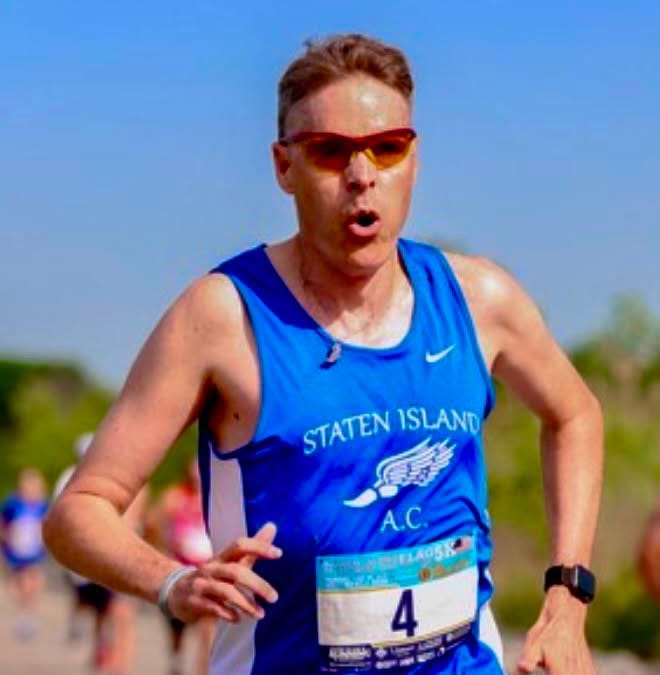
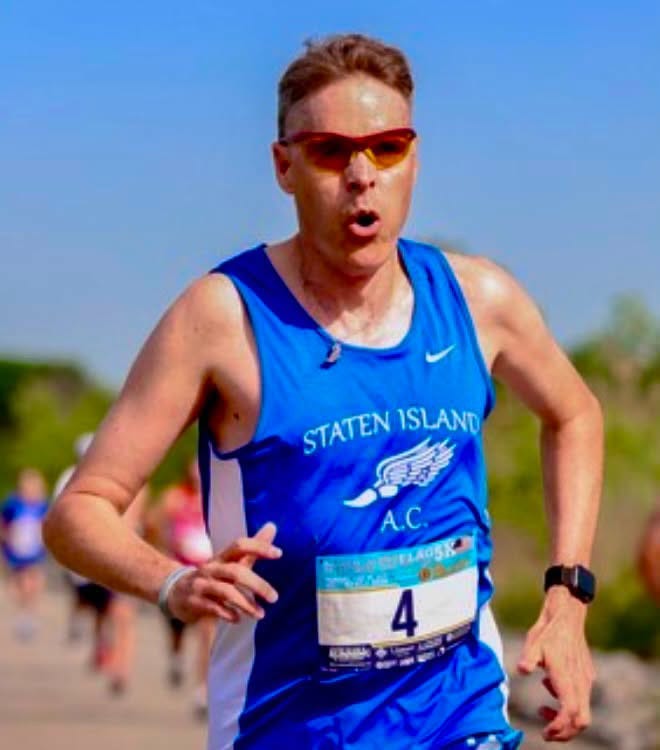
Jeff Benjamin admits that to most people in the running community outside of Staten Island, the borough is known simply as the start of the New York City Marathon—before everyone immediately leaves across the Verrazzano.
But he wants to ensure they all realize that the Staten Island running scene has a lot more to it than just that.
Part of emphasizing that entails sharing the history of the sport in his borough, from former Olympians to longtime coaches. It connects well with Jeff’s background as a social studies teacher, in addition to his passion for highlighting the sport’s rich history as a journalist for nearly 40 years. He’s done his fair share of pushing the community forward himself as well, whether it be as president of the Staten Island Athletic Club or as co-founder of the Staten Island Running Association.
It all traces back to his running origins in high school, learning from New York City legend Art Hall how to make the sport not just something he participated in, but a lifestyle.
We spoke with Jeff to discuss the importance of patience in running, lessons that stand out from covering the top athletes in the world, the Staten Island Running Association’s annual gala during New York City Marathon week and more.
This interview has been edited for length and clarity.
Can you start off with an intro of yourself, where you’re from and how you got into running initially?
Sure. Well, I’m Jeff Benjamin. I live in Staten Island, New York. Moved to Staten Island in 1972, when I was about seven years old. Played sports in the street, like all kids did in that era, and went to Susan Wagner High School.
I was introduced to running by a social studies teacher who was running laps during a lunch break around the track, and a few weeks later, I joined my high school track team. But then I gravitated toward a club on Staten Island, which was called the North Shore Track Club. Its coach is a local, not only Staten Island but New York City legend, the late Art Hall, who was an African-American distance runner in that time period where they were far and few between…. The idea of African-American men and women running distance at a high competitive level was very rare in the United States. Ted Corbitt was a long-time legendary guy in New York City, and one of the founders of what is today the New York Road Runners Club. Art was one of Ted’s proteges. And Art finished top five in the early New York City Marathons when it was still run in Central Park. From ‘70 to ‘75, the marathon was four laps of Central Park, 26.2 [miles]. Art finished top five in two of them, and I believe in the ‘74 version on a hot day, he actually beat an unknown runner by the name of Bill Rodgers, who later on would become Bill Rodgers, the four-time champion, world-class [runner].
And so I fell in with Art, and my senior year I returned back to my Susan Wagner High School team, where we actually won the New York City Cross Country Championships, and I was the number five guy on the team. And what that means is that whenever we have a reunion or a get-together, I don’t pay for dinner. Everybody covers me, because you’re only as good as your weakest link, and cross country top five score, so I was the fifth person. Stayed local for college, ran for the College of Staten Island, and immersed myself in the sport through Art and others throughout the years. Got a job working for the New York City Board of Education. Mostly my career was at New Dorp High School here on Staten Island, social studies, usually American history. I got into the writing gig around 1988-89, just wanted to try it. And Fred Lebow, the great leader of the New York Road Runners at the time, got me my first credential, and I covered a meet called the New York Games. Fred had involved the Road Runners Club not just in road racing but in a bunch of other things as well, and he created a world-class track meet at Columbia University, which was on NBC, for about four years in a row. He had Carl Lewis and Michael Johnson and Jackie Joyner-Kersee, and great milers like Steve Scott, Jim Spivey, Saïd Aouita of Morocco. He basically brought all those runners who were competing at the world-class level in Europe mostly over here to the United States, to run here in New York to try to promote the sport. And that’s always been a struggle for us for whatever reason.
But that’s how I got in, and I’ve been very lucky. I was never an Olympic caliber athlete, but I got to hang around and meet and befriend many of these people and train with some of them, although I wouldn’t call it training on their part. And when I got a little committed about my running, my coach was Tom Fleming, a two-time winner of the New York City Marathon, who ran 2:12 in Boston. And Tom coached me for seven or eight years. Always his philosophy was getting you ready on the day, and that meant that it was like a seven-month, eight-month plan….
The one thing I have learned from all of these great athletes, the one advice I believe is you got to commit yourself and you got to give it time and give yourself patience…. It really is a process, and you have to have enormous, enormous amounts of patience.
What kept you motivated to keep running individually past college?
I have to trace it back to Art Hall again, because running with Art as a teenage kid, like 16, 17 years old…. Art didn’t really show us the magic workout, because there’s no such thing as the magic workout. I hope I’m not breaking anybody’s heart with this right now, but that’s the true reality. Art showed us a lifestyle, how to live with it, how to make it part of your m.o. So I guess for myself and a few others of us—and my friend Tony, 45 years later, still runs as well—it was put into our DNA, so to speak. So when we did get out of college, we still wanted to run….
“Art showed us a lifestyle, how to live with it, how to make it part of your m.o….. It was put into our DNA, so to speak”
And one philosophy I was taught as well is that the greatest feeling in the world is getting on the starting line, knowing that you put in all the work. It’s okay to be nervous, but you have no fear because you already put in all the work, and that kind of confidence you have really goes a long way. I coached high school for a while—and you’ll see that at any level—but at the high school level, if that’s that high school kid who’s missing that Sunday morning run that they’re supposed to do by themselves, or there’s a three-day weekend, coach tells you to run those days and you don’t, you go to the line, you’re not going to have that kind of confidence.
Within your journalism background, just involvement in the sport, you focus a lot on the history of the sport. I know that’s part of your professional experience as well, you’re a history teacher, history major. What fascinates you so much about running history or history in general, and why has that been such a big part of what you try to bring to light?
Yeah, the one thing runners have to realize is that people came before us. Josh Kerr last week set the world record in the mile for 60,000 people in London running 3:42—an article I [wrote] for runblogrun.com, I reached out to many of the world’s legendary milers, some as old as 70, and I said to them, ‘If you had the same setup that Josh Kerr has today in 2026, the shoes, the nutrition, all these other things, what would you run?’ And it’s interesting because a few did not reply or got back to me and said, ‘Out of respect, I really don’t want to answer that question. I’m proud of the time that I did,’ which I totally get. Others jumped right in. One person told me they would run 3:40 without hesitation. Others said they would run 3:42, 3:43. And that kind of talk gets people involved. Because if you learn about Herb Elliott from Australia, who was undefeated in a pretty short career, about three or four years at the world class level, undefeated in 1500-meter and mile races that he ran and destroyed the world record in his time running on a dirt track, 3:54, around 1959, 1960, and you ask, ‘Gee, what would he have done today?’….
“If you become students of the sport, you will learn that no matter what you go through running, you’re not alone”
The other thing too is that many of these champions came from tough situations. You don’t just go on a track and win. Just like if you’re Jalen Brunson with the Knicks, you don’t just play the ball game. Preparation, going through hardships and struggles, injury. So if somebody’s battling an injury right now, and yeah, it’s really frustrating and it really stinks, but you’re not alone. Some of these people have gone through massive injuries, massive sickness in their career, but kept the faith and stayed consistent with their psychological belief. And when they came back, they came back very carefully, and they really excelled. It’s very inspiring, and I think that’s the big thing: inspiration. I think all runners like to hear an inspiring story before a major run or a major race they’re going to do, and I try to espouse that with people. Sebastian Coe always tells everybody: become students of the sport. If you become students of the sport, you will learn that no matter what you go through running, you’re not alone. Hardships you have, others have had hardships as well. And you can learn from them, you can empathize with them, and you see how they react to it, and you can carry that through a lot of miles.
Through covering the sport and just your general involvement, you’ve been around a lot of high-level athletes and people who have reached the apex in running. Are there commonalities or lessons that you’ve learned just from being around them, interviewing them, etc. that stand out over the years?
Nobody trains the same, but every one of them has a 100 percent no-doubt, committed attitude toward whatever their coach is telling them to do. You never hear from any of these athletes, ‘Why are we doing this?’ You just don’t hear it. And some coaches will explain everything beforehand, of course. Others will just say, ‘Just do it.’
It’s like a basketball situation years ago—in the ‘90s, the Knicks hired Pat Riley as the coach. And Pat Riley had five NBA rings, and those Knicks players didn’t. And I’d like to think that when Pat Riley got into that room with these guys, and they were hungry and stuff, he showed them the rings and said, ‘I’ll show you the way, but you got to listen to what I got to do.’ And he almost got them there.
“Doubt is always the greatest enemy of anybody, no matter what you’re looking to try to be in life”
And I think that belief that I’ve seen with all the runners in their program, their process, their coaching, is totally 100 percent with no doubt. Doubt is always the greatest enemy of anybody, no matter what you’re looking to try to be in life. So to get rid of those doubts and have the total faith, that’s something you don’t have to worry about when you’re running.
Through again covering the sport for many years, decades, are there any favorite memories or moments that stand out?
I covered the Fifth Avenue Mile back in 1990, and at that time, one of the world’s greatest milers was Saïd Aouita of Morocco, who ran 3:46 for the mile and was the world record holder at 5k. He was the first man under 13 minutes for 5k, and a sub-3:30 1500-meter man. And when I met him, he’s Moroccan, but he spoke French, and he had a translator there. It was a cool interview, and everything’s going along. And then I started talking to the translator that I live in Staten Island, I said, ‘There’s a Moroccan who lives here, who runs very well.’ And I mentioned the name, and immediately Saïd’s eyes lit up and started speaking to me in English. So that was kind of funny….
All these athletes are very receptive, and I’m very thankful for that. So it would be great, with our sport, that they get even more publicity out there. Because they really are unbelievable people with what they do to themselves, physically, psychologically, to try to be the best they can be.
On that note…running’s been booming recreationally within the past three to five years—do you have thoughts on what are the best ways to translate that toward actual interest in the sport at the professional level that maybe isn’t being executed well enough or just isn’t being done enough right now?
I feel like if you ran the 1981 New York City Marathon, if you were a seven-hour marathoner and crossed the line, you would eventually know that Alberto Salazar set the world record that day, or world best. You ran the New York or Boston Marathons in the ‘70s, you knew Bill Rodgers won the race that you were in. There was a connection between the elite athletes and the people who just run to try to get the best out of themselves of all ability…. I think anybody who ran last year’s 2025 New York City Marathon, I would guess that maybe 80 percent of these people don’t even know who won the race. And the goal would be for the powers that be to try to get that connection back.
There was an interesting thing that happened—in 2017, TrackTown USA, which is based in Eugene, Oregon, put on a series of track meets with the national class runners of the United States—and they were world class—throughout different parks. And they had it at Randall’s Island. The person who runs Randall’s Island is Louis Vazquez…and TrackTown, with them, came up with an idea for this evening track meet. It was in July. I think it was a weeknight. Let’s do a 5k run before the meet. Let’s have the 5k start and finish on the track. Start at 6 o’clock, you figure it’ll go an hour. The meet could start at 7:30, and when the people entered the race, their race number became their ticket to go into the meet. So, needless to say, that night the place was packed. And what’s so interesting is that we had so many runners there, a large percentage of them had never been to a track meet before. And when the 1500 meters was taking place, the announcer did a spectacular job of explaining to the audience what the distance was, how it converts to the mile. Traditionally the 1500 is like 17 seconds faster than the mile, give or take a little bit. And so when people ran that night, the crowd understood. So I think it’s a combination of education and promotion, promotion, promotion. That goes back to Phil Knight of Nike and Fred Lebow with New York Road Runners. You got to just constantly put it out there, so to speak….
Like I said, I think the more that runners in general are around these unbelievably gifted physical specimens, as I like to say, I think it’s a great combination. I think it’s very inspiring for people. Because that mentality—if you are somebody who’s like, ‘I got to break the four-hour marathon,’ that kind of mentality, that drive that you have to do it with your training, is very similar to the world-class person who’s like, ‘I got to get down to two hours for the marathon.’ But yeah, marketing, marketing, marketing is huge.
You’ve been involved in the Staten Island running community and Staten Island running scene for a very long time. What makes the Staten Island running scene special to you individually, and just what would you say about that to other New Yorkers who maybe aren’t as familiar with the Staten Island running scene as the communities in other boroughs?
Yeah, well, the Staten Island running scene for most people outside the borough is, ‘Oh, that’s where the New York City Marathon starts. I go to Fort Wadsworth, I go on the line, and I leave Staten Island.’ That is true. But we have a rich running community here.
We’ve had some legendary people live here. Staten Island is the birthplace of Abel Kiviat, who in 1912 set the world record for 1,500 meters three times over 12 days, leading up to the 1912 Olympics. And his roommate going to the Olympic Games in Stockholm was Jim Thorpe. Abel would get a silver medal and a gold medal on a relay team, and we all got to know Abel because he died in 1991 at the age of 99—he was the world’s oldest living Olympic medalist. Staten Island guy.
“We are known for the start of the New York City Marathon, but we have a lot more to offer on a lot of other levels”
We just had a man pass away, a legendary runner, coach, Bill Welsh, who passed away about three years ago. And from the 1940s right through his passing, he was running and training. National class road runner, ran for Millrose Athletic Association, coached New Dorp High School, and coached Charlie Marsala to a sub-four minute mile in 1987. And coached Bill Jankunis, Staten Island guy, who won the Olympic Trials in the high jump in 1976 to make the United States Olympic team. So as always, like you said, getting the history out there and stuff…. The 2016 Olympian Robby Andrews from New Jersey, his father Bob and his mom were born here, grew up on Staten Island. There are a lot of connections here with the sport. Like I said, we are known for the start of the New York City Marathon, but we have a lot more to offer on a lot of other levels.
Any underrated races on Staten Island that you’d like to touch on, and also underrated running spots on Staten Island?
What’s interesting is that Staten Island, we still have woods and trails. If you just drive through the borough on the Staten Island Expressway, you will see suburbia. You’ll see a lot of development going on, house, house, house. But we have an area called the Greenbelt, and the Greenbelt is thousands of acres of marked cinder trails throughout it, little dirt paths as well….
Staten Island is known for its hills. I think the toughest hill in the borough is a hill called Hillside Avenue. It’s in Stapleton…. For many years there was a race here called the Stapleton Steeplechase five-mile road race, and they also had a 10-mile road race where you did the course twice. And at the first mile you ran up Hillside Avenue, and you still had like four miles to go. Thousands of runners would come for this thing. And in 1978, I think it was, the Olympian Jeff Galloway came, and won the race. Later on, he said, ‘It was one of the hardest courses ever. I call that hill the wall.’ And most know Galloway with his training programs and all that stuff, who sadly passed away this past year.
We have a race called the Michael Ollis Run, which is the largest race now in the streets here. It’s the first week of June. Michael Ollis was a NATO soldier who was killed in Afghanistan, taking a grenade, shielding himself, and saving the lives of Polish colonels and generals in Afghanistan. That race draws about 1,000 runners.
The traditional one is the Lou Marli Run on Thanksgiving morning. It is the same rule that has gone on since the beginning. There is no entry fee. You just take a card, sign up and awards are given to the top three in the age groups. There are three different three-mile races, and then I think three different one-mile races and half-mile races based on ages and gender. And Mr. Marli passed away in 1997—his estate still covers all the awards for it. The only thing they ask, and it’s just a request, if people can bring canned food that they can bring to the soup kitchens. And they usually get a lot of that as well.
The running community is pretty vibrant, pretty strong. The clubs we have here are the Richmond Rockets and the Staten Island Athletic Club, they’re the two main ones. Also, every Saturday morning at 9 o‘clock in the morning, it is free, open to anybody, is the Staten Island Athletic Club three-mile run for fun. Show up, sign a waiver, go. Runners, joggers, walkers, racers show up. There could be five people there one day, there could be 150 people there one day. It’s always hit or miss. That goes on every single Saturday on Staten Island, unless there’s another road race on Staten Island that day, they cancel it.
Recently we honored somebody at the Staten Island Athletic Club Fun Run, Judge Michael Brennan, retired Staten Island Supreme Court judge. He took over the running scene as a race director in 1975 as the [running] boom was going on. The people before him were like, ‘Hey, I didn’t ask for this, there are way too many people here. We don’t want to do this.’ And so they gave it to Brennan, and Brennan took the reins and helped organize and put on races. We have an annual Memorial Day run now as well, and Brennan created all of these races, led the movement. And as president of the Staten Island Athletic Club for six years, he was at pretty much every single fun run, officiating that run, rain, hail, sleet or snow for six years. Real dedication.
You’ve been involved in the Staten Island running community in various capacities, you were the president of the Staten Island Athletic Club for several years as well. Now you’re more involved in the Staten Island Running Association—can you give an overview of your involvement there and the mission of what you guys do?
Sure. The Staten Island Running Association was created by Michael Schnall and myself back in 2018. We’re a nonprofit, we have a board of directors, the whole deal. Our mission is to try to promote the sport, but also help people, mostly youth, with something related to it. So for example, during COVID, in honor of Art Hall, we donated 20 laptops to students in need in their houses who did not have them. We have donated shoes to kids. We sponsor Staten Island High School Championships. We are the only borough that has a high school borough championship with public and Catholic and private all against each other. Those championships in cross country, indoor, outdoor track have been around since 1957. Brooklyn tries to do it. The Bronx tries to do it. Nobody could do it. But we do it. So we cover that. We put on the annual Memorial Day run, the past five years.
But the big thing that we do—we have an annual dinner, Staten Island annual gala, marathon week. The Wednesday before the New York City Marathon, and this year it’s October 28, we invite people to come on down. And thanks to beyond generous sponsors, not just on Staten Island but worldwide, we are able to bring in Bob Beamon, the legendary jumper, Dave Wottle, the Olympic champion at 800 meters from 1972. Some of you old-timers might remember he wore the golf cap when he won his dramatic race. Bill Rodgers, four-time winner New York, Boston. Frank Shorter, Joan Benoit, Steve Jones, Geoff Smith and current athletes Allie Wilson and Ajeé Wilson—no relation, but they’re both 800-meter Olympians. And they come to our gala. We give out awards to people in our community, named for Art Hall, named for Vic Navarra, the longtime start coordinator for the New York City Marathon. Other awards named for a lot of people as well.
And the biggest thing that we do is we have 150 kids, college and under, they come for free. We have sponsors pay for their seats, the kids show up. When Eamonn Coghlan, the great mile indoor runner, world record holder, comes to the dinner, they don’t know who he is. But we show video, we do a presentation, and after those video presentations, then the kids want their autograph. Then they want a selfie. Then they want something signed. We call it the Beatlemania effect. Bob Beamon’s legendary jump of 29 feet, two-and-a-half inches, we measure it with a tape measure across the room, and we show a slow motion video of the jump. And you see the look on these kids’ faces, and even some adults, like, ‘Oh my god.’ And that’s the kind of effect we have, trying to link up people and especially those kids with that stuff. We show a quick thing of Bill Rodgers winning one of his Boston Marathons, coming from way back and dramatically winning, and it’s inspirational.
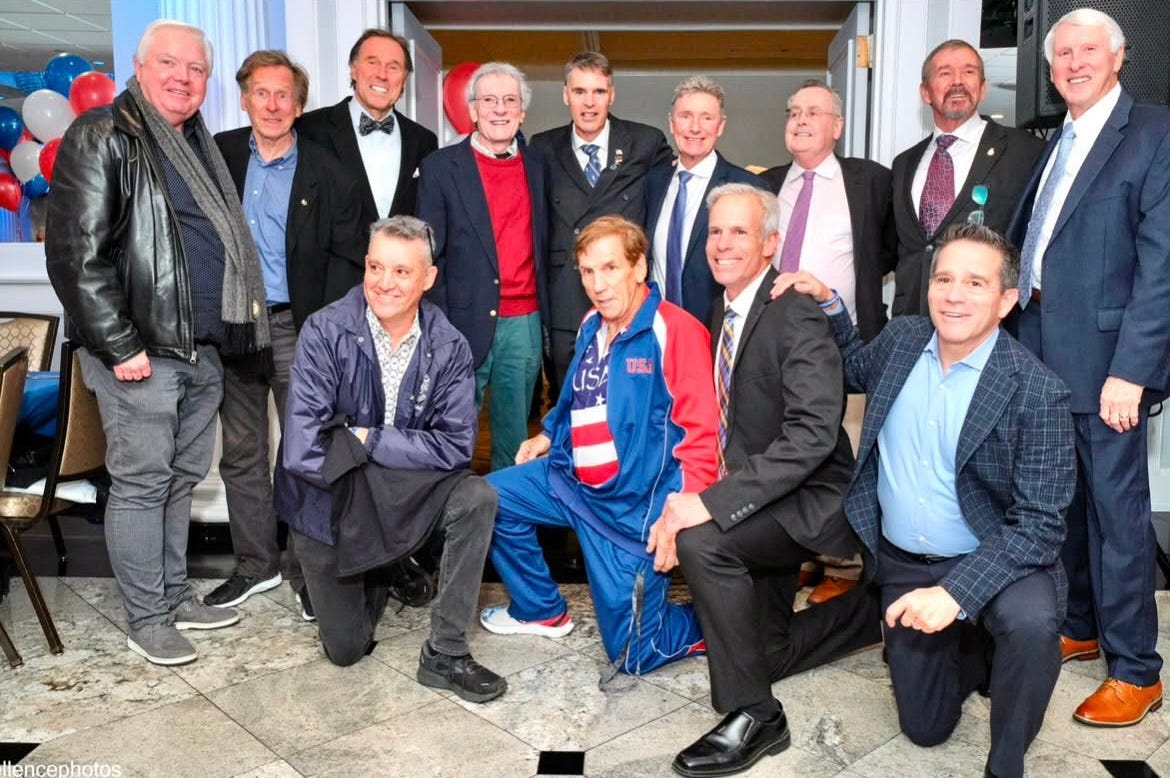 Jeff at the 2025 Staten Island Running Association Gala
And we have it the week of the New York City Marathon as well with the hope that besides our legendary guests that come, others might come. And if there are any current runners or legendary runners who are in New York that week anyway, because some of them are represented by shoe companies, we’d love to have them. And this past year, we were amazed because we had 350 people. We sold out two weeks before. We had people come from South Carolina, Iowa, California. And one guy, James Rhodes, journalist like myself, he flew in from England because he couldn’t believe it. He was like, ‘You’re really going to have these people here?’ I go, ‘Yeah.’
So this year we’re celebrating the 50th anniversary of the five-borough race created in 1976. We have a whole load of announcements coming soon, a whole load of surprises. And we’re definitely having Bill Rodgers, who was the winner of that first five-borough race. So we have some really cool things going on.