
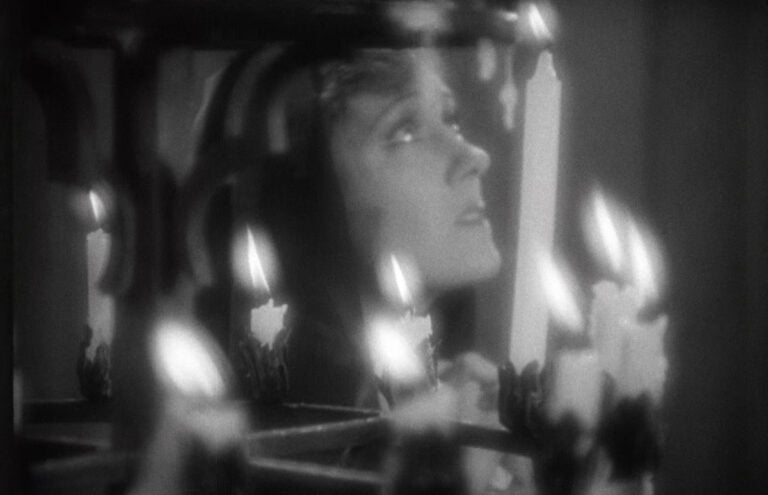
The Curse of Queen Kelly by Pamela Hutchinson
New York: Sticking Place Books, 2026, 250 pp.
We tend to blame Ronald Reagan for combining politics with showbiz so thoroughly that we can no longer recognize “reality TV” as an oxymoron, or expect even Trump to know when he isn’t putting on a show. Our confusion between news and media fantasy can be traced back to the Hollywood fan mags of a century ago, in which every tragic story—like capitalism itself—is obliged to have a happy ending. The result is that we often can’t distinguish between Erich von Stroheim, a middle-class Viennese Jew (as we’ve learned since his death) impersonating an aristocrat (yet also playing a fake aristocrat in 1922’s Foolish Wives) and the same man acting out our own fantasy of being an all-powerful movie director. In short, we can’t tell if he’s a realist or a fantasist, or which Stroheim we prefer. Or even how his public factored in his conversion to Catholicism.
So the fact that we can’t tell whether the “curse” of Pamela Hutchinson’s fascinating book refers to the unfinished movie or its protagonist is significant, and indicative of more than the volume’s hasty copyedit. The mythological status of three roguish, double-dealing con artists—producer-star Gloria Swanson (the book’s heroine), her lover and co-producer Joseph Kennedy (JFK’s dad and the book’s villain), and writer-director Stroheim (Swanson’s muse and my own principal interest)—ensured an organizational challenge to even a silent-movie specialist as seasoned as Hutchinson. She does a superb job of following Queen Kelly’s multifaceted history and afterlife, including such matters as the repurposing of its bordello set in Tay Garnett’s Her Man (1930) and the use of a Queen Kelly clip in Sunset Boulevard (1950).
Stroheim is the most elusive of the three schemers, maybe because his imagination remains so potent—and because he tended to be more discreet about his own private life than about the lives of his characters. Prior to this book, what always confounded me about Queen Kelly was how Stroheim’s style had apparently mutated from the stark realism of Greed (1924) to the trashy elegance and kinky delirium of a Nathanael West or a Georges Bataille, forging a kind of Catholic porn of outrage while his heroine improbably evolved from a frail European convent student to a hardened madam of an African whorehouse. Most of what Stroheim shot before Swanson halted the filming in 1929 was the European part, but it was the African section—more specifically, Tully Marshall as a crippled bridegroom drooling tobacco juice on bride Swanson’s hand during a wedding performed by a Black minister—that got Swanson to close the production down. As The Curse of Queen Kelly makes clear, Stroheim envisaged a scandalous rhyme scheme between the story’s two parts, with convent and bordello serving as thematic twins. Hutchinson reports Allan Dwan—a friend of Swanson who directed eight of her films—saying to Kennedy after reading diverse versions of the screenplay, “I can’t quite get the storyline. It’s either the story of a nun who turned whore or a whore who turned nun and I can’t figure out which it is. But it’s one or the other, and in any case, it stinks.” Not even Stroheim’s own novelization of his story, available in French as Poto-Poto, clarifies this issue, because his art lies in his mise en scène and découpage—not his overheated prose, typically meted out in one-sentence paragraphs and dialogue ending in exclamation points. And his insistence on being an artist is the only part of his aristocratic self-image that survives the book. Yet without enough existing African footage to fill out his dialectic, the artistry of Queen Kelly as a whole offers a teasing question mark. That we don’t even have Stroheim’s editing to suggest what he had in mind places his character and film in netherworlds furnished and outfitted only by our own imaginations.
When industry apologists—for instance, Richard Dreyfuss presenting the Irving Thalberg Award to Steven Spielberg at the 1987 Oscars—argue that Hollywood studios were justified in destroying Stroheim’s work, they ignore the fact that Stroheim was popular enough to command large budgets, and that Greed lost money even after it was mutilated. Kennedy’s lust for both cultural prestige and Swanson led him to produce Queen Kelly, but his subsequent move to force her to pay all the bills makes him the least sympathetic character in this tale, abandoning art and adultery in the same gesture, as if they were codependent. Hutchinson understandably stays on Swanson’s side throughout, meanwhile regarding Stroheim from a respectful if querulous distance. She tracks the Swanson-Kennedy affair and the diverse bicoastal and/or transatlantic complications of their infidelities in much detail, but when it comes to Stroheim’s sex life and his own marriages, she’s less forthcoming. (A stray reference to “Von” repairing to a brothel is the closest we get.)
A dialectic between “Irish” (suggested by “Kelly”) and aristocracy (suggested by “Queen”) comprises an alternative version of Stroheim playing the fake aristocrat in Foolish Wives, thus implying a unity in his late work that echoes the idealism and realism of its beginnings. That Swanson had the good taste to hire Stroheim and accept a scenario bound to cause trouble, as well as the nerve first to shut the film down and then to revive its remnants for the remainder of her life, is a “curse” well worth exploring in all its unresolvable ambiguities. Stroheim’s original casting call included 138 Black performers, but how much the film would have been racially progressive, racist, and/or both seems impossible to figure out from the available evidence. It would likely have been more than we could reconcile, then or now.