
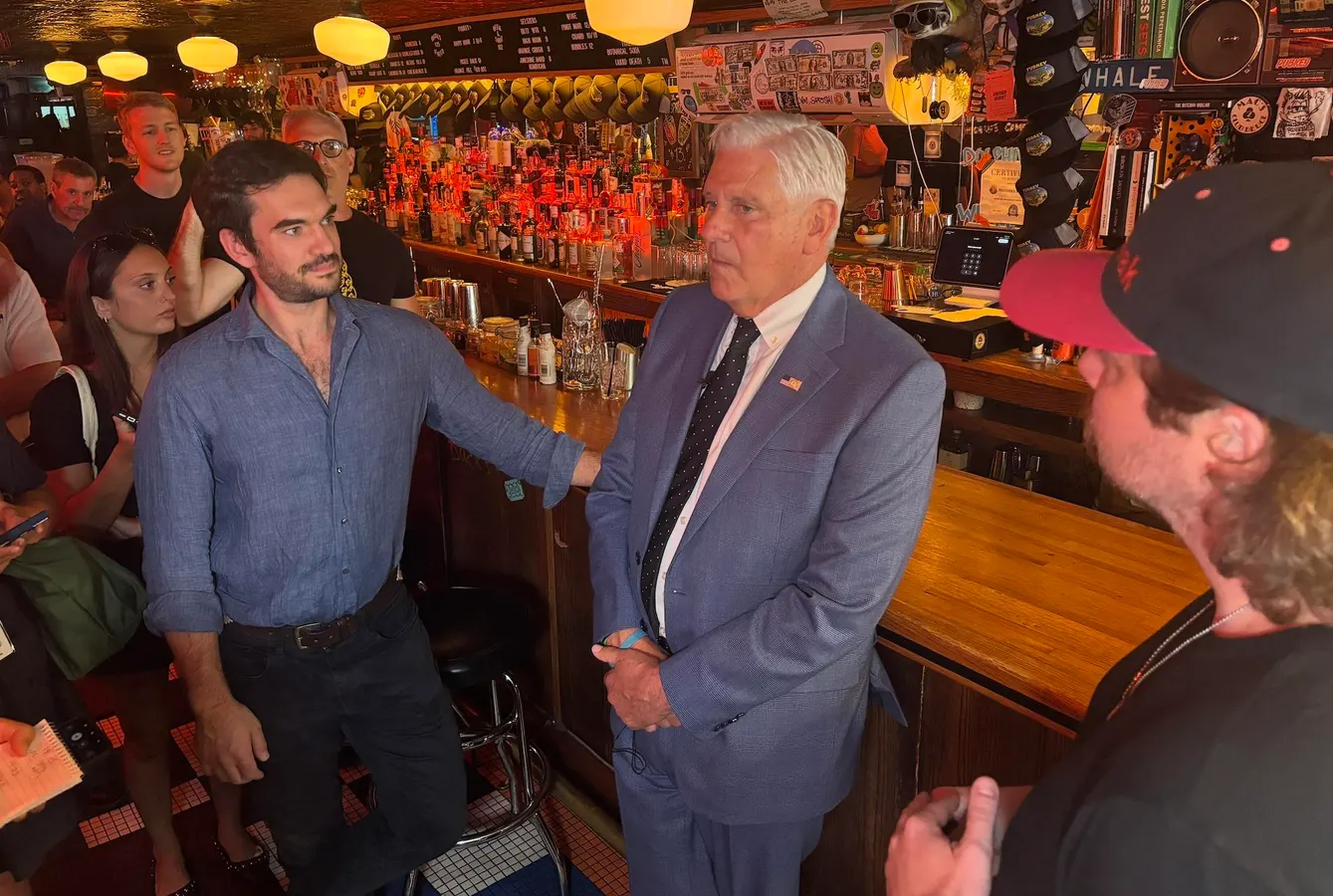
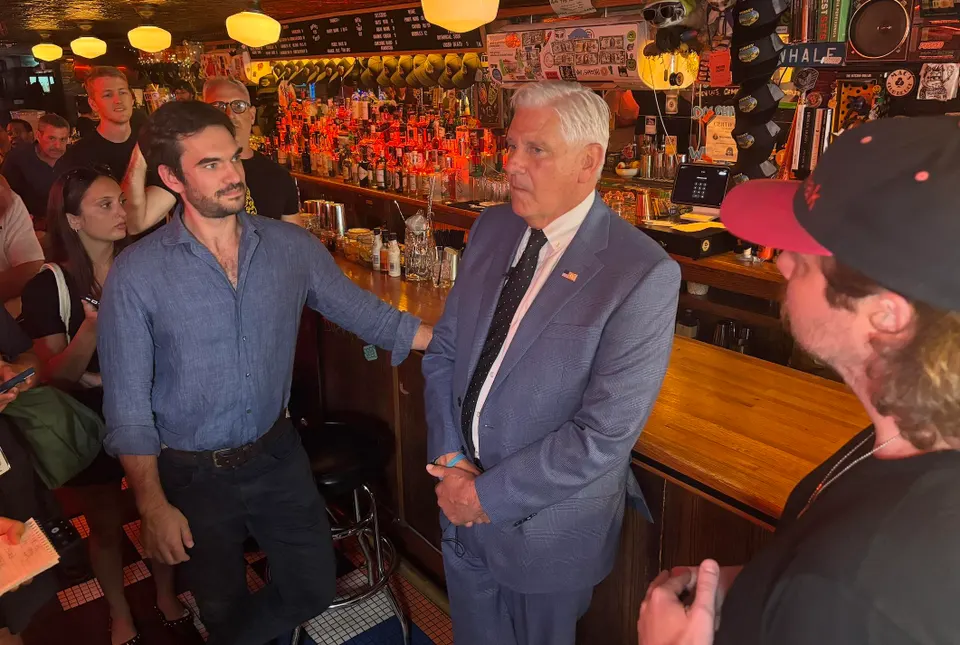
County Executive Blakeman speaks with PubKey co-founder Thomas Pacchia (R) and River CEO and CTO Alex Leishman (L)
Frank Corva
Earlier today, New York gubernatorial candidate and current Nassau County Executive Bruce Blakeman made an appearance at New York City’s Bitcoin-themed bar, PubKey, to discuss what he would do to make the Empire State more welcoming to the Bitcoin and crypto industry if he were to be elected governor.
At the bar, which is no stranger to hosting major political figures, as the likes of Rep. Thomas Massie and even President Trump have made appearances there in recent years, Blakeman made it clear that New York has been unfriendly to the crypto industry for too long and that it’s time for that to change.
“When I become governor, we will work together with the crypto industry not only to end the restrictions and the regulations that are trying to strangle this business, but also […] to create economic activity in the state,” Blakeman told those in attendance at the event.
The main regulation that makes it difficult for Bitcoin and crypto businesses to operate in New York State is the Virtual Currency Business Activity License, more commonly referred to in Bitcoin and crypto circles as the “BitLicense”.
When asked if he’d be willing to abolish the BitLicense, Blakeman responded, “Yes, I think we have to get rid of it.”
The Burden of the BitLicense
The BitLicense was first enacted into law by the New York Department of Financial Services (NYDFS) in June 2015 and has ever since made it difficult for crypto businesses to operate in New York given how arduous it is to obtain one.
It imposes notable financial costs on crypto companies that can reach over $1 million and applicants often face years-long application delays.
“The BitLicense is something that nobody voted for and it just has been a pernicious piece of regulation that’s been hurting New York State, New Yorkers, and the industry at large for many years,” Thomas Pacchia, co-founder of PubKey and long-time New Yorker, told me in an interview.
“The BitLicense has been punitive not just for Bitcoin companies that want to operate in New York — like River, for example — but also, if you take the state’s point of view, New York has missed the opportunity to bring in tax revenue from businesses that would have operated here,” Pacchia added.
A ‘Dismantle the BitLicense’ poster on the wall at PubKey
Frank Corva
CEO and CTO of River, Alex Leishman, was in attendance at the event.
Pacchia introduced Leishman to Blakeman, informing Blakeman that “River is one of the main exchanges that doesn’t service [customers in] New York State because of the BitLicense.”
Blakeman asked Leishman how many states River operates in, to which Leishman responded “48”.
After commenting on Governor Hochul’s failure to engage with businesses like River, Blakeman said to Leishman, “We’ll be welcoming you [on] January 1st in New York.”
Maintaining New York’s Status as the Financial Capital of the World
While it’s been proposed since as far back as 2019 that the NYDFS would ease the requirements for obtaining a BitLicense, the opposite has transpired — it’s only become more difficult.
Jack Mallers, CEO of Bitcoin exchange Strike, which has recently obtained a BitLicense after years of effort, spoke to how challenging it was to accomplish this task when he and his team appeared at PubKey earlier this year to celebrate the milestone.
Blakeman spoke to the notion that it’s antithetical to a city like New York to have it be so difficult for crypto companies to operate and serve customers here.
County Executive Blakeman speaking with reporters at PubKey
Frank Corva
“When I’m governor, this should be the financial capital of the world,” said Blakeman. “And without crypto, it is not the financial capital of the world.”
Pacchia spoke to this point, as well.
“I think New York still thinks it’s the financial capital of the world, but it’s kind of delusional when you look at all of the fintechs that have gone to places like Dubai or Singapore,” said Pacchia.
“Also domestically, just look at Citadel and other hedge funds going to Miami,” he added.
“It’s not a foregone conclusion that New York just keeps the ‘financial capital of the world’ title and doesn’t do anything to actually work on that — and it needs a lot of maintenance right now.”