
by Michelle Mullen
Federal immigration enforcement activity has increased across New York City in recent weeks, with U.S. Immigration and Customs Enforcement agents reported in several boroughs, including areas close to greater Riverdale.
Just outside of Marble Hill, federal agents have been spotted in Inwood, according to multiple news sources including News12 and CBS News. During one encounter near Seaman Avenue and Isham Street on July 31, video circulating on social media showed a masked federal agent approaching a woman who was recording agents with her cellphone before she was pepper sprayed. She was later identified as 72-year-old Linda Wolff.
The activity comes amid a broader expansion of federal immigration enforcement under President Donald Trump’s administration and follows several high-profile encounters in the Bronx.
With ICE activity drawing increased attention across the city, here’s what residents should know about the agency, its authority and the rights they have when encountering immigration officers.
History of ICE
Launched in 2003, ICE formed as part of the government’s reorganization following the Sept. 11, 2001, terrorist attacks. This restructuring created the Department of Homeland Security and moved immigration enforcement responsibilities previously handled by the Immigration and Naturalization Service and other federal agencies into newly created departments.
ICE became responsible for immigration enforcement within the United States as well as investigations involving certain cross-border crimes. Its responsibilities include identifying, arresting, detaining and removing some noncitizens who federal authorities determine are subject to removal under U.S. immigration law.
ICE is separate from U.S. Customs and Border Protection, which is primarily responsible for enforcement at and near the nation’s borders and ports of entry.
ICE in New York City
As a federal agency, ICE can conduct enforcement operations in New York City regardless of policies adopted by the city.
New York City’s laws, however, restrict cooperation between municipal agencies and federal immigration authorities. City agencies, including the New York Police Department, generally do not assist with federal immigration enforcement or share certain personal information with ICE except under limited circumstances.
Many city agencies also do not ask about immigration status when providing services, and many programs are available regardless of a person’s status.
Those protections do not prevent ICE from independently making arrests or conducting other enforcement activities within the five boroughs.
What ICE can do
ICE agents can approach and question people in public spaces, including streets and portions of businesses that are open to customers or visitors. When it comes to arrests, agents can detain someone if they have probable cause to believe there is an immigration violation.
At workplaces, agents do not need a warrant to enter areas such as lobbies and storefronts, but are not permitted to enter any areas marked private without a proper warrant, unless an employer or another authorized person gives them permission.
In order to enter private areas, agents must present a judicial warrant, signed by a judge, rather than an administrative warrant, which ICE issues internally without judicial review.
What ICE can’t do
An ICE administrative warrant does not give agents the same authority as a judicial warrant to enter private spaces.
At private homes, residents do not have to open the door or allow agents inside based solely on an administrative ICE warrant, according to the city. If agents say they have a warrant, residents can ask them to slide it underneath the door or hold it against a window so they can determine whether it was signed by a judge.
ICE agents also cannot require someone to voluntarily give up constitutional rights simply because they have been approached. People have the right to remain silent and do not have to answer questions about where they were born, whether they are U.S. citizens or how they entered the country.
Individuals can ask to speak with an attorney before signing documents and should not lie to agents or provide false documents.
Workshops for more information
New Yorkers who want to learn how those rights apply in different situations can attend Know Your Rights trainings offered by immigration and civil liberties organizations.
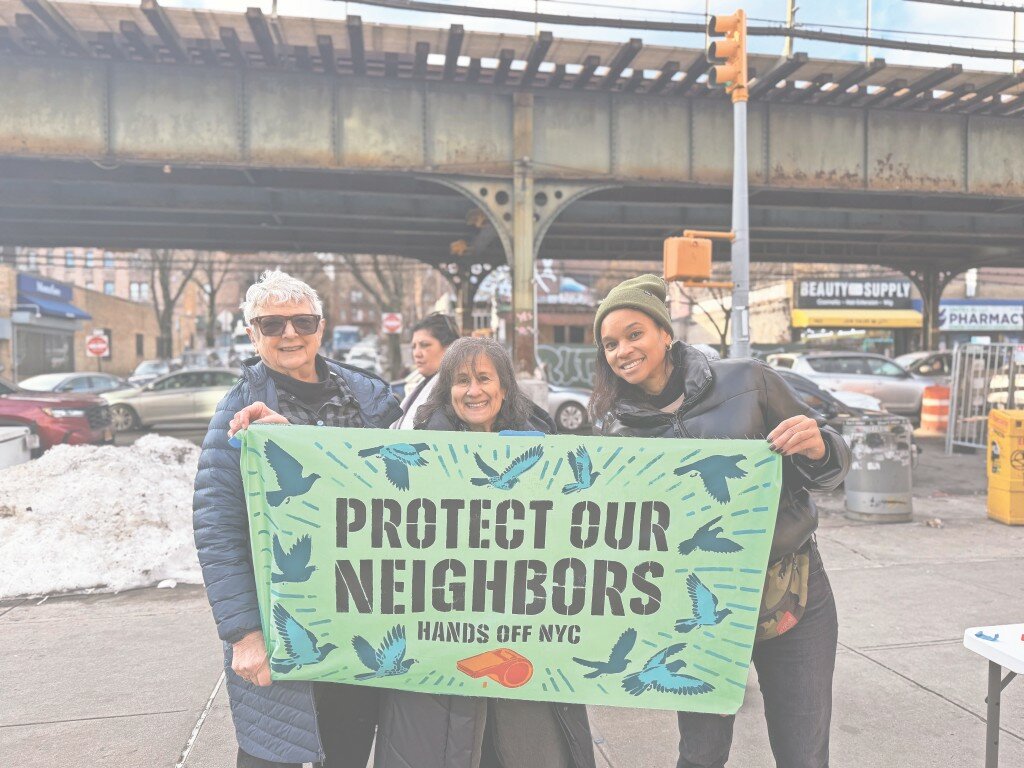
Hands Off NYC and the New York Civil Liberties Union offer a free 90-minute virtual training once a month. The program covers what to do when encountering immigration agents at home or in the community, how to identify ICE and other federal agents and how people can respond during an encounter.
Participants also learn what information they may want to keep available and ways to assist family members and neighbors. No legal background is required.
The New York City Mayor’s Office of Immigrant Affairs also provides Know Your Rights materials and other immigration resources. Information is available in English, Spanish, Arabic, Bangla, Chinese, French, Haitian Creole, Korean, Polish and Russian.
Keywords
ICE,
immigration enforcement,
U.S. Immigration and Customs Enforcement,
Riverdale,
Inwood,
Marble Hill,
New York City,
immigration rights,
Know Your Rights,
ICE agents,
federal immigration enforcement,
NYC immigration,
immigrant rights