
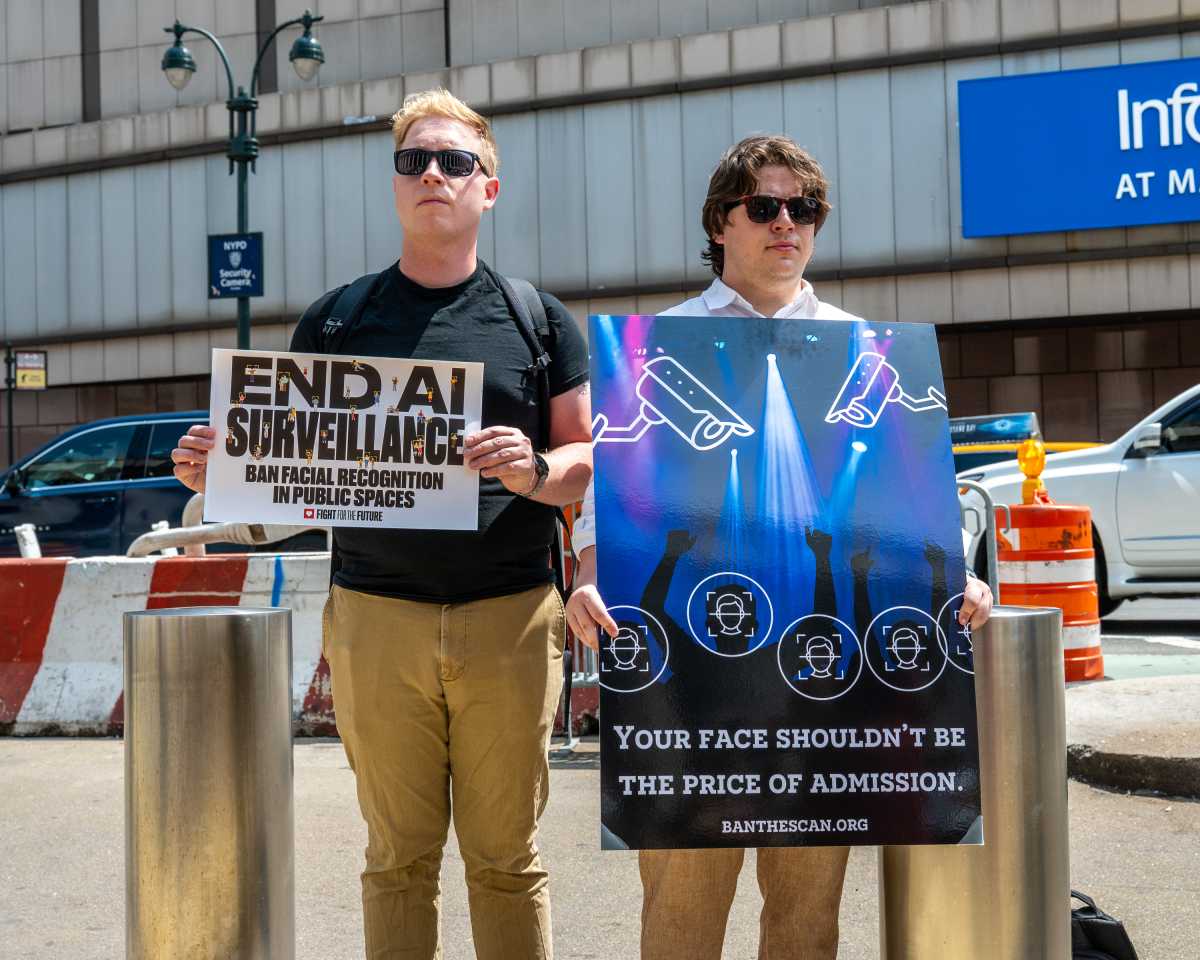
A coalition of privacy advocates, local lawmakers and artists gathered outside Moynihan Train Hall, across from Madison Square Garden, on Aug. 14 to renew calls to end the use of biometric surveillance in places of public accommodation such as MSG. The group also urged the City Council to pass Council Member Shahana Hanif’s (D-Brooklyn) Ban the Scan, Int. 213, which would prohibit businesses open to the public from collecting or using customers’ biometric information for surveillance.
The organizers — Surveillance Technology Oversight Project (S.T.O.P.), Fight for the Future, NYC DSA Tech Action, the Jim Owles Liberal Democratic Club, and musicians Cristy Road Carrera and Paisley Fields — urged immediate action as more private businesses implement biometric surveillance. They warned that sensitive information — including people’s faces, names and voices — is vulnerable to misuse, could be sold to third parties such as Immigration and Customs Enforcement, or exposed in data breaches.
In June, ShinyHunters, a hacking group, stole sensitive customer information from MSG and threatened to leak 26 million records unless the company paid a ransom.
The rally also came amid renewed scrutiny of MSG’s use of facial recognition technology, including the venue’s alleged compilation of files tracking activists who openly protested its use of the technology. Civil rights groups and lawmakers have long alleged that MSG owner James Dolan is flagrantly abusing facial recognition technology, violating visitors’ privacy and banning critics.
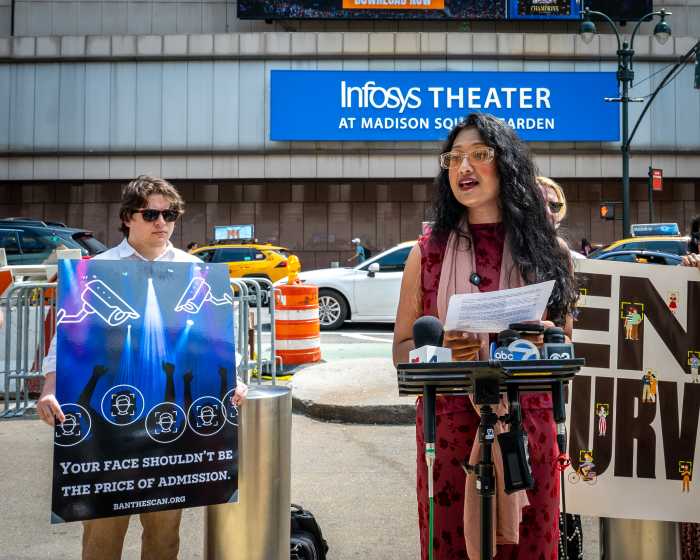 City Council Member Shahana Hanif’s “Ban the Scan” bill would prohibit businesses open to the public from collecting or using customers’ biometric information for surveillance.Photo by Gabriele Holtermann
Hanif said momentum was on the side of privacy advocates, noting that Samuel A.A. Levine, commissioner of the Department of Consumer and Worker Protection, and 27 council members, including members of the Council’s Progressive Caucus, support Intro 213.
“Madison Square Garden has shown us exactly what happens when corporations are allowed to deploy facial recognition without meaningful limits: they use it to track, profile, and blacklist people they don’t like,” Hanif said. “Your face should not be a tool that a corporation can use to punish you for exercising your rights. We have the opportunity to stop this abuse in New York City. It is time for the Council to pass Ban the Scan.”
S.T.O.P., a Brooklyn-based civil rights nonprofit, has been fighting discriminatory surveillance and working to protect the privacy and civil rights of New Yorkers since 2019. Its executive director, Michell Dahl, said the dangers of facial recognition and other AI-driven surveillance tools extended far beyond MSG. Venues and businesses such as Citi Field and Wegmans also use facial recognition and other AI-driven surveillance tools, she said.
Currently, New York City businesses are only required to post a notice informing customers that they are collecting biometric data; they are not required to obtain customers’ permission.
“The data collected by these systems is different. It is highly sensitive data. You can change your password. You can get a new credit card, but you cannot change your face if that data is hacked,” Dahl said. “We don’t know how this data may be retained or shared, including with immigration or law enforcement, which poses an alarming threat to immigrant New Yorkers and Black and Brown community members across the city.”
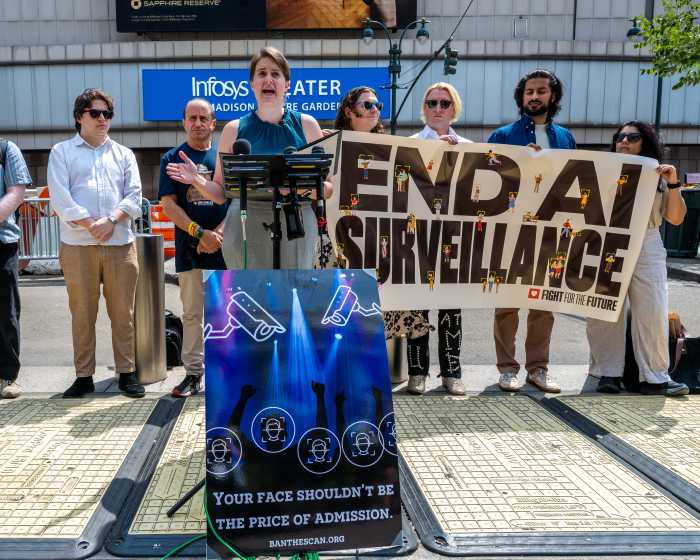 Protesters call for an end to biometric surveillance at businesses open to the public during an Aug. 14 rally outside Madison Square Garden.Photo by Gabriele Holtermann
 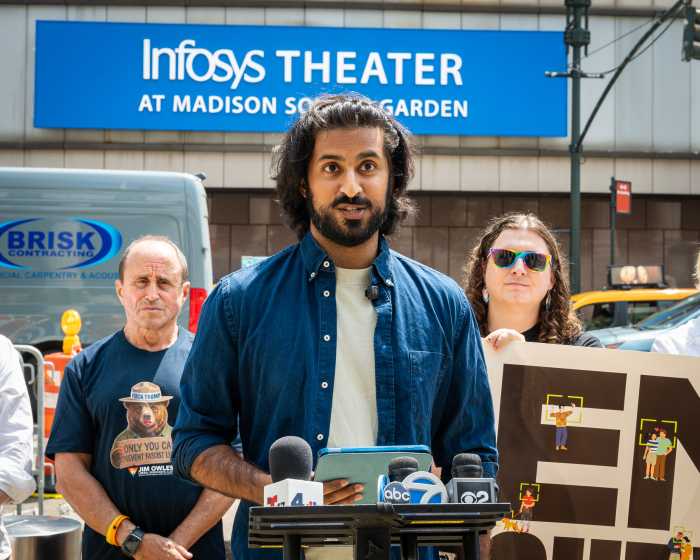 Protesters call for an end to biometric surveillance at businesses open to the public during an Aug. 14 rally outside Madison Square Garden.Photo by Gabriele Holtermann
Raaid Arshad, a member of the NYC DSA Tech Action Working Group and a software engineer, said he was “well aware” of both the positive and negative aspects of modern technology. Biometric surveillance misidentified Black and Brown people at rates up to 100 times higher than white people, according to the ACLU of Massachusetts, and Arshad said the tools not only posed immense privacy risks but also threatened civil liberties through high error rates and the disproportionate criminalization of marginalized New Yorkers.
“We should not have to give up our faces to attend a basketball game,” he said. “We should not have to let our gait be analyzed just to buy a toothbrush. And we should not be locked out of our homes or unfairly evicted because facial recognition tools can’t recognize our black and brown skin tones. We must “Ban the Scan” in New York City.”
Evan Greer, director at Fight for the Future, was among the activists whose information was included in a trove of hacked documents. A folder titled “Facial Recognition Activist” contained a three-page dossier about Greer. She warned that Dolan had assembled a “surveillance empire” that rivals some nation-states.
“There are far fewer rules governing how he can use it than how our own government can use its surveillance capabilities,” Greer said. “If we continue down this path, where billionaires, corporations, and powerful individuals can leverage surveillance to protect their power and profits to escape accountability, we won’t just lose our privacy; we will lose the last vestiges of democratic control in this country.”
Country music artist Paisley Fields said his fan base is largely queer and transgender, and that he wants his fans to feel safe and welcome when they attend his concerts. He called biometric surveillance technology an invasion of privacy that also poses a danger to the LGBTQIA+ community.
“We are often at risk of being targeted. As an artist who is unabashedly political in my music, this type of facial recognition technology and AI surveillance is very much in opposition to the message I’m looking to put out,” Fields said. “The data collected could be leaked or hacked and used to track, surveil, or target specific groups of people.”