
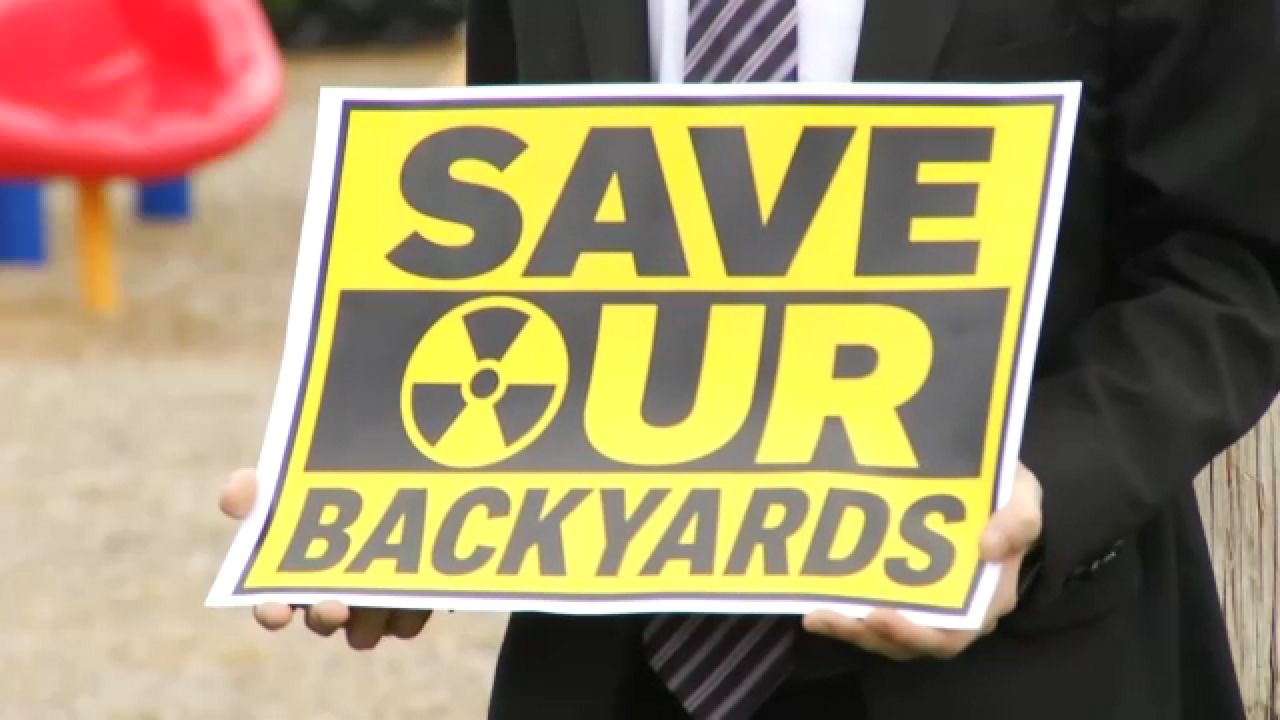
An ongoing investigation into radioactive contamination in Niagara County is moving beyond concerns over what may be in the ground and into a political debate over New York’s response.
Some affected homeowners have spent weeks asking Gov. Kathy Hochul to visit their neighborhood and hear their concerns firsthand.
Her Republican challenger in the governor’s race, Nassau County Executive Bruce Blakeman, did just that last week alongside state Senate Minority Leader Rob Ortt.
Hochul now says she does not plan to make a visit of her own, arguing that doing so would risk turning residents’ concerns into a political event.
“I have seen people go up there and politicize their cries for help,” Hochul said Thursday while speaking with reporters in Chautauqua County. “I go there, it’s a political show, and I’m not going to use politics to capitalize on people’s misery.”
But for town of Niagara homeowner Lexi Hawk, the political fight came after months of frustration over testing, communication and what she says remains an uncertain future for her family.
From a letter to confirmed contamination
Hawk said she first received a letter in March informing her that earlier radiological surveys had flagged her property for possible contamination.
State and federal officials later sought access to conduct additional testing.
Hawk said the property-access agreement she was initially asked to sign included language waiving potential claims for reimbursement against the government.
“That one part was just, it was scary to me to read that,” Hawk told Spectrum News 1. “I’m like, ‘Why are you making me waive rights?’”
Hawk said she initially refused to sign the agreement.
She later allowed testing to move forward, and on June 29, she said the New York State Department of Environmental Conservation and U.S. Environmental Protection Agency confirmed contamination on her property and advised her family not to go beyond the firepit or into the woods.
The waiver language was later removed from the access agreement.
For Hawk, who has a 3-year-old daughter, the concern is now part of everyday life.
“I don’t know what to do next as a mother,” Hawk said. “How do you protect your kid from something that you can’t see, taste or smell?”
Hawk said her family is among those being temporarily relocated while the investigation continues, but she is still waiting for a suitable place to go.
Residents wrote directly to Hochul
On July 7, Hawk and three other residents sent a letter directly to Hochul outlining several requests.
The families asked the governor to provide access to available testing data, help relocate affected residents, designate the neighborhood under New York’s State Superfund program and meet with them in their homes.
They asked for that meeting to take place by July 10.
It never happened.
The letter also raised concerns about how long it took residents to learn their properties may have been affected and criticized what the families described as a lack of information about specific readings and testing results.
Governor’s race enters the dispute
The issue later became part of the governor’s race when Blakeman visited the affected neighborhood alongside Ortt.
Both Republicans criticized Hochul’s handling of the situation and her decision not to visit residents herself.
Days later, Hochul was asked whether she would follow them to Niagara County.
She said no.
Hochul argues that her administration is already heavily involved in the response and that the focus should remain on the state officials and experts doing the work.
She said more than 160 people are involved, including officials from DEC, the state Department of Health and emergency management.
“We are all over this,” Hochul said. “I want people to know that I am looking out for them.”
Hochul has also said the state launched aerial and road surveillance efforts that helped identify radiological hotspots and is continuing to work alongside the EPA as the investigation expands.
Hawk, however, said her request for Hochul to visit predates Blakeman’s appearance and was never intended to create a campaign event.
“It was honestly just super disappointing to hear that,” Hawk said when asked about the governor’s “political show” comments. “It wasn’t so that he can have a political campaign. It was so maybe she would finally listen to me.”
Ortt pushes change to state Superfund law
The response is also moving into the state Legislature.
Earlier this month, Ortt introduced legislation that would change New York law so nuclear and radioactive waste could qualify under the state’s Hazardous Waste Superfund program.
The proposal comes in response to the radiological contamination being investigated in Niagara County.
The bill is currently in the Senate Rules Committee.
In a statement to Spectrum News 1, Ortt also pushed back directly on Hochul’s characterization of a potential visit.
“One of the most basic responsibilities of an elected official is showing up when the people you represent need you most,” Ortt said. “Listening to families isn’t a political show. It’s actually our job.”
The proposal would not automatically designate the affected neighborhood as a Superfund site or guarantee relocation for homeowners. It would expand the types of contamination that could be addressed through New York’s State Superfund process.
Lawmakers are currently out of session, meaning the proposal cannot be passed unless they return to Albany.
DEC returns to Hawk’s property
DEC officials arrived at Hawk’s home Friday while Spectrum News 1 was at the property.
Spectrum News 1 was not part of the conversation between Hawk and state officials.
Hawk later said officials provided her with a new map of the property.
She described the map as looking more alarming to her than what she had previously seen, but characterized the meeting itself as uneventful.
Hawk said she did not receive new answers about the contamination or what happens next.
For now, state and federal testing continues in Niagara County while two separate debates move forward: whether Hochul should personally meet with the affected families, and whether New York should expand its own legal authority to respond to radioactive contamination.