
By Sharon Oliver
Contributing Writer
BOSTON – What is basically a tale of two cities, began long before the Boston Red Sox played against the New York Yankees, the Bruins skated past the Rangers or the Giants dared to intercept a Patriot’s pass. For some, the rivalry has been so longstanding that they don’t even know why they must display loyalty to such animosity.
The so-called bad blood actually stretches back to the days of colonial New England when the two forming empires fought over regions, with the Bay State losing a large portion of land to the Empire State. However, Boston became the leading city for resistance to British rule during the American Revolution.
Centuries-old rift
While New England militiamen saw “Yorkers” of New Amsterdam (now New York City) as blasphemous drunks, their rivals viewed them as Puritans who were too intolerant and prudish to even celebrate Christmas in the 1600s. Since then, the two metropolises have battled over food, industry, literature, politics, sports and even accents.
In fact, the first ever photograph of someone giving the middle finger is seen in a 1886 team picture of the Boston Beaneaters, wherein pitcher Charles “Old Hoss” Radbourn was captured flipping the New York Giants the bird.
The differences between the two new neighboring cities were vast. Puritans held their heads high in moral superiority, allergic to mirth. Citizens of New Amsterdam were more secular and fostered a policy of religious freedoms. By 1644, Massachusetts had created a powerful alliance with other colonies. Eventually Boston and New York City became competing port cities. But only one city had access to a river inland with the opening of the Erie Canal in 1825 and suddenly New York was the gateway into an expanding American west. The canal siphoned much of Boston’s jobs and income, one ship at a time.
Bostonians were not happy. The founder of Boston’s first daily newspaper saw a diversion of goods to New York as “evil” and suggested his hometown jump on a new transportation idea – the steam-powered railroad. A few years later, train tracks were laid along the old Boston Post Road in an effort to connect Boston to the waters of the Hudson River. Author Eric Jaffe wrote: “…the goal of everyone involved in Boston’s railroad system at the time was clear: to move Manhattan toward the [Massachusetts] Bay along the highways of the future.”
Curse of the Bambino
By 1860, New York City was the largest city in America, thanks in large part to the immigration boom. The city of Boston favored colonial-era architecture while New York City focused on skyscrapers. Nevertheless, hardy Bostonians stood firm in regional pride on their own greatness in achievements as the bitter rivalries continued. In fact, one actually escalated into one of the most iconic rivalries in U.S. history. The Yankees vs. the Red Sox.
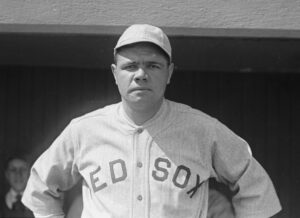 While many believe the Boston vs. New York City rivalry was instigated by the 1919 trade of Red Sox superstar Babe Ruth to the Yankees, the rift between the two cities goes back to colonial America.
Photo/Wikimedia Commons/Library of Congress
The 1919 trade of Red Sox superstar Babe Ruth to the Yankees launched one of the greatest dynasties in sports history. It also prompted and popularized the phrase “The Rivalry” and a superstition known as the “Curse of the Bambino,” which is attributed to Boston’s 86-year World Series drought that began after Ruth switched uniforms. The Yankees have often been portrayed as the dominant team who ruled the diamond, whereas the Red Sox had to face a long-standing reputation for being an underdog.
Since the days of Babe Ruth’s trade to the Yankees and that decades-old losing drought, the Red Sox have gone on to win several World Series championships. Boston arguably remains an educational, cultural, artistic, and economic power in the United States with its elite schools, museums and businesses.
RELATED CONTENT:
Red Sox–Yankees Rivalry Fueled Bridge Nine Records
Red Sox lose Tim Wakefield, one of their most storied pitchers
Citgo sign is a beloved symbol of Boston
Post Views: 1