
In 1938, German scientists Otto Hahn and Fritz Strassmann discovered nuclear fission: splitting the nucleus of a uranium atom and an enormous amount of energy is released. And it did not take physicists long to wonder whether that energy could be harnessed to create an incredibly powerful explosion.
The crucial work was done in Britain. In 1940, physicists Rudolf Peierls and Otto Frisch calculated that a relatively small amount of uranium-235 could sustain an explosive chain reaction. The following year, Britain’s secret MAUD Committee concluded that an atomic bomb wasn’t science fiction. It could actually be built, and possibly in time to affect the outcome of World War II.
That conclusion helped transform what had until then been a modest American research effort into what became the Manhattan Project. The fear that Nazi Germany might get there first also provided a serious dose of motivation.
How to build a nuclear bomb
But knowing a bomb was possible and building one were very different things. The biggest problem was obtaining the material required to make a bomb. Scientists pursued two routes. One involved separating out uranium-235, which makes up less than 1% of natural uranium. The other involved a newly discovered element: plutonium.
Physicists knew that plutonium-239 could be created by bombarding ordinary uranium-238 with neutrons inside a nuclear reactor. At least in theory. Nobody had ever attempted to manufacture the amount that would be required for a bomb, but the U.S. decided to try.
Why was plutonium considered better for building a bomb than uranium?
Plutonium had one huge advantage over uranium: it could be produced from abundant uranium-238 in a nuclear reactor, while bomb-grade uranium required the immensely difficult task of separating the rare uranium-235 isotope from natural uranium. The catch was that plutonium required a more complicated implosion bomb design, but once that problem was solved it offered a far more practical route to producing material for multiple weapons.
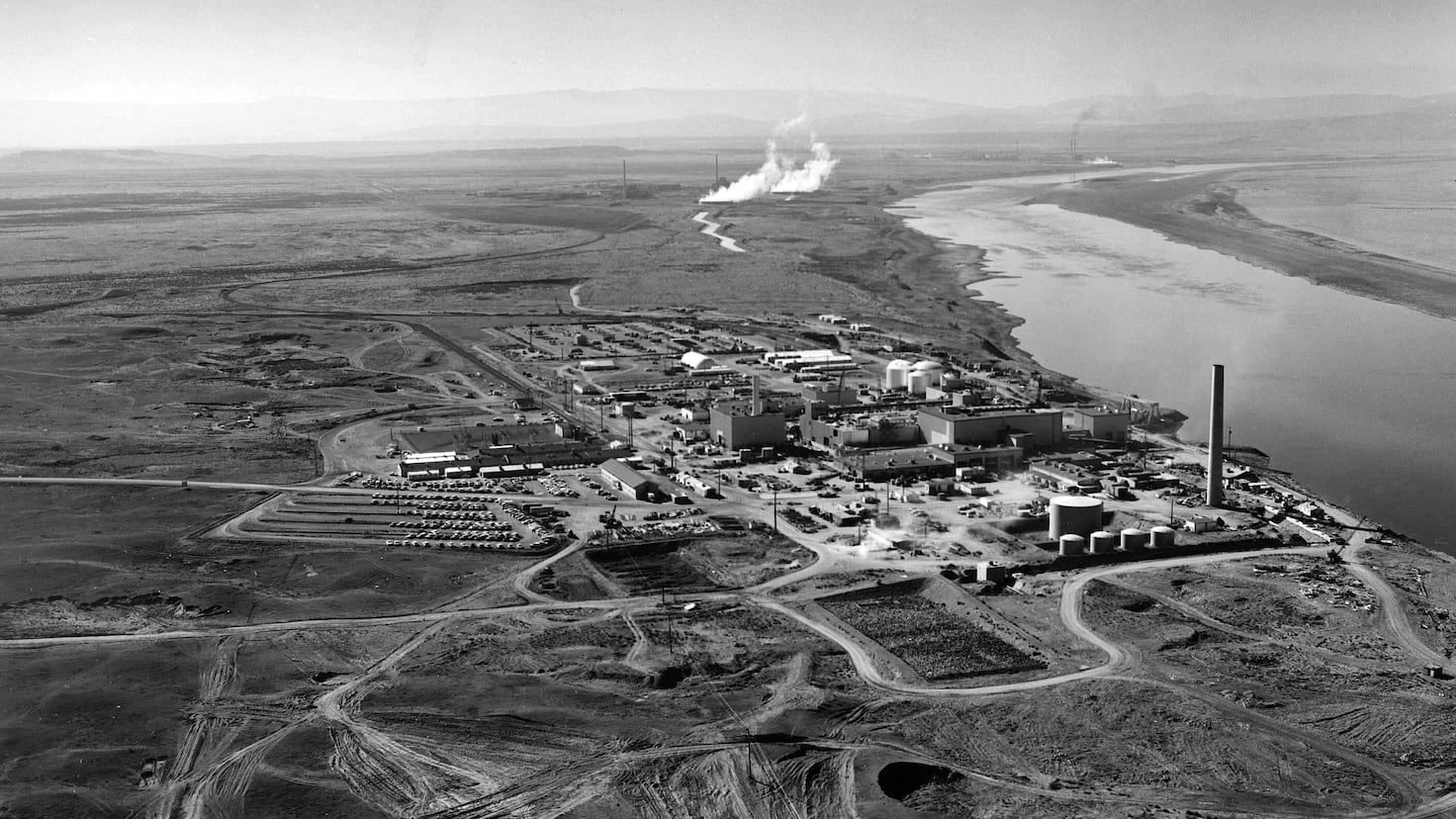
A vast, isolated site beside the Columbia River in Washington state was chosen in 1943. Within 11 months, workers had built the B Reactor at Hanford, the world’s first full-scale plutonium production reactor. It began operating in September 1944.
The process was extraordinary. Uranium was manufactured into fuel rods, transported to the reactors and irradiated. Some uranium-238 atoms absorbed neutrons and, through radioactive decay, became plutonium-239.
The irradiated rods were then transported to enormous chemical separation plants. At T Plant, completed in 1944, the rods were dissolved in chemicals and the tiny quantity of plutonium separated from the intensely radioactive material surrounding it. That plutonium was eventually sent to Los Alamos, where it was fashioned into the core of a bomb.
Hanford plutonium was used in the Trinity nuclear test in July 1945 and in the Fat Man bomb dropped on Nagasaki the following month, killing an estimated 60,000 to 80,000 people by the end of 1945.
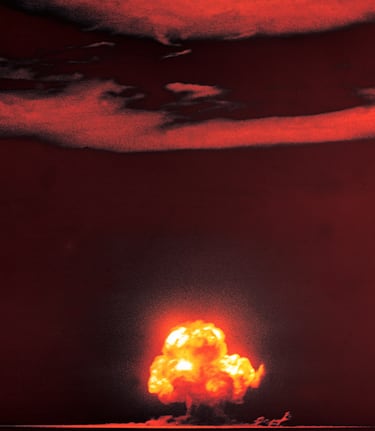 Trinity testProducing plutonium is a dirty business
Producing a tiny quantity of plutonium required processing enormous amounts of uranium and left behind radioactive fuel, contaminated machinery and huge volumes of chemical waste. And disposal practices were very different from what would be acceptable today.
Hundreds of billions of gallons of contaminated liquid were poured onto the ground, into trenches or into holding ponds. Solid radioactive waste was buried, sometimes in drums or boxes and sometimes simply placed in the ground. The most dangerous liquid waste was pumped into enormous underground tanks.
World War II ended, but Hanford didn’t. As relations with the Soviet Union deteriorated, the United States built a vast nuclear arsenal. Eventually nine reactors operated at Hanford. Over four decades the site produced nearly two-thirds of the plutonium used in the U.S. nuclear weapons stockpile.
The older reactors began closing during the 1960s and early 1970s. The last, N Reactor, continued producing plutonium until 1987. By then the problem had changed completely. America no longer needed Hanford to make plutonium. It needed to work out what to do with everything that making it had left behind.
In 1989, the Department of Energy, Environmental Protection Agency and Washington state signed the Tri-Party Agreement, beginning the enormous cleanup operation that continues today.
Hanford has 177 underground tanks, 158 of which still contain some of the roughly 56 million gallons of radioactive and chemical waste produced during the plutonium program. There are thousands of tons of spent nuclear fuel and plutonium-bearing material, millions of cubic feet of buried solid waste and vast areas of contaminated soil and groundwater.
One of the main solutions sounds almost as extraordinary as the original project. Radioactive tank waste is being mixed with glass-forming materials and heated until molten, a process called vitrification. Once cooled, the radioactive material is trapped inside solid glass.
It is painstaking, technically difficult and staggeringly expensive. The Government Accountability Office estimated in 2022 that completing the entire Hanford cleanup could cost between $300 billion and $640 billion. Some cleanup work is now projected to continue into the 2080s.
Does the U.S. still make plutonium?
The United States no longer needs to manufacture new plutonium for its weapons. During the Cold War it made so much that it already has the material it needs.
However, it is rebuilding its capacity to manufacture that existing plutonium into new nuclear weapon “pits,” the cores that trigger modern warheads. The first production pit for the new W87-1 warhead was completed at Los Alamos in 2024, while the U.S. is working toward the capacity to produce at least 80 pits a year. A 2026 Department of Energy assessment explicitly says existing pits can be used as feedstock, meaning there is “no need” to produce new plutonium.
More than 80 years after Hanford first started making the stuff, America still has plenty of plutonium. But it will be cleaning up the mess left behind for decades to come.
Related stories
Get closer to the game! Whether you like your soccer of the European variety or that on this side of the pond, our AS USA app has it all. Dive into live coverage, expert insights, breaking news, exclusive videos, and more. Plus, stay updated on NFL, NBA and all other big sports stories as well as the latest in current affairs and entertainment. Download now for all-access coverage, right at your fingertips – anytime, anywhere.
And there’s more: check out our TikTok and Instagram reels for bite-sized visual takes on all the biggest soccer news and insights.