
NIAGARA FALLS, N.Y. — Nearly 60% of college students who are food insecure told the Government Office of Accountability they didn’t get benefits. A big reason: They didn’t know they could. The GAO says that in 2020, there were nearly four million food-insecure college students.
For SNAP for Students Act creator Jaime Lechner, what started as a school project is now legislation with statewide bipartisan support.
“This obviously can help to address the food insecurity issue that college students have that’s often overlooked because of the stigma that if you’re going to college you are privileged, and you can afford it and everything else,” Lechner said. “Where in this day and age, that’s a myth.”
Since April 2024, the Niagara University graduate has been trying to bridge the gap that myth has created. It started with a phone call.
“I spent about three hours on the phone one day in the summer, trying to call my local county offices to get the information,” Lechner said. “And the website, unfortunately, is so confusing because there are so many caveats in the first place for college students. It’s not something that they can find their way through, like a map.”
That’s when Lechner took matters into her own hands and created the “SNAP for Students Act.”
“The bill requires that there’s an email sent out just once annually, by the school,” Lechner said. “Their students [are] saying, ‘hey, here’s information about SNAP in case you need it.’ “
Assemblymember Phara Souffrant Forrest (D – NY57) is one of the bill’s initial sponsors. She understands the need all too well.
“While I was a student over at CUNY, I was the recipient of SNAP benefits,” Forrest said. “And it really was important, not only to be able to feed myself, but to be able to attend school and focus on my studies.”
She says there is a disconnect between what students face and what families face.
“The traditional portrayal of a student is a young person in a dorm room with a meal plan, but actually across New York State to date, the data just doesn’t reflect that,” Forrest said.
Kirsten E. Keefe, the senior director of Policy & Advocacy, New York at The Institute for College Access & Success (TICAS), writes, “There’s a big opportunity to close the gap: Tens of thousands of New York college students are potentially eligible for SNAP but are not enrolled.” … Importantly, all communication would be sent electronically, making implementation a low-lift. The bill is endorsed by 40 organizations including The Commission on Independent Colleges and Universities (CICU) in New York State. With no opposition in the way, the Legislature can pass this bill, which would stand as a win for schools and students.”
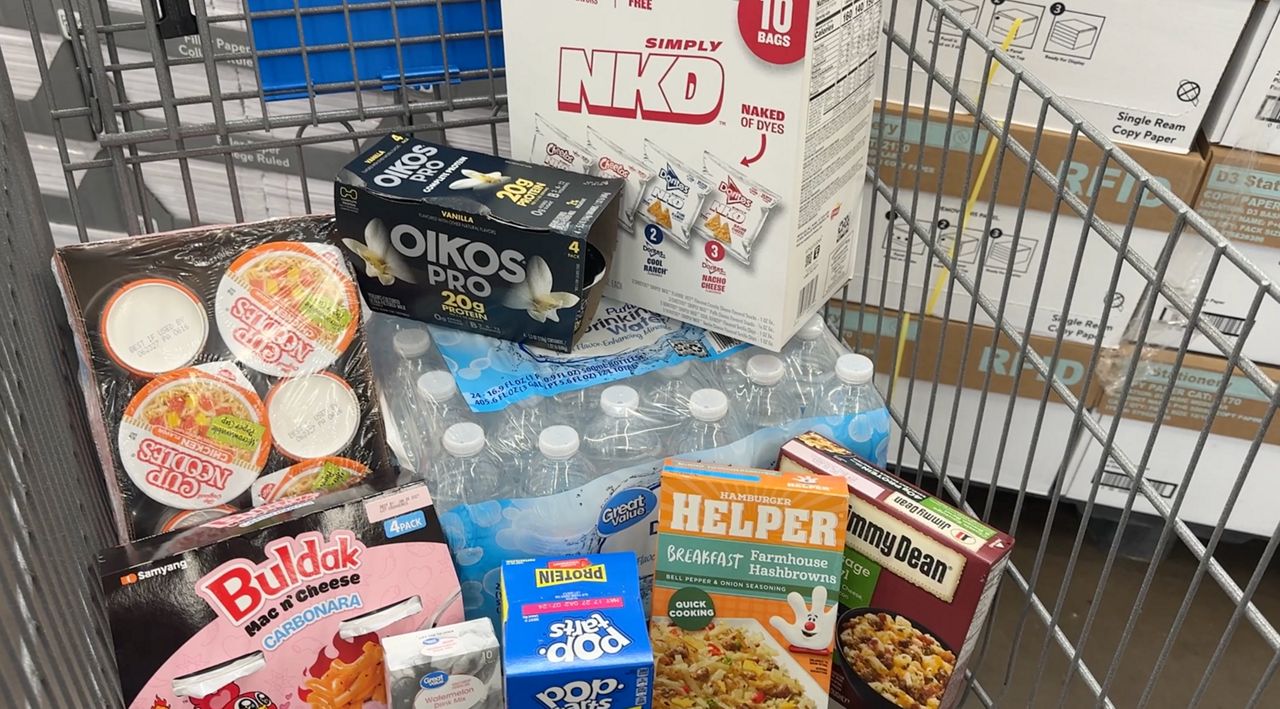
While lawmakers hash out the details, major retailers like Walmart are trying to ease the burden. For the first time, it has a meal bundle for college students for less than $35.
“The food insecurity issue is also the crux of the physical health of the students, because being food insecure negatively impacts your health and negatively impacts your academic performance and your mental health,” Lechner said.
As we head into a new school year, Lechner is urging students to get help if they need it. Here are some resources she’s created.
Sen. Robert Jackson, a co-sponsor of the bill, said that the “SNAP for Students Act” is a “modest legislative step with profound consequences”:
“The promise of higher education means little if students are forced to choose between feeding themselves and finishing their degree. Across New York, too many students who may qualify for SNAP never receive that support simply because they do not know they are eligible or how to apply. The SNAP for Students Act addresses that gap by making sure students receive clear, accessible, and multilingual information about benefits for which they may already qualify.
This legislation does not create a new entitlement. It removes a barrier to information. When government helps people understand and access resources already available to them, it strengthens equity, improves educational outcomes, and invests in a more prosperous New York.
This is a modest legislative step with profound consequences. Food security is academic security.
During the last legislative session, this bill remained in the Senate Social Services Committee and did not advance before the session concluded. I intend to continue working with my colleagues, higher education leaders, and anti-hunger advocates to build the support necessary to move this legislation forward. Hunger should never be an obstacle to learning, and helping students access existing resources is a practical, fiscally responsible step toward ensuring that every New Yorker has a fair opportunity to reach their full potential.”