
For some odd reason, throughout the history of teams associated with the borough of Brooklyn, the month of August saw precious few ball players born or die.
Albert John “Doc” Bushong was one of those who did, dying in the month of August in Brooklyn.
He had a strong tie to Brooklyn, having played for three teams: the Atlantics, the Trolley Dodgers, and the Bridegrooms. Those of you who follow my columns know that those three teams could be one team with the same members but different names or some combination thereof. Bushong leaped to the head of this short list because he, like my father, was a dentist who practiced in Brooklyn. There is more to the story than that, but we’ll save the surprise for later.
Bushong made his Brooklyn Major League Baseball debut in 1875 as a catcher for the Brooklyn Atlantics of the National Association. During his entire major league career, he also played for the Philadelphia Athletics, Worcester Ruby Legs, Cleveland Blues and Saint Louis Browns. Bushong batted and threw right-handed. Here I pause to share with you a peculiarity of researching old time baseball. Everyone states the facts but the facts aren’t always the same.
For instance, in this piece one writer talks of Buchong’s short career, another points to his 17 years behind the plate. Near as I can figure, one is talking about full-year employment vs. part-time. As my grandma used to say whilst scratching her head, “Go figure!”
Leaning as I so often do on the Society for American Baseball Research, I found this: Though Bushong’s full-time career in baseball was rather short – less than a decade – he built a reputation as one of the finest catchers of the 19th century. Standing 5-feet-11 and weighing 165 pounds, according to the encyclopedias (the Brooklyn Eagle in 1889 described him as 5-feet-8½ and weighing 140 pounds), Bush was among the pioneers behind the plate in calling pitches, crouching, one-handed catching, coaching, and glove/mitt construction. He was highly regarded among the press corps and among his colleagues and fans for his scientific approach to the game. As an intelligent, temperate, and educated man, he was often sought out and cited in the newspapers to help explain the nuances and evolutionary process of the game from the perspective of the backstop.”
Last night, watching premier catcher Cal Reileigh of the Seattle Mariners wave at a low and inside slider for a third strike, I mused that logic would dictate that catchers should be the best hitters in baseball. But for a few — Roy Campanella, Yogi Berra, Johnny Bench — they mostly aren’t. Bushong was no exception. His career batting average was .218, but his skills behind the plate more than made up for his lack of hitting.
Baseball Almanac presents this quote from a local sportswriter: “His (Doc Bushong) style of receiving pitched balls was so gracefully efficient he suffered relatively little permanent hand or finger damage during his 16 years in baseball (note the differing total 16 vs. 17), despite playing in the barehanded backstop era,” wrote Frank Phelps in “19th Century Stars.” That was 1989. Further investigation showed that his career included eight seasons where his error total was zero, a goose egg.
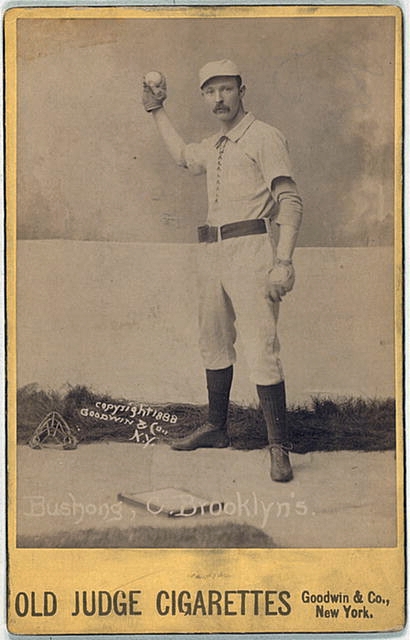
Always looking for unusual citations, I found one about Doc Bushong from the Metropolitan Museum of Art. The museum owns a collection of early baseball cards. For those of us who grew up as part of the Topps generation of cards, few of us knew that baseball cards were about as old as the game itself. In the early days, they were advertisements. The museum has one Bushong from the Old Judge Cigarettes collection dated 1888. If you’re sharing your love of the game with children and grandchildren, the museum’s collection might be something to show off to them. They hardly look like baseball players but for the uniform.
Two things struck this writer as unexpected. First, for someone credited as one of the finest catchers in the game, his card shows him standing, not crouching, and known for his inventiveness about gear, he is shown gloveless. The second is, of course, the link to smoking, a link that lasted well into the 20th century. It’s worth a detour.
Here’s what the Los Angeles Times wrote about the issue: “The hot dogs and beer aren’t going away. But with the 1993 baseball season officially underway, cigarette ads are being snuffed out of the parks — a trend that may cost the tobacco giants their last best bastion of advertising.”
Sometimes the right place is better than every place. The Times went on to say, “Ever since tobacco advertising was banned from television in 1971, critics contend that tobacco makers have tried to weasel around the law by strategically placing huge billboards in the TV camera’s eye. The two biggest-selling cigarette brands — Philip Morris’ Marlboro and R. J. Reynolds’ Winston — are in practically every ballpark that will let them.”
The Times continued, “But the tobacco giants may have to find alternative ad venues. Fans who filed into the Houston Astrodome on Monday for the Astros’ season opener saw an odd site in center field: the familiar Marlboro sign had been covered with black plastic. It will remain that way until the Astros find a new advertiser. Tobacco ads have been banned from the park.” The Times went on to point out that the Red Sox, the Dodgers, and Padres had joined the ban with Dodger Stadium nixing smoking throughout the stadium.
Yet, there’s that bulge so often seen in a player’s cheek — chewing tobacco. Known as smokeless tobacco, it hung around until an early 2020 players’ contract outlawed its use for new players but grandfathered in previous users. Even today, if you look closely at dugout shots, you’ll occasionally see players with a “chaw” pushing out their cheeks. Some will tell you it’s bubble gum. That holds water until the player spits. Nothing but chewing tobacco looks like that dark, nasty stream that shoots from a player’s mouth. Ugh.
Now a note about the personal aspect of this. When one’s father practiced dentistry for 68 years and was the first New York University dental school graduate to open a regional, not neighborhood practice, one in an office building not a residence, in my father’s case, the Fox Building at 1 Nevins St., finding a baseball-playing dentist was a hoot. Because of Bushong’s skill, mentioned above, his hands went undamaged and therefore didn’t impede his dental work. You’d be hard-pressed today to find a catcher whose fingers would permit the fine motor skills of dentistry. But something told me not to be too impressed about the dental skills of the 1880s.
Many years ago, I was tooling around in an Eastern Pennsylvania barn-turned antique shop. There I found a set of dental tools from the mid to late 1800s. Suffice it to say, they looked like they had been crafted by Black and Decker. Any of you who are fans of old Westerns have seen the standard dental procedure — half a bottle of whiskey, a dentist’s foot levered against the chair, arms straining to yank out the offending tooth. Not too much finesse required. Bushong graduated from Penn’s dental school, but there’s no record of him ever playing baseball for Penn, probably because he was already a rostered professional.
After his retirement from professional baseball in 1890, Bushong turned to the full-time practice of dentistry, first in Hoboken, New Jersey, and then in Brooklyn, where he died in 1908. He’s buried in Holy Cross Cemetery on Tilden Avenue. He shares that sacred space with another Dodger great, Gil Hodges.
Before I close, I promised you a surprise. While remembered for many things in his career, the most notable single part of the Bushong legacy is the invention of the modern-day catcher’s mitt. While a player from long ago, that creation makes him present at every modern baseball game. Now that’s a legacy.