
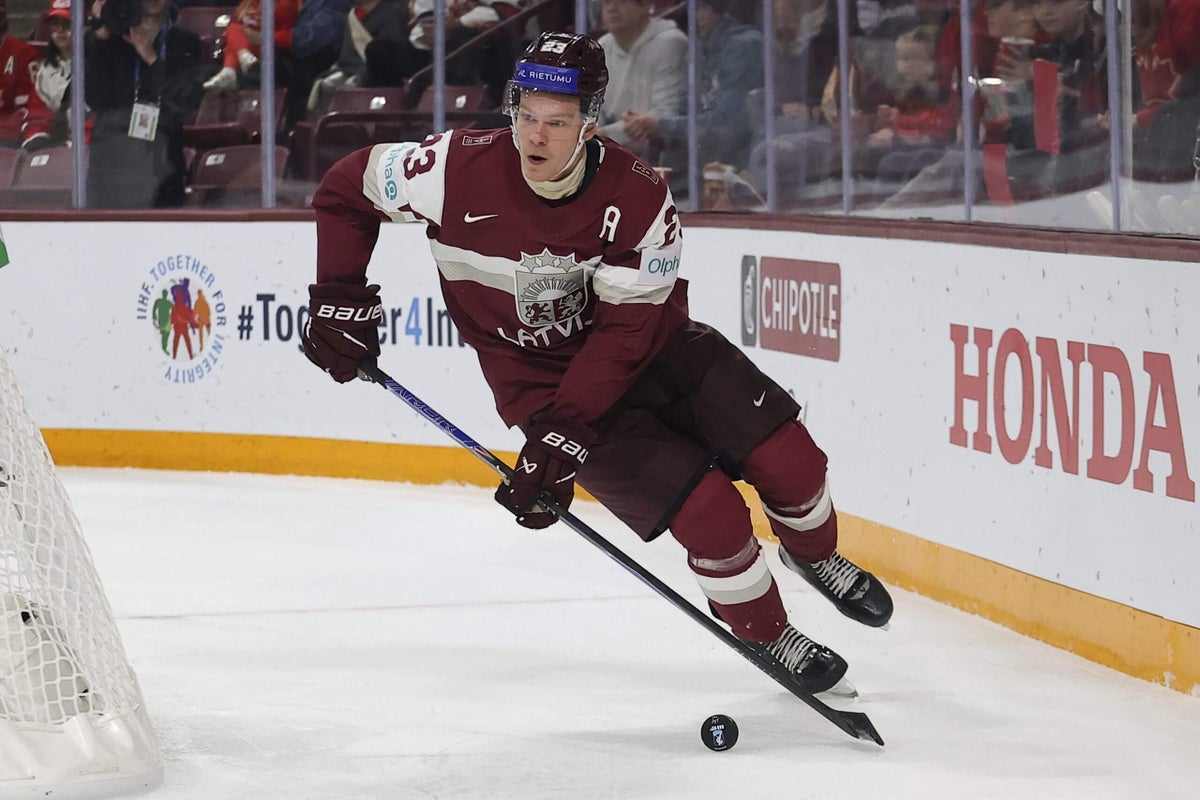
The New York Rangers have a quality prospect pool with some impressive pieces at the top. Alberts Šmits gives them a highly mobile, top-pairing-caliber defenseman, while Cole Beaudoin provides a tremendously hardworking presence down the middle. New York has a nice blend of skill and compete in a system that should produce reliable NHL talent but still has a lot of work ahead in this next rebuild.
2025 ranking: 24
2026 NHL Draft grade: B-
Player Ranking1. Alberts Šmits, D
Dec. 2, 2007 | 6-foot-3 | 205 pounds | Shoots left
Drafted: No. 5 in 2026
Tier: Top of the lineup player
Skating: NHL average
Puck skills: NHL average
Hockey sense: NHL average
Compete: Above NHL average
Shot: High-end
Analysis: Šmits is a tall defenseman with impressive mobility and smarts. He can make a reliable first pass and has a big point shot, projecting to have quality amounts of offense. He isn’t a super smart puck-mover, but there’s enough touch in his game to project to be reliable with the puck in the NHL. He defends very well due to his length and feet, while also competing hard and being willing to play the body. He projects as a top-pairing defenseman.
2. Cole Beaudoin, C
April 24, 2006 | 6-foot-2 | 210 pounds | Shoots left
Drafted: No. 24 in 2024
Tier: Middle of the lineup player
Skating: Below NHL average
Puck skills: NHL average
Hockey sense: Below NHL average
Compete: High-end
Analysis: Beaudoin is a very likable player. He’s a tremendously hardworking center. He’s constantly noticeable throughout the game in how many pucks he wins. He’s quite physical and doesn’t shy from getting to the tough areas of the ice and does so without taking bad penalties. He can create offense in junior, but with a somewhat heavy skating stride, the debate is in how his game will translate to the pros. He has good offensive skills and was a top OHL scorer last season, but he’s not overly creative or instinctive with the puck for higher levels. Beaudoin projects as a third-line center.
3. Liam Greentree, RW
Jan. 1, 2006 | 6-foot-3 | 215 pounds | Shoots left
Drafted: No. 26 in 2024
Tier: Middle of the lineup player
Skating: Below NHL average
Puck skills: Above NHL average
Hockey sense: NHL average
Compete: NHL average
Shot: Above NHL average
Analysis: Greentree was one of the top forwards in the OHL. He makes difficult plays often with the puck as a handler and passer and possesses high-end creativity while also having a good shot. He competes well enough and can use his size to get to the net. The main concern on Greentree is his pace. He’s a so-so skater, and when the game gets fast and hard, he can fade into the background at times. He projects as a middle-six winger.
4. Nathan Aspinall, LW
March 30, 2006 | 6-foot-6 | 185 pounds | Shoots left
Drafted: No. 159 in 2024
Tier: Middle of the lineup player
Skating: Poor
Puck skills: NHL average
Hockey sense: NHL average
Compete: NHL average
Analysis: Aspinall was one of the best players in the OHL, taking significant steps forward as a player and prospect. He’s massive at 6-foot-6 and is very skilled. His coordination for his size is quite impressive, and he makes a lot of small-man-type plays with the puck. Aspinall has continued to develop his offense and physicality, although he doesn’t get to the middle of the ice as often as I would like. I’ve seen worse skating guys with his length, but his feet are heavy for the NHL level. He projects as a middle-six winger.
5. Malcolm Spence, LW
Sept. 22, 2006 | 6-foot-1 | 190 pounds | Shoots left
Drafted: No. 43 in 2025
Tier: Middle of the lineup player
Skating: NHL average
Puck skills: NHL average
Hockey sense: Below NHL average
Compete: High-end
Analysis: Spence’s compete is excellent and is the calling card of his game. He’s a tenacious worker who wins a ton of battles and gets to many pucks due to his length, speed and effort. He comes back hard and is a great two-way forward who plays the body often. Spence has good offensive skills and can create chances with pace, but I wouldn’t call him a dynamic or overly creative player with the puck. His finishing touch is at times a minor question, but he gets a lot of greasy-area goals. He can be a very likable middle-six winger who coaches will use a lot.
6. Gabe Perreault, RW
May 7, 2005 | 5-foot-11 | 163 pounds | Shoots left
Drafted: No. 23 in 2023
Tier: NHL prospect
Skating: Below NHL average
Puck skills: Above NHL average
Hockey sense: Above NHL average
Compete: NHL average
Analysis: Perreault had a good rookie pro season, scoring 27 points for the Rangers. Perreault is a very skilled and intelligent winger. He makes highly creative and unique dekes and passes with the puck at a high rate, both off the perimeter and in small areas. His puck game is clear NHL power-play quality, and he will score as a pro. The issues on Perreault’s game are his 5-foot-11 frame and his below-average foot speed. I have concerns about his long-term projection unless the offense is so off-the-charts good, which I’m on the fence about whether it will be or not.
7. Tomas Chrenko, C
Nov. 2, 2007 | 5-foot-11 | 172 pounds | Shoots right
Drafted: No. 81 in 2026
Tier: NHL prospect
Skating: Above NHL average
Puck skills: Above NHL average
Hockey sense: NHL average
Compete: NHL average
Shot: Above NHL average
Analysis: Chrenko has standout skill with the puck, displaying high-end creativity, vision and ability to create off the perimeter. He’s a good-to-very good skater with strong speed and edge work. Chrenko isn’t that big and can be pushed to the outside by stronger defenders, which will be his main issue, but he works hard enough to potentially overcome that. He’s also shown he can play center, although it’s debatable whether he projects as that in the NHL. His skill could get him games, but it’s not a sure thing that he sticks in the league.
8. Carey Terrance, C
May 10, 2005 | 6-foot-0 | 178 pounds | Shoots left
Drafted: No. 59 in 2023
Tier: NHL prospect
Skating: NHL average
Puck skills: NHL average
Hockey sense: Below NHL average
Compete: Above NHL average
Analysis: Terrance is a strong skating forward. He has the edge work and speed for higher levels and can routinely skate by junior defenders. He has good hands and can create offense off the rush. I don’t think his vision is a selling point, and Terrance makes very basic plays with the puck. His compete is solid and he can kill penalties. Terrance lacks a wow factor, but he’s reliable and competitive enough that he could have a path to play at the bottom of a lineup.
9. Dylan Roobroeck, C
July 27, 2004 | 6-foot-7 | 206 pounds | Shoots left
Drafted: No. 178 in 2023
Tier: NHL prospect
Skating: Poor
Puck skills: NHL average
Hockey sense: Below NHL average
Compete: NHL average
Analysis: Roobroeck is a massive center at 6-foot-7. Because of his size, he’s gangly as a skater and lacks quickness for the pro game. His skating will be a major issue, but he has hands, can score goals and has some physicality in his game. Those traits give him a real chance to be a bottom-of-the-lineup forward for an NHL team.
10. Mikkel Eriksen, C
Sept. 13, 2007 | 5-foot-11 | 187 pounds | Shoots left
Drafted: No. 111 in 2025
Tier: NHL prospect
Skating: NHL average
Puck skills: NHL average
Hockey sense: NHL average
Compete: Above NHL average
Analysis: Eriksen had an excellent season as a top junior scorer in Sweden and good play for both Norway’s U20 and senior team. Eriksen can skate and handle the puck well. He’s a smart player who makes tough plays. He creates offense in a translatable way, and he plays at the net. For a 5-foot-11 forward, he wins battles. He isn’t very dynamic, but he has a chance to make it.
11. EJ Emery, D
March 30, 2006 | 6-foot-4 | 183 pounds | Shoots right
Drafted: No. 30 in 2024
Tier: NHL prospect
Skating: NHL average
Puck skills: Below NHL average
Hockey sense: NHL average
Compete: Above NHL average
Shot: Below NHL average
Analysis: Emery is a 6-foot-3 defender who skates very well for his size. He’s strong on gaps and retrievals, breaks up a lot of plays, plays hard on his checks, and has the potential to make a lot of stops. He can attack with his feet and often jumps up into the rush. Emery’s puck play is a major question, though. There are times his first pass can be decent, and times it is unreliable. He’s a clear NHL defender, but he will need to make a steady outlet to play full-time, and I would say that aspect of his game is on the bubble.
12. Charlie Morrison, D
Oct. 12, 2007 | 6-foot-3 | 198 pounds | Shoots left
Drafted: No. 77 in 2026
Tier: NHL prospect
Skating: NHL average
Puck skills: Below NHL average
Hockey sense: NHL average
Compete: Above NHL average
Shot: Below NHL average
Analysis: Morrison is a tall, mobile defenseman who’s quite physical. He kills a lot of plays with his stick and body and has strong gap control. With the puck, though, he’s somewhat limited. He makes an OK outlet pass, but can fight the puck at times with his decisions and isn’t a natural offensive player.
13. Jacob Battaglia, RW
March 17, 2006 | 6-foot-1 | 202 pounds | Shoots left
Drafted: No. 62 in 2024
Tier: NHL prospect
Skating: NHL average
Puck skills: NHL average
Hockey sense: NHL average
Compete: NHL average
Shot: Above NHL average
Analysis: Battaglia is a skilled winger with a legit chance to be an offensive threat. Battaglia has the quick hands and high-end creativity to make a lot of things happen with the puck. He often beats defenders with his one-on-one play and does so with pace. He also is a strong playmaker who makes tough plays in traffic and off the perimeter. I wouldn’t describe him as hard to play against, but his compete level is good enough to go with his pure offensive talent that he could be a bottom-six winger.
14. Danai Shaiikov, G
April 13, 2007 | 6-foot-2 | 192 pounds | Catches left
Drafted: No. 67 in 2026
Tier: NHL prospect
Skating: NHL average
Hockey sense: NHL average
Analysis: Shaiikov was up and down last season in the Q, but there’s NHL talent in his quickness and athleticism. He can make NHL-caliber saves. He’s a little inconsistent, and at his size I’d prefer his sense to be excellent instead of just good, but he has a chance to make it.
Player eligibility: All skaters who are 22 years old or younger as of Sept. 15, 2026, regardless of how many NHL games they’ve played, are eligible. Player heights and weights are taken from the NHL.
Tool grades: Tool grades are based on a scale with six separate levels, with an eye toward how this attribute would grade in the NHL (poor, below-average, average, above-average, high-end and elite). “Average” on this scale means the tool projects as NHL average, which is meant as a positive, not a criticism. Skating, puck skills, hockey sense and compete for every projected NHL player are graded. Shot grades are only included if a shot is notably good or poor.
Tier definitions: Tiers are meant to show roughly where in an average NHL lineup a player projects to slot in.