
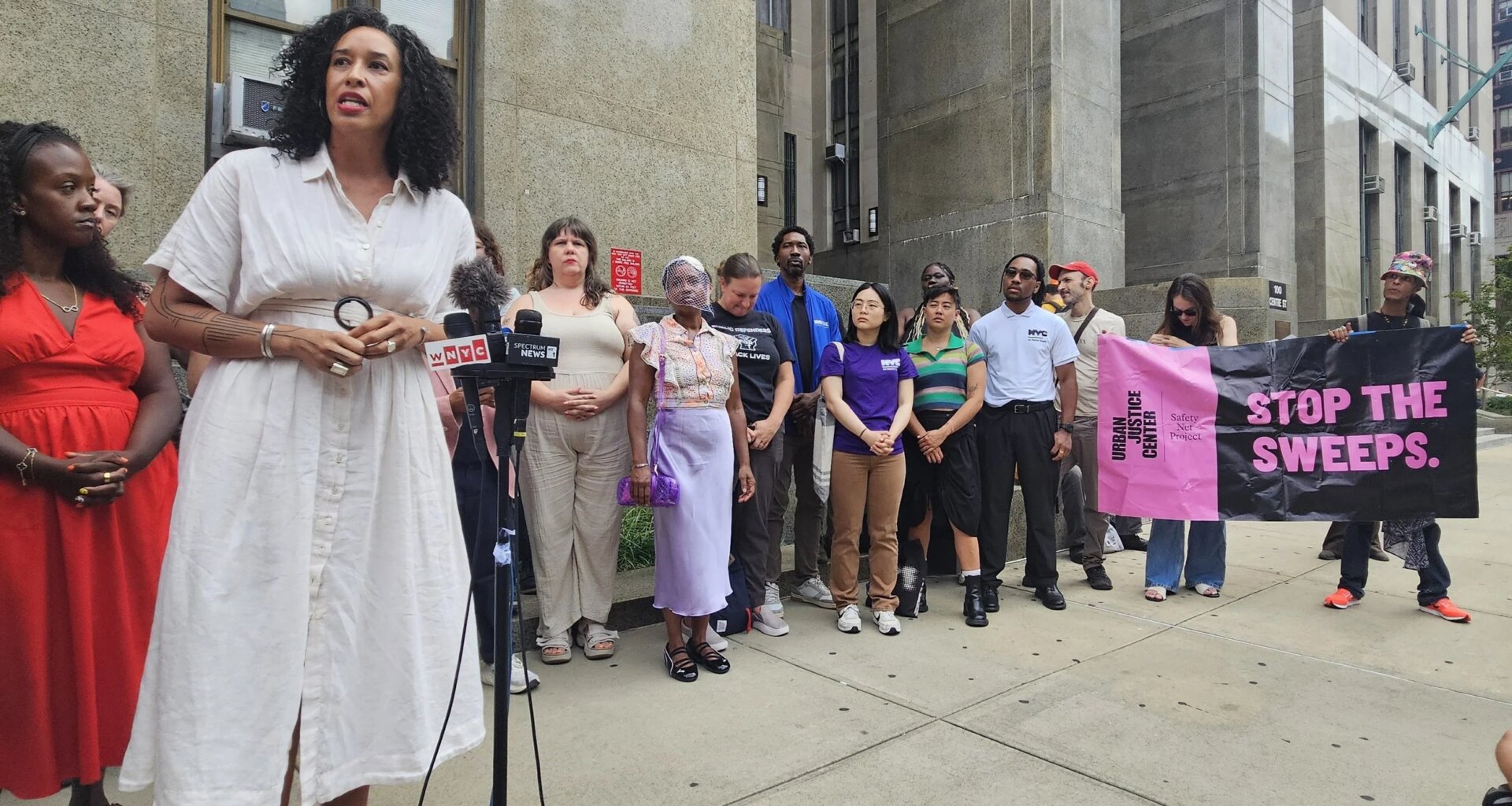
Representatives from the Queens borough president’s office also participated in court watching the past week, and said they regularly witnessed arraignments for those with substance abuse disorders.
Queens Borough President Donovan Richards also appeared alongside advocates in Manhattan on Thursday, and called on the city to move money away from the Department of Correction and into community programming and workforce development. Richards said if the current level of low-level arrests continues, the city would never be able to close Rikers Island – which it is legally required to do by August 2027.
“There is no way we’re ever going to close Rikers Island if we keep arresting people for these low-level offenses,” Richards said. “The only way to make our communities safer is through intentional investments – investments in our community centers, investments in the justice system that don’t keep our people in the justice system when they get out.”
Alongside Richards, Brooklyn City Councilmembers Sandy Nurse, Lincoln Restler and Crystal Hudson, and Brooklyn Assemblymember Emily Gallagher, demanded change to policing practices under Mamdani.
At an unrelated press conference on Wednesday, Mamdani said that he doesn’t “believe New Yorkers should have to choose between safety and justice.”
“We have to be able to deliver both of these things,” Mamdani said. “We know that every single day is an opportunity to do better. So, I look forward to the findings and we’ll review those.”
When asked by reporters again about the findings on Thursday, Mamdani said he was confident in Commissioner Jessica Tisch’s ability to lead the NYPD.
“I would not have someone serving our city if I was not confident in what they were doing,” Mamdani said. “I appreciate all of these different initiatives that are all looking towards the same thing, which is how to deliver safety and justice in our city, and that continues to be a focus for us.”
In response to the data, a spokesperson for the NYPD said that current low-level arrest rates are significantly lower than pre-pandemic numbers.
“The NYPD makes arrests based on complaints received from the community,” an NYPD spokesperson said. “Since 2010, the NYPD has made significant efforts to reduce the amount of low-level arrests. This resulted in a 50 percent decrease in misdemeanor arrests in 2018 from 2010. Since the City has emerged from the pandemic years, the amount of misdemeanor arrests have held steady at levels seen in 2018.”
During his 2025 mayoral campaign, Mamdani made overhauling the NYPD’s response to non-criminal and mental health emergency calls a key issue.
Central to his pitch was the Department of Community Safety, which he said would divert mental health cases away from the NYPD and into the hands of social workers and mental health professionals.
In July, Mamdani instead launched a scaled-down version of the plan, dubbed the Office of Community Safety, which he called a “first major step” towards realizing a full department and scaling back the use of NYPD officers in non-criminal cases.
But in the first half of his administration, a different story is emerging as arrest rates remain as high or higher as they were under Mayor Eric Adams’ administration.
According to data from the Mayor’s Office of Criminal Justice, there were over 130,000 arrests in the first six months 2026, a 50 percent increase from that same time period in 2022.