
Many of us parents have been there: hauling a stroller up the subway stairs, toddler strapped in, while somehow also holding another kid’s hand, and trying not to completely lose it because, well, city parenting.
But okay, I see the side-eye. You just had a baby. Can we maybe chill a little with the “how to survive parenting in NYC” content?
Yes. Absolutely. Because this isn’t another guide telling you how hard city parenting is. It’s about navigating these early years with resources, tips, and little shortcuts that can actually make life with kids in NYC a whole lot easier.
As a more seasoned mom, I know that riding the subway can have its good and challenging days. Add a newborn, a toddler or two, and the subway can be downright intimidating. Throw in a stroller and those stairs you’ve never noticed before, and kids have become a very BIG deal.
Best news: you absolutely can do the subway with kids. The key is knowing which stations have elevators and which stations are easier to navigate with a stroller; getting around the city becomes a lot less daunting.
Time for some stats.
The MTA has more than 150 subway stations with elevator or ramp access; this is huge for us families who are looking for the most accessible stations. But as a frequent subway rider, I have to say: I especially love when there’s a ramp. A ramp means that it’s okay if the elevator is out of order (ahem, MTA). And while I’m past the stroller stage, I have a child with special needs, so the MTA’s accessible features are helpful for parents with strollers, but they are also designed to make subway travel easier for a range of riders, including people with mobility needs and parents navigating the city with strollers.MTA Accessible Subway Stations
Psst…Check Out the Best Libraries in New York for Kids
A Little Subway Planning Goes a Long Way
The biggest tip? Don’t always choose the closest subway entrance. Look for the elevator.
Keep in mind the elevator entrance may be on a completely different corner from the regular subway entrance, so it’s worth checking before you leave. The MTA’s accessibility guide lists elevator locations, and if you plan to take the subway often, definitely download the app, which also shows accessible stations and current elevator status.
And check that status before you go. An elevator being out of service can spiral from a quick subway trip into something with a not-so-good vibe, all while you’re pushing a stroller.
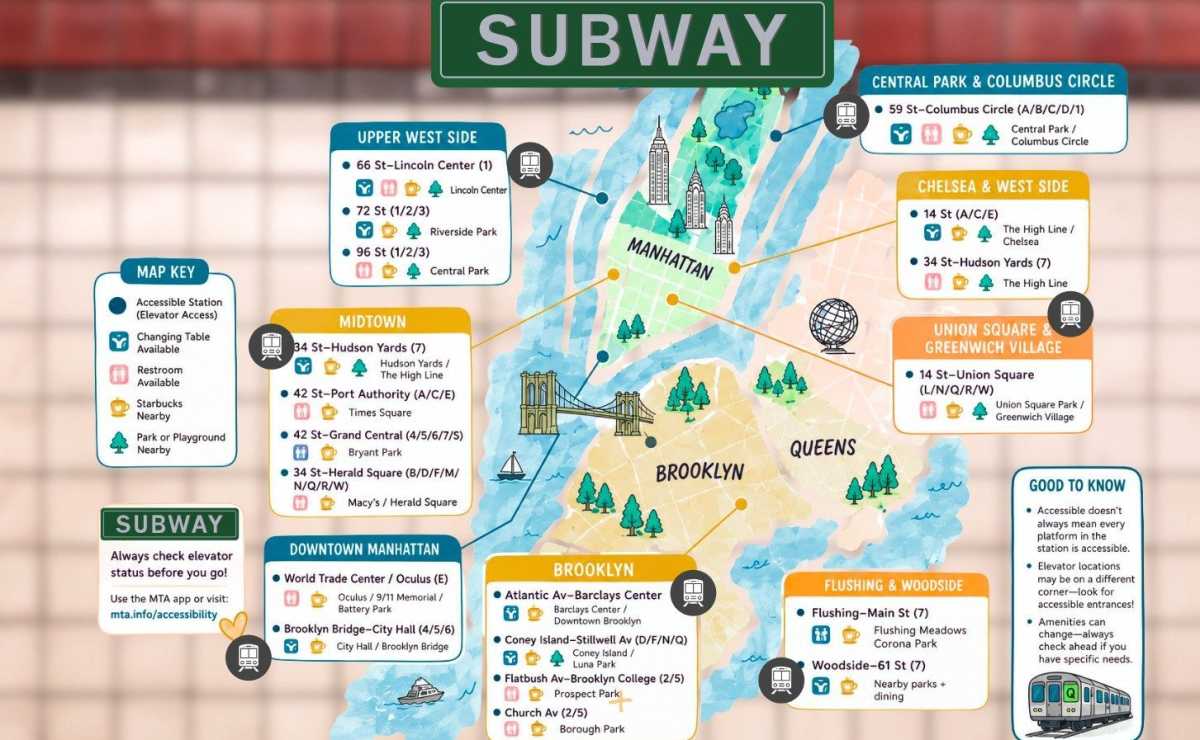
Save (screenshot, drag onto your desktop) our subway map; you’ll thank us later!
Subway Stations Parents Should Know
Rather than trying to list every accessible station in NYC, these are some useful options to keep on your radar when you’re heading to popular neighborhoods and family destinations.
Upper West Side
66 St–Lincoln Center — 1 train
The accessible 1 train station puts you right in the middle of the Upper West Side, near Lincoln Center, Central Park, and Riverside Park.
Good for: Lincoln Center, Central Park, Riverside Park and the Upper West Side.
Parent perk: Lincoln Center
Lincoln Center’s Atrium has accessible gender-neutral restrooms and changing tables, and the Clark Studio Theater has baby-changing tables in both gendered restrooms. David Geffen Hall has accessible restrooms on every level and infant changing tables on every level.
72 St — 1/2/3 trains
Another useful Upper West Side option, particularly if you’re heading toward Central Park, Riverside Park or the neighborhood’s restaurants and shops.
96 St — 1/2/3 trains
A helpful option farther uptown for families spending time around 96th Street and Broadway.
Midtown
34 St–Hudson Yards — 7 train
Definitely one to know. Because it’s a newer station, it can feel easier to navigate with a stroller than some of the city’s older subway stations.
Good for: Hudson Yards, High Line and Chelsea.
42 St–Port Authority — A/C/E
A useful Midtown option if you’re heading toward Times Square, Broadway or the surrounding neighborhood.
Good for: Times Square, Broadway and Midtown.
42 St–Grand Central — 4/5/6/7/S
Another major transportation hub to know about when you’re traveling with kids.
Good for: Grand Central, Bryant Park and Midtown East.
34 St–Herald Square — B/D/F/M/N/Q/R/W
Useful for families spending the day around Herald Square and Midtown shopping.
Good for: Macy’s, Herald Square and Midtown.
Central Park & Columbus Circle
59 St–Columbus Circle — A/B/C/D/1
This is a useful station for families because you’re right next to Central Park, win-win!
Good for: Central Park, Columbus Circle, Lincoln Center and the Upper West Side.
If you’re planning a Central Park day with a stroller, it’s worth checking this station before automatically choosing the closest entrance.
Chelsea & the West Side
14 St — A/C/E
A useful option for getting into Chelsea and the West Village.
Good for: Chelsea, West Village and the High Line.
34 St–Hudson Yards — 7
Another option for the western side of Chelsea, particularly if you’re heading toward the High Line.
Union Square & Greenwich Village
14 St–Union Square — L/N/Q/R/W
This is one where parents should pay attention to which train they’re taking.
The accessible portion serves the L/N/Q/R/W lines; the 4/5/6 platforms are not accessible.
This is a good reminder that you can’t simply search “accessible subway station” and assume the entire station works for your route.
Good for: Union Square Park, Greenwich Village, and the surrounding neighborhood.
Lower Manhattan
World Trade Center / Oculus — E
The World Trade Center campus has step-free routing for families with strollers, and the Oculus has elevators connecting its different levels. There are also public restrooms in the Oculus.
Good for: Oculus, 9/11 Memorial & Museum, Battery Park and FiDi.
Parent perk: Oculus
Parent pit stop: The Oculus is a good place to regroup, with accessible restrooms, elevators, and plenty of indoor space if you need to take a stroller break.
Brooklyn
Atlantic Av–Barclays Center
A major Brooklyn transportation hub worth knowing, particularly when you’re traveling between neighborhoods or heading to an event.
Good for: Barclays Center, Downtown Brooklyn and Prospect Heights.
Coney Island–Stillwell Av — D/F/N/Q
If you’re taking the kids to Coney Island, this is an obvious one to know. It serves four subway lines and is an accessible station.
Good for: Coney Island, the beach, and Luna Park.
Flatbush Av–Brooklyn College — 2/5
Another accessible option worth knowing for families in central Brooklyn.
Church Av — 2/5
A useful accessible station for this part of Brooklyn.
Queens
Flushing–Main St — 7
A useful accessible option at the end of the 7 line.
Good for: Flushing and family outings in the neighborhood.
Woodside–61 St — 7
Another accessible 7-train stop and an important transportation connection for Queens families.
If You’re Traveling With More Than One Kid
Because getting one child through the subway is one thing. Getting a stroller, a walking toddler, and another child through the subway is another sport entirely.
Don’t automatically take the closest station.
The station three blocks farther away might have an elevator while the one next door has stairs. Those extra three blocks could save you a whole lot of negotiating.
Find the elevator before you leave.
The subway entrance with the big MTA sign isn’t necessarily the elevator entrance. Check the accessible station information before you go.
Check the elevator status.
This is especially important with a stroller. The MTA’s accessible-trip planner takes elevator outages into account.
Give the older kid a job.
Have them hold the subway map, help count stops, watch for the train number or be responsible for pressing the elevator button. Anything that makes them feel like they’re helping can make the whole process smoother.
Know your exit.
With a stroller, getting off at the wrong stop isn’t quite as simple as hopping back on the next train. Check which station exit gets you closest to where you’re going—and where the elevator is.
And don’t be afraid to bail.
If the elevator is broken, the train is packed, and everyone has reached their limit, take the bus or a cab.
The Parent Subway Checklist
Before you leave:
Is there an elevator at my station?
Is the elevator currently working?
Is the specific line/platform I’m using accessible?
Where is the elevator entrance?
Is there a changing table near my destination?
Is there somewhere nearby to grab coffee/snacks?
Is there a park or playground nearby if everyone needs a reset?
If You’re Traveling With More Than One Kid
This is where a little strategy can make a huge difference.
Give yourself more time. Getting three people, a stroller, and everything they suddenly need through a subway station takes longer than it does when you’re alone.
Don’t be afraid to walk a few extra blocks. The closest station isn’t necessarily the easiest one. If another station has a working elevator and a simpler entrance, it may be worth the extra walk.
Know your exit before you get on the train. With a stroller, getting off at the wrong stop isn’t quite as simple as turning around and walking down the stairs.
Check elevator status before you leave. This may be the most important tip of all. The MTA’s elevator status can change, so check before heading out.
And give yourself permission to change plans. Sometimes the elevator is broken, the train is packed, your toddler is melting down, and a $12 cab ride suddenly feels like the best transportation decision you’ve ever made. Welcome to New York.
A Few Things Every New NYC Parent Should Know
The subway sign isn’t necessarily the elevator entrance. Look for the elevator location specifically.
Accessible doesn’t always mean every line in the station is accessible. Check your actual train and transfer.
A stroller doesn’t mean you have to avoid the subway. Once you know your elevator stations, the system becomes much easier to navigate.
The MTA is still adding accessibility. The current MTA capital plan includes at least 60 additional accessible subway stations, so this list is worth updating as new stations come online.
Keep in mind: Subway elevator availability can change, and elevators can be temporarily out of service. Always check the MTA’s current accessibility information before traveling. The MTA continues to add accessible stations as part of its ongoing accessibility program. Its 2025–2029 Capital Plan calls for at least 60 more accessible subway stations.
Official resources:
MTA Accessible Subway Stations
MTA Accessible Travel by Subway
 0
0