
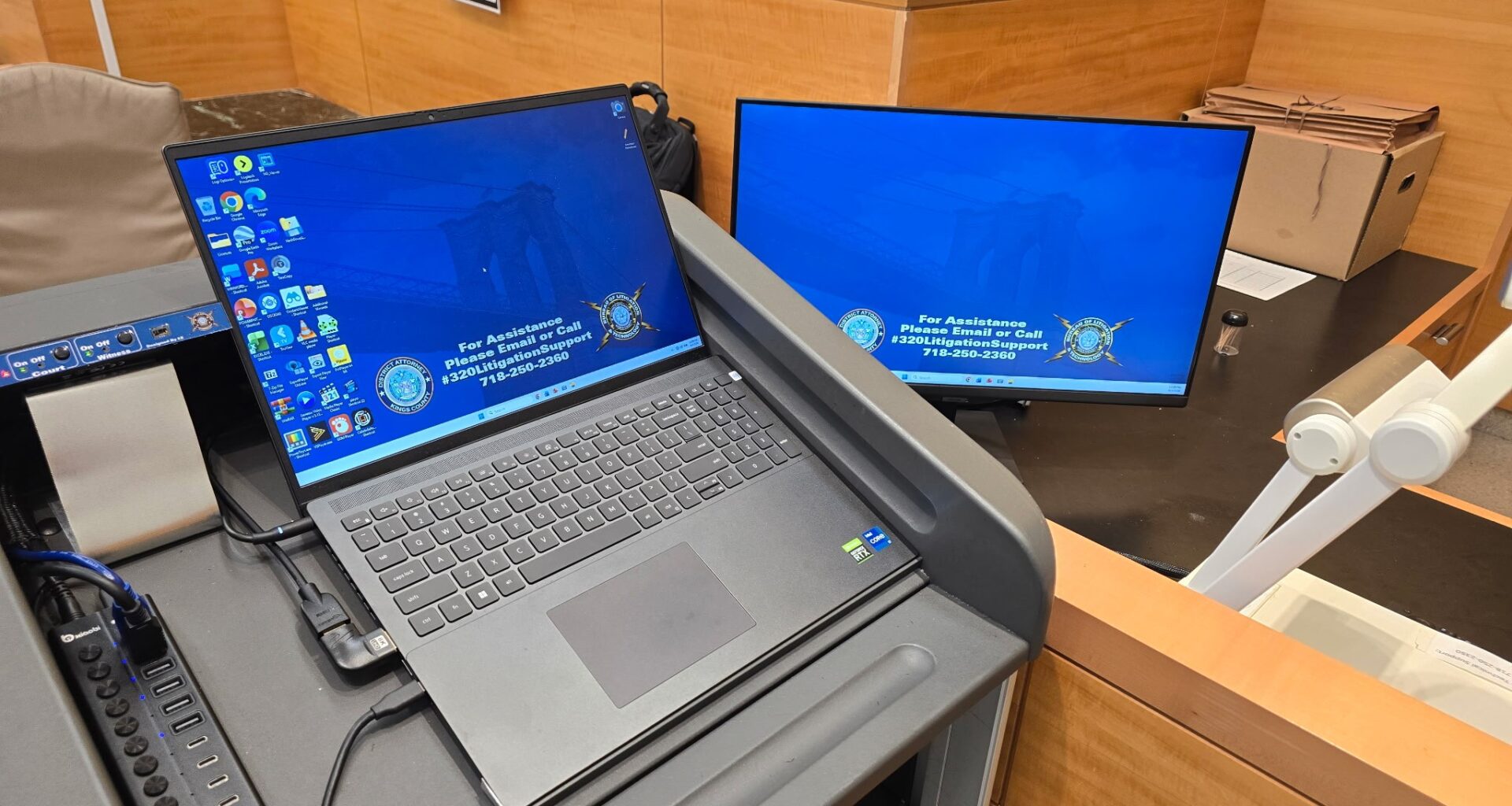
 DOWNTOWN BROOKLYN — On Aug. 5, the Brooklyn District Attorney’s Office unveiled technological upgrades in all nine grand jury rooms in Supreme Court at 320 Jay St.
The Bureau of Litigation Technology replaced the overhead projectors that used to screen evidence photos onto a wall with large, moveable monitors. It also installed portable podiums that allow prosecutors to show evidence only to the witness and can also seamlessly toggle between computer files and a document camera.
According to Brooklyn District Attorney Eric Gonzalez, the new technology in Brooklyn’s grand jury rooms lets prosecutors present evidence more accurately and efficiently, keeping up with the evolving nature of evidence, which now often includes video compilations and other visuals.
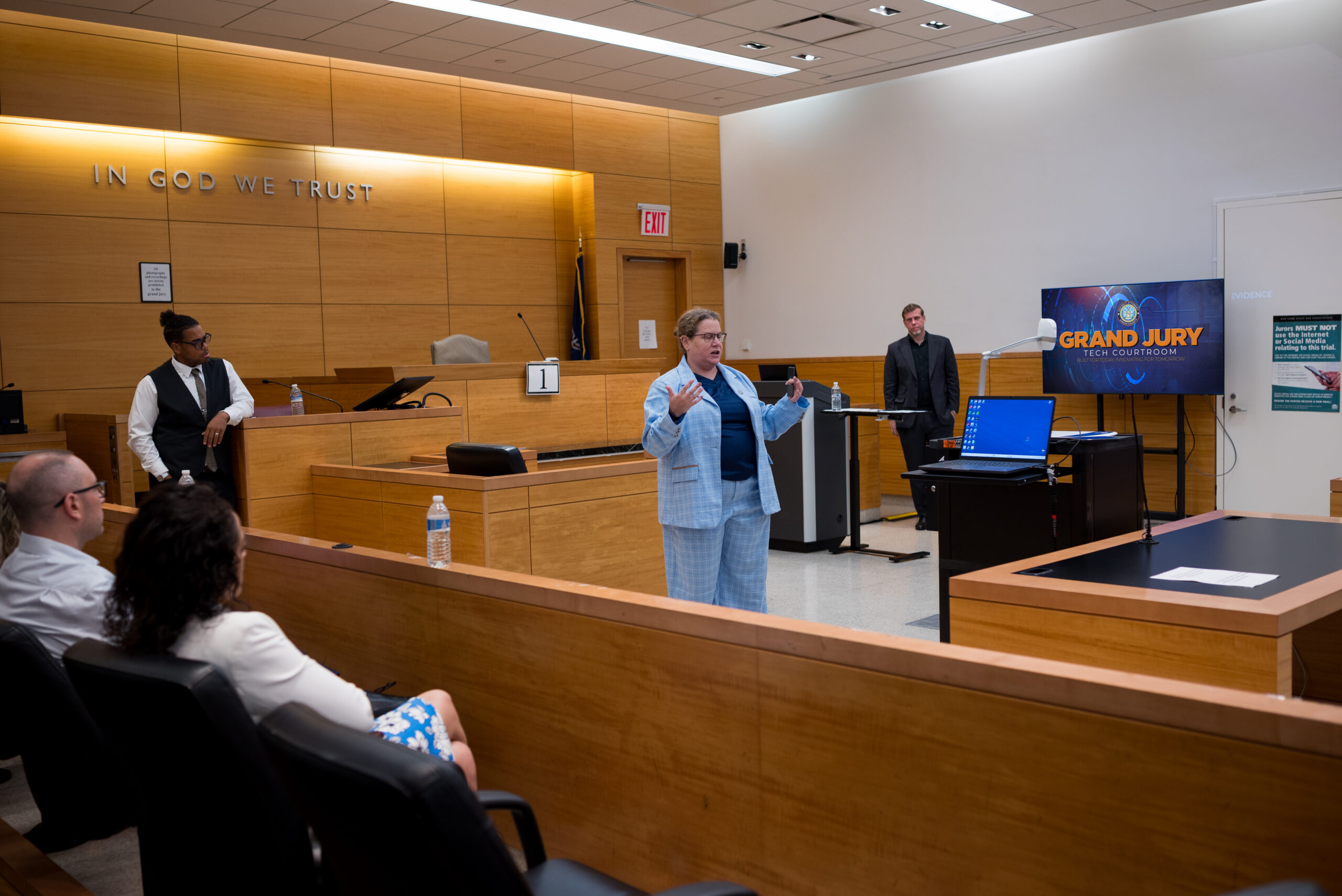 Bureau of Litigation Technology Chief Sara Kurtzburg speaks. Photo: Brooklyn District Attorney’s Office
“This project is part of our ongoing investment in tech upgrades and their integration across the agency,” Gonzalez said.
Adapting to the era of digital evidence
Sara Kurtzburg, chief of the Bureau of Litigation and Technology at the Brooklyn District Attorney’s Office, said the most noteworthy change is that grand jurors can now see and hear the evidence better and the presentations are easier to support.
“So much of the evidence we present today is digital,” Kurtzburg said. “It is surveillance video, body-worn camera footage, photographs, maps, cellphone evidence and other multimedia. We wanted to ensure that when a prosecutor presents that evidence, every grand juror has a clear view of it.”
The new system uses high-definition monitors throughout the room, allowing the ADA to move seamlessly between different types of evidence.
Training benefits
Kurtzburg said the new tech also has a training benefit.
“We intentionally designed these systems to work similarly to the technology our prosecutors use in our courtrooms,” she said. “Our younger ADAs spend a lot of time in the grand jury before they begin trying felony cases. Now, they are learning how to present digital evidence and becoming comfortable with presentation technology much earlier in their careers.”
 Brooklyn District Attorney Eric Gonzalez. Photo: Brooklyn District Attorney’s Office
The new systems will also accommodate those with visual and hearing impairments, working with assisted-listening devices already installed in the grand jury rooms, including the ability to connect compatible headsets and hearing devices.
“Our office also regularly creates closed-captioned versions of audio and video evidence,” Kurtzburg said. “If a grand juror needs a better or closer view of something, we can reposition a screen rather than asking that person to struggle to see the evidence.”
According to Kurtzburg, good courtroom technology should almost disappear into the background.
“Nobody should be thinking about which button the prosecutor needs to press, or how we are going to get a video onto a screen,” she said. “They should be paying attention to the evidence.”
When asked about other upgrades on the horizon, Kurtzburg said, “Technology changes too quickly to ever say that a room is finished. The end game is for our technology and training to keep pace with the evidence our prosecutors are actually handling.”