
City Council members had hoped to use a public hearing on Tuesday to grill Mayor Zohran Mamdani’s administration about how it had handled the rollout of a new tax on second homes.
But the lawmakers had no officials to question: The Mamdani administration had declined to attend. City officials, citing a pending lawsuit, had submitted written testimony instead. So the lawmakers posed questions to real estate brokers, homeowners, labor leaders, housing experts and other members of the public who had been invited to testify, while making jab after jab at the administration.
“They should show up and answer questions about the rollout,” Eric Dinowitz, a Bronx Democrat, said.
The hearing, before the Committee on Finance and the Committee on Governmental Operations, State and Federal Legislation, is the latest twist in the turmoil over the rollout of the tax on high-end second homes, or pieds-à-terre. The tax was introduced by Gov. Kathy Hochul as part of the state budget and backed by Mr. Mamdani; the Council has no official role in its implementation, but has positioned itself as a check on the mayor.
The Council speaker, Julie Menin, did not attend. In a statement, she said it was “disappointing that instead of providing clarity and addressing the public’s concerns, the administration chose not to appear.”
Matthew Rauschenbach, a spokesman for the mayor, said in a statement that the administration had made a “good faith effort” to find an “appropriate time” for the hearing, but that the Council had declined to reschedule.
“The administration did not believe that it would be prudent and in the legal interest of the city to appear in person,” he said, noting that two of the plaintiffs in the lawsuit against the city were related to Councilman Frank Morano, a Staten Island Republican.
The tax, collected as a surcharge on annual property tax bills, would apply in the first years to condos and co-ops that are used as second homes and have a “market value” — a complicated metric determined by the city’s Finance Department — of at least $1 million. It would also apply to one-, two- and three-family second homes with a “market value” of more than $5 million.
In July, the city began mailing letters to 17,000 property owners, informing them that they might have to pay the tax unless they could demonstrate that they were full-time city residents. Soon after, the city published a large data set online of nearly one million records that included owners’ names and was described as including “properties that may be subject to the charge.”
Both moves caused backlash among some homeowners and critics of the mayor, who argued that the data set was intended to shame people. (Mr. Mamdani has noted that the city has published similar tax rolls “twice a year for years, frankly, if not decades and centuries.”) Some longtime residents received letters, raising questions about how the city had arrived at the subset of 17,000.
Earlier this month, a group of homeowners sued the city — not to challenge the legality of the tax itself, but to argue that state law had required officials to do more to determine who owed it before sending the letters and publishing the data set. At the hearing, Council members and speakers reiterated that argument.
At the end of the three-hour hearing, the committee chairs, Gale Brewer and Linda Lee, both Democrats, read the questions they would have asked administration officials.
They included: How did the city interpret the state law that created the tax? Does the Department of Finance believe it is adhering to the law? How can homeowners appeal exemption denials or verify that a notice did not get lost in the mail? Will notices be handled electronically in the future? Does the city think it is giving homeowners enough time to apply for an exemption from the tax?
Supporters of the tax, including some lawmakers, held their own rally before the hearing.Credit…Nate Schweber for The New York Times
The written testimony sent by the administration — a five-page document written by the finance commissioner, Richard Lee — largely did not detail how the city had made its decisions.
Mr. Lee said that “pending and active” litigation prevented him from testifying in person. He noted that the administration had unsuccessfully asked the City Council to postpone the hearing.
“Whenever government implements a new law affecting thousands of property owners, questions inevitably arise,” Mr. Lee wrote, acknowledging the criticism from members of the public. “Government should communicate clearly and effectively about new policies.”
Mr. Lee said he would testify in person after Aug. 31. The reasoning behind that date was not immediately clear, though it is the same day the parties are due back in court before a Staten Island judge. Last week, the judge sided with the homeowners and issued a temporary restraining order halting the rollout, but that order was stayed when the city filed an appeal, which is pending.
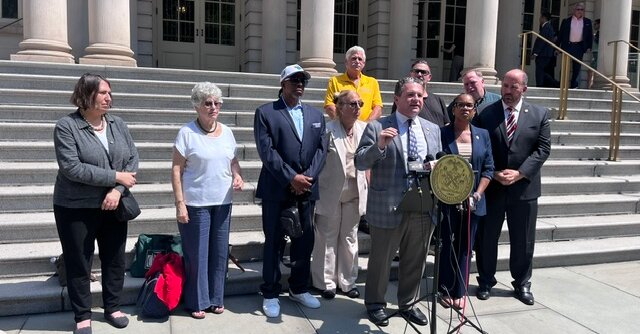
Supporters and critics of the tax both held rallies in front of City Hall before the hearing.
Kamillah Hanks, a Democrat who represents the North Shore of Staten Island, was among the dozen or so people gathered on the building’s steps who took issue with the rollout. She said working-class constituents of hers felt they had to prove they were full-time city residents.
“It makes people ashamed of actually owning property,” she said.
Proponents of the tax, however, drowned out many of those critiquing the rollout with chants of “Tax the rich!”
Diana Moreno, a Queens assemblywoman and an ally of the mayor, said she had attended “to show and build support in our city to increase taxes on the wealthy.”
“Every time we try to take some of the wealth that we create, they try to take it back,” she said.