
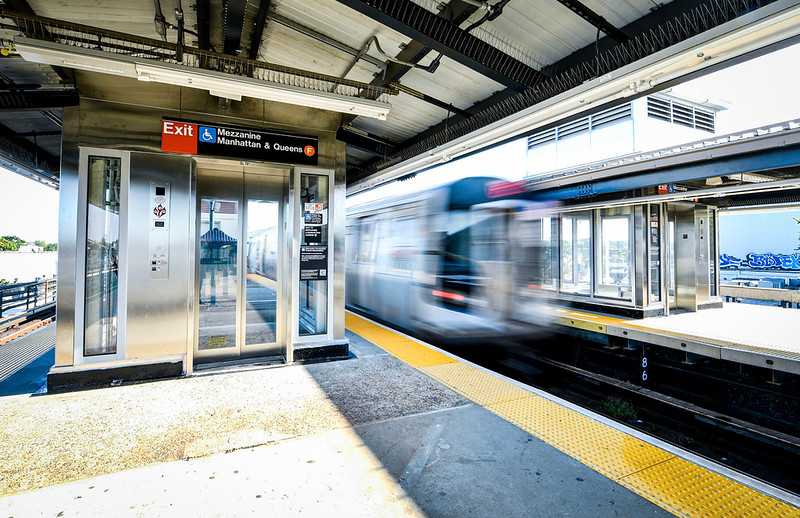
F train riders with mobility disabilities finally have a station where they can access the subway system along the sizable stretch between the Church Av and Coney Island-Stillwell Av stops.
The MTA on Wednesday celebrated the addition of three new elevators to the Kings Highway F station — making the elevated stop the latest that was brought into compliance with the 1990 Americans with Disabilities Act. The station sits in the Gravesend section of Brooklyn, where riders can connect to the B82 bus as well as its Select Bus Service counterpart.
One of the new elevators connects the mezzanine to the street level, while each one of the other two link it to the Coney Island and Manhattan-bound platforms respectively.
“Kings Highway now has three brand-new elevators up and running,” MTA Chair and CEO Janno Lieber said during a Wednesday morning news conference inside the station. “It is great news for the thousands and thousands of riders who pass through here every day on the F train, which is the heart of this part of Brooklyn.”
Lieber said that due to the station being 107 years old, it was “pretty difficult” to carry out the $72 million construction project.
“In stations this old, you don’t have enough room for dropping all of the elevators in,” he said. “The structure, when we uncover it, usually is eroded and in challenging shape. So it means that there is a lot of work in addition to dropping in the elevators that’s done.”
The additional work included expanding and reconfiguring the mezzanine, redoing the roof, reconstructing the platforms’ accessible boarding areas, and installing new lighting and fire alarm systems, according to the MTA.
During the event, Quemuel Arroyo, the MTA’s chief accessability officer, said making more of the subways accessible is beneficial to all riders, not just those with disabilities. He said seniors, parents pushing strollers, or anyone with an injury could end up relying on them.
“Every New Yorker should have access to a reliable, a safe, and an accessible transport system,” Arroyo said. “Because it’s not only people with disabilities, it’s everyday New Yorkers who sometimes are too tired or don’t want to go up stairs or may have sprained their ankle. The disability community is the only minority demographic that anybody can join at any moment.”
The stop is the fifth that the MTA has completed work on in its latest $692 million package of eight station accessibility projects, according to the agency. Two other stations in the package, the Steinway St R and M station in Queens and the Junius St 3 station in Brooklyn, are already under construction.
Lieber touted the suite of projects as being the first where the agency has utilized a public-private partnership in which private firms pay for the construction work upfront and the MTA reinburses them once it is completed and found to meet agency standards.
“This is an approach that saves us and the taxpayers a ton of money in the long-run,” Lieber said.
After years of lagging far behind on installing elevators in stations, the MTA has very much picked up the pace. The shift came in earnest after the agency settled a lawsuit by a group of disability advocates over its lack of compliance with the ADA in 2023.
Over the past six years, the agency has made 46 stations ADA accessible, it says. Another 35 stations are currently under construction and another 60 are set to get elevators under the MTA’s current $68 billion 2025 to 2029 Capital Plan.
“We have the same number of ADA projects complete or in construction in the last few years and right now equivilent to what was done in the 30 years before that,” Lieber said. “That is real progress and proof of our committment.”