
ROCHESTER, N.Y. — Child Advocacy Centers traditionally receive financial support through a combination of outlets, from fundraising to federal grants and, most importantly, state allocations. Advocates and local elected leaders say this year they are seeing all of its funding disappear.
What was long a safe space for thousands of children to turn to, now, may no longer be an option.
“Child Advocacy Center of the Finger Lakes serves hundreds of children, more than 300 victims across Ontario, Seneca and Yates County,” Child Advocacy Center of the Finger Lakes executive director Ashley Davoli said.
“These are the most horrific cases that our court system sees, people who sexually and physically abuse our most vulnerable population, our children, and having the ability to fund this crucial task and role is something that we can just not afford to lose,” Ontario County District Attorney Jason MacBride said. “These cases are either made or broken at the inception of investigations and Child Advocacy Centers play a fundamental and critical role in that process. Without cases, we do not have the ability to collaborate with experts across the field. And this involves just [the] well-being of children. Cases, for folks that don’t know, provide critical medical care for children regardless of what happens to them in court. Their physical and emotional and physical well-being are on the line. There’s really no words that can describe what that need is. You know, decisions that are made at that very juncture of who to investigate, who to interview, what crucial physical evidence is needed to be obtained within minutes and hours of a child’s disclosure, has a profound outcome on bringing justice to children.”
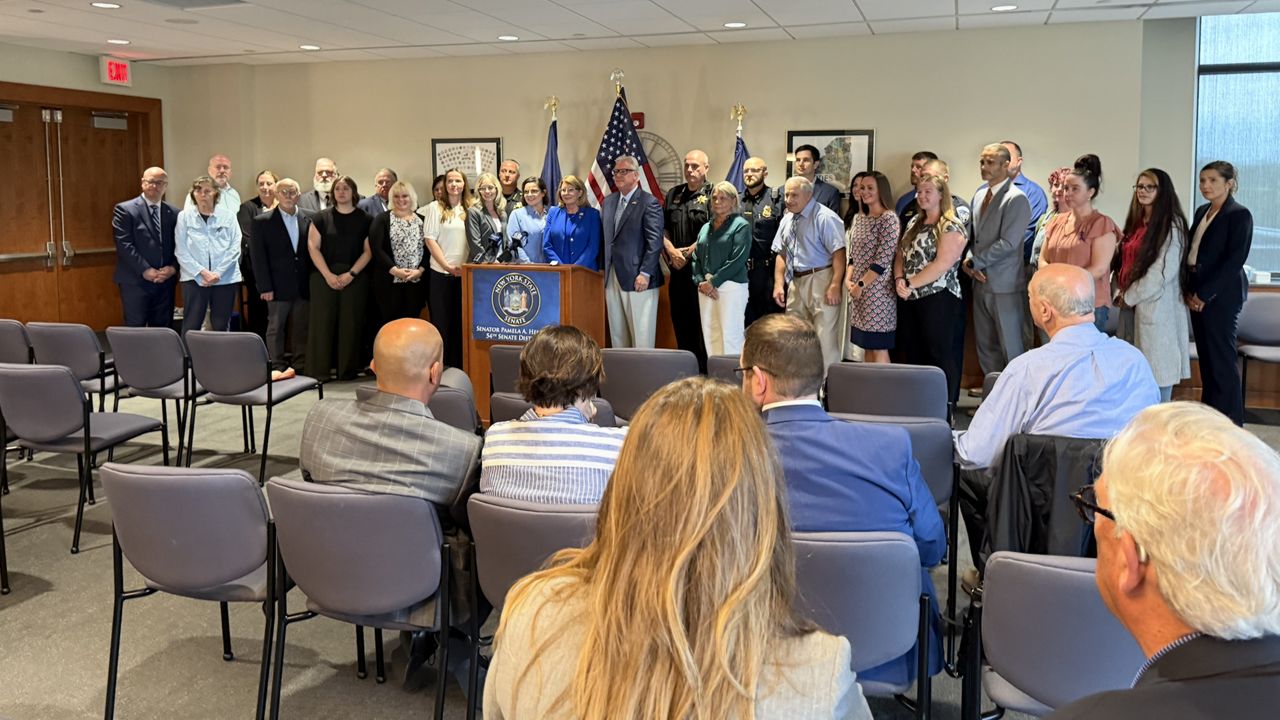
“All these groups and organizations behind me,” state Sen. Pam Helming said. “They do everything they can to protect and serve our children and their families. And I think it’s also very important to note their role in investigating what happened and holding offenders accountable, and something else that everyone should know. These centers are not optional in New York State. They’re established in New York state law as part of our response to child abuse. These centers are not optional in New York state. They’re established in New York state law as part of our response to child abuse.”
“Without these services that the Child Advocacy Centers perform,” state Sen. Tom O’Mara said. “Perpetrators will walk free. The budget has grown by over $100 billion in just the last nine years. It’s not a matter of a lack of money. It’s a matter of lack of priorities. And I can tell you that these cases involving children of sexual abuse [and] violent physical abuse are the most tragic cases that we deal with. And I can tell you that when I was a prosecutor, I was woefully underprepared and lacked the real skills and abilities to deal with the child victim and advocate for them, get them in a position where they can be supported, where they’re getting the care they need, and they’re getting the encouragement to pursue prosecution. I can’t say it any more clearly or bluntly than that. There is a glaring concern of the actions in Albany, from the leadership of our state, of the lack of concern of victims of crime in the state, and the coddling of criminals in this state. It needs to change, and it needs to change from the top.”
Historically, Child Advocacy Centers across the state have received funding through the state administered victim of crime act victim assistance grant program. But this year, under the state’s 2026 awards, they claim they received nothing.
“On Sept. 30, the Office of Victim Service Funding will end,” Davoli said. “Funding that we have relied on for decades. On Oct. 1, children will still need protection. Unfortunately, child abuse is not going to end on Sept. 30.”
Advocates say the cuts they are seeing are more than $6.9 million — which is a 31% cut from previous funding.
“If this funding is not restored, where will these children go?” Davoli said. “How many of these children are going to fall through the gaps that this is going to leave behind?”
“We wish we didn’t have children who are being abused,” Helming said. “But that’s not reality. And I think we’re very clear in our messaging that we’re calling on the governor to do two things. One, restore the funding, especially to those sick cases that have been completely defunded [and] that short term and long-term fix the broken funding system once and for all. They need long-term consistency with their funding.”
Leaving a ripple effect across multiple agencies, including law enforcement.
“If our investigators have to travel to another jurisdiction or county to their Child Advocacy Center to conduct the interview there, they will,” Ontario County Sheriff David Cirencione said. “Right now, that place is a Child Advocacy Center. If we no longer have that, then we’ll have to find a way to make one. I started my career 29 years ago, not as a police officer, but as a child protective caseworker in Seneca County. I spent five years doing that work. And from 1997 to 2002, when I was in child protective, there was no trauma-informed approach. There were no Child Advocacy Centers. There were no advocates. We would receive a report of child physical or sexual abuse, and the caseworkers would call a police officer, depending on the jurisdiction, and we would show up at their child’s school unannounced, or if it was after hours, at their house, and drag these people into a police station with no notice. Back then, sometimes you got a police officer that was a road patrol police officer that had no special training in doing investigations of child abuse, let alone interviewing a child, of sexual abuse or horrible physical abuse. You fast-forward to today, where we’ve been working under this trauma-informed approach for years, and we have the Child Advocacy Centers, trained forensic interviewers, the medical teams; everybody is there together to start this case. The difference it makes is remarkable, not just in the number of cases that come to arrest and lead to a better prosecution.”
Ontario County Sheriff’s Department reported that since January of 2020, they have collaborated with several agencies to investigate 286 cases. And, in the past two years, these investigations have resulted in 20 arrests, many of them being charges of rape, sexual abuse and violent felony assaults against children.
According to the Office of Victim Services, its spokesperson shared:
“OVS received an unprecedented response to its 2026 request for applications (RFA) to fund victim assistance programs statewide: 316 applicants sought $626.1 million over two years, which exceeded the funding available by $373.1 million. Never in its history has OVS received that many applicants seeking that level of funding. Every RFA begins a new funding cycle. OVS cannot provide preferential treatment to currently funded programs or consider current funding when making award decisions. The incredible demand, the state’s competitive procurement process, and federal rules and funding uncertainty, required us to make difficult decisions. The $126.5 million to be awarded annually represents the single largest investment in victim services in the state’s history, allowing us to fund more programs and reach more New Yorkers in need.”
OVS has also reported that they are providing $124.4 million in funding to support victim assistance programs. The state Office of Children and Family Services also provides $156.5 million to residential and nonresidential domestic violence services, and Child Advocacy Centers across the state.
“It was, kind of shocking to me that the response made it very clear that the decisions were intentional,” Helming said. “Our budget now is closing in on $280 billion. That’s roughly more than $23 billion more than what we spent last year. And I just don’t get it. How do you cut these critical services for the most vulnerable children?”
Displacing its victims and its centers, as they already brace it’s the losses now.
“We had to cut staff; we had to minimize,” Davoli said. “We would have to rely on another Child Advocacy Center to support that child, [and] that creates a lot of burdens on families. It makes it difficult for teams. It cost counties more money to be able to have to do that. You have to travel long distances. Some rural areas, it could be hours that a family would have to travel. And our transportation systems are not set up in a way to make it very accessible for families to just hop on a bus to get to another county. It might mean that a family has to make a very hard decision on not having that child go.”
“Our investment should honor the extraordinary courage it takes for a child to tell someone that they have been hurt,” New York State Children’s Alliance Executive Director Theresa Roth said. “These cuts mean fewer staff and fewer services. That could mean fewer advocates walking alongside families to court and to counseling, and to other necessary responses to this trauma that they’ve experienced. The cuts mean fewer trained professionals available to interview children, and less access to the mental health and medical care that helps children to heal. This is especially devastating because New York has only recently reached an important milestone. For the first time in our movement, children in all 62 counties have access to a Child Advocacy Center. It took years of work, investment and commitment to get here. We cannot allow the instability of funding to undo that progress. And the impacts extend far beyond cases.”
The same demands for financial assistance are being called out by advocates from not only Child Advocacy Centers, but also domestic violence centers and rape crisis programs whose primary source of funding also stems from the federal victims’ crime act as well.