
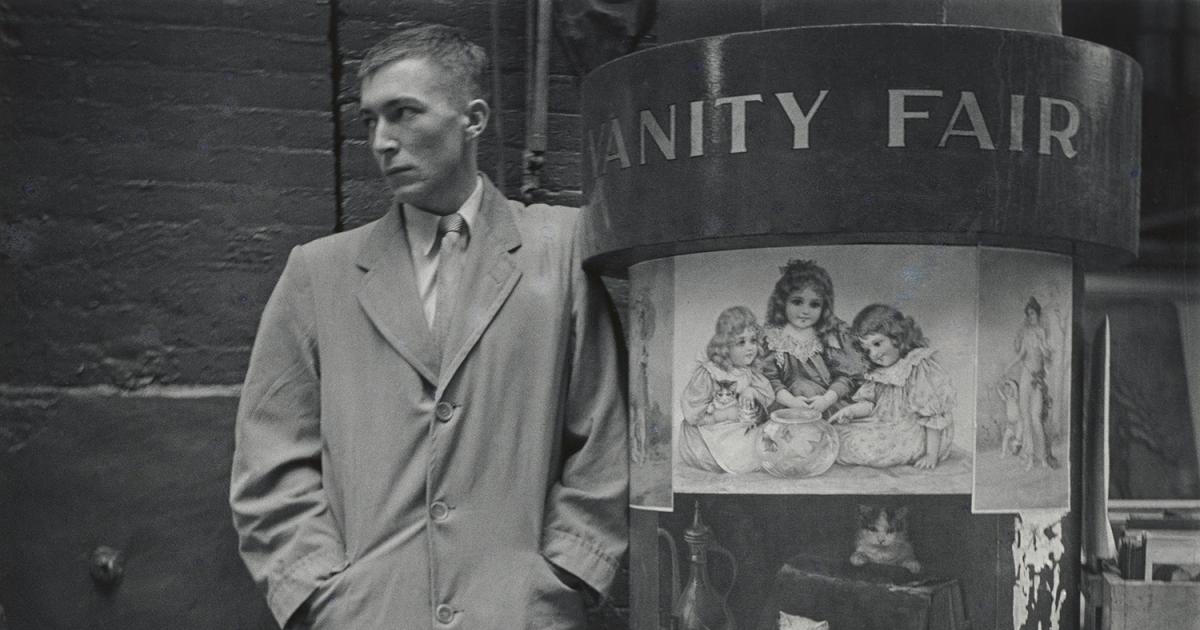
In the first section of the show, we see some notable people featured in a few of Rauschenberg’s photos. Can you tell us a bit about one of them and who they were in terms of their connection to Rauschenberg?
Sean Corcoran: One of the most significant figures we see is artist Jasper Johns. Rauschenberg met Johns in late 1953, and they soon began an intellectual and romantic relationship that lasted until 1961. The portrait of Johns included here was taken in 1958, shortly after the two relocated to 128 Front Street in the South Street Seaport district, where they maintained studios on adjacent floors.
This was an extraordinarily productive period for both artists. Rauschenberg was creating and exhibiting his Combines while also collaborating with the Merce Cunningham and Paul Taylor Dance Companies. At the same time, Johns had just held his first solo exhibition at the Leo Castelli Gallery. In the background of Rauschenberg’s photograph, we can see two of the works from that show: Target with Four Faces (1955) and Target (1958).
Rauschenberg eventually stopped taking his own photographs for a time. What led to that, and how did it affect his work?
Sean Corcoran: In the 1960s, Rauschenberg lost his camera, and for many years afterward he largely stopped making his own photographs. We’ve included in this exhibition a silkscreen painting—Untitled (1963)—that demonstrates how, even then, photography remained central to his practice. The work combines imagery from his own photographs of the Merce Cunningham dancers with images he gathered from other sources, showing how he continued to explore photographic imagery through other mediums.