
This column originally appeared in the Looped In NYC newsletter. Sign up here.
Has there ever been a better time to be in New York City if you want a style of pizza that’s not from here?
Detroit style. New Haven style. Chicago style (deep dish). The other Chicago style (tavern thin). Maryland. Rome. Tokyo. Naples. St. Louis. A pizzeria that’s billed as “reminiscent of your childhood Pizza Hut experience.”
They’re all represented, despite the city’s glut of famously delicious New York-style pizza.
How did we get here? How did New York City, the Michael Jordan of self-mythologizing about its own pizza, come to welcome so many other styles?
Scott Wiener, the founder of Scott’s Pizza Tours, said the trend really started in the early 1990s, back when “everything was cheesy, greasy, Ninja Turtles pizza.” Then Patsy’s, Lombardi’s and Totonno’s started using coal-fired ovens, fresh mozzarella and simple tomato to make pizza the way it was originally envisioned. In Italy.
“Not the translation of Neapolitan that happened when Neapolitans landed here in the late 1800s, but like the reintroduction of pure Neapolitan,” Wiener said.
Wiener said New York City’s transplant population began to explode in the early 2000s, leading to the current situation, where we have a city full of newcomers who aren’t wedded to a particular style of pizza and eager to try things they see on social media.
“ Nobody ever calls something the style of a city unless they’re trying to aggressively market it,” Wiener said. “ Nobody in Detroit called it [Detroit-style] until there was money to be made.”
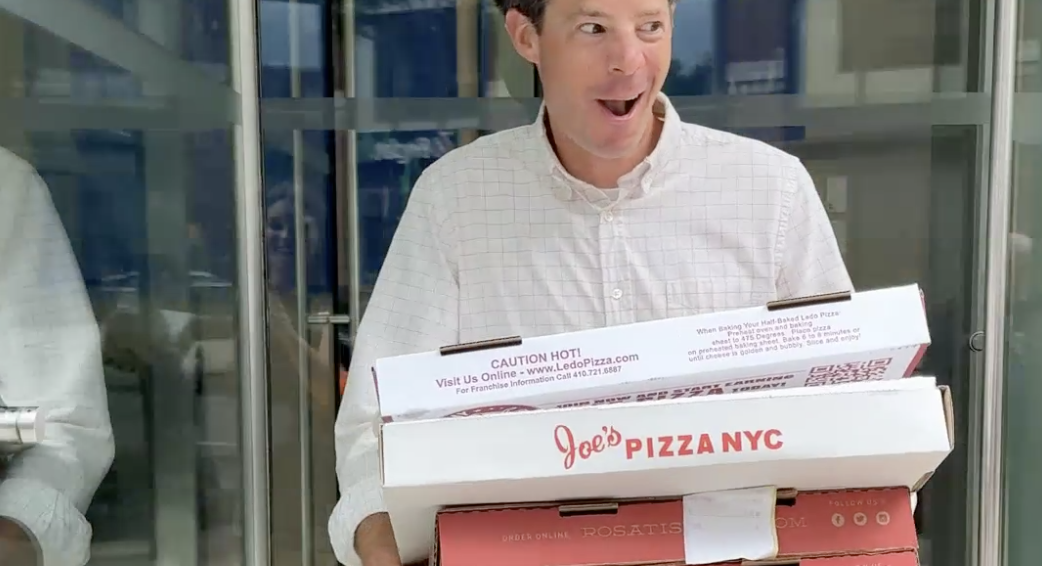
Are these other pies any good? This week, we ordered a few to find out.:
Detroit-style: From Emily, we got a thick, rectangular “VIP” (vodka sauce, red sauce, garlic parsley pesto, pepperoni cups and Calabrian chiles).Chicago-style: From Rosati’s Chelsea location, we picked up a classic deep dish and a thin, tavern-style pie with sliced Italian beef and giardiniera.Maryland-style: We ordered a “thick cut pepperoni” pie from Ledo, a Maryland-based franchise with two locations in the city.New York-style: And for a control group, we got a plain pie from Joe’s on Carmine Street.
A note before we get into the reviews: This was not a scientific study. We didn’t hit all the “best” spots; we got pizzas from places near our office that happened to be open at noon on a Monday, and by the time we dug in, they were not piping hot. All that said:
Reporter Walter Wuthmann, my colleague who recently reported on the rise of the fancy slice, likened Ledo’s Maryland pizza — a sweet, softer pizza — to “what you eat at Chuck E’ Cheese.” (The extremely thick pepperonis, in my opinion, were fun.)
The Chicago deep dish, Wuthmann added, was “like the little pizza you get in the Lunchables.”
Transit editor Clayton Guse, an Illinois native, said the deep dish pie was fine, but not really suitable for lunch.
“I gotta work,” he said. “You eat it at night. You go to sleep after, and you wake up very full, still.”
Guse added that the Chicago tavern-style thin pizza, a crispier pie covered in pickled peppers that I quite enjoyed, would actually be better the day after.
“It just coagulates,” he explained. “It gets almost chewier.”
Reporter Willow Higgins gave the whole spread a thumbs up.
“I don’t discriminate, I’ll eat whatever,” she said. “I’m just a hungry gal.”
That said, her pick was the classic New York slice from Joe’s.
But the overall winner of our taste test was undeniably the Detroit-style pizza from Emily. This pie had it all: rich flavors, perfect density of the dough, a buttery edge, those little cupped pepperonis that are all the rage for a reason. (It was also, notably, the smallest and most expensive pizza we got, at $32 including tip.)
In a fun twist, Wiener told me that Matthew Hyland, the co-founder of Emily, never used the term “Detroit-style,” for fair reasons.
“ I remember them calling it Detroit-inspired pizza,” Wiener said. “Matt had never been to Detroit at that point. He was just inspired by the idea of that caramelized cheese.”
It was only later, when a venture capital firm took over, that that marketing language changed.
Well. Whatever they call it, we’re buying.