
Manhattan Gold Corporation Ltd. Aug. 20 reported high-grade gold intercepts in the first batch of assays from its inaugural drill program at the Hook Lake project in Nunavut’s Kivalliq region.
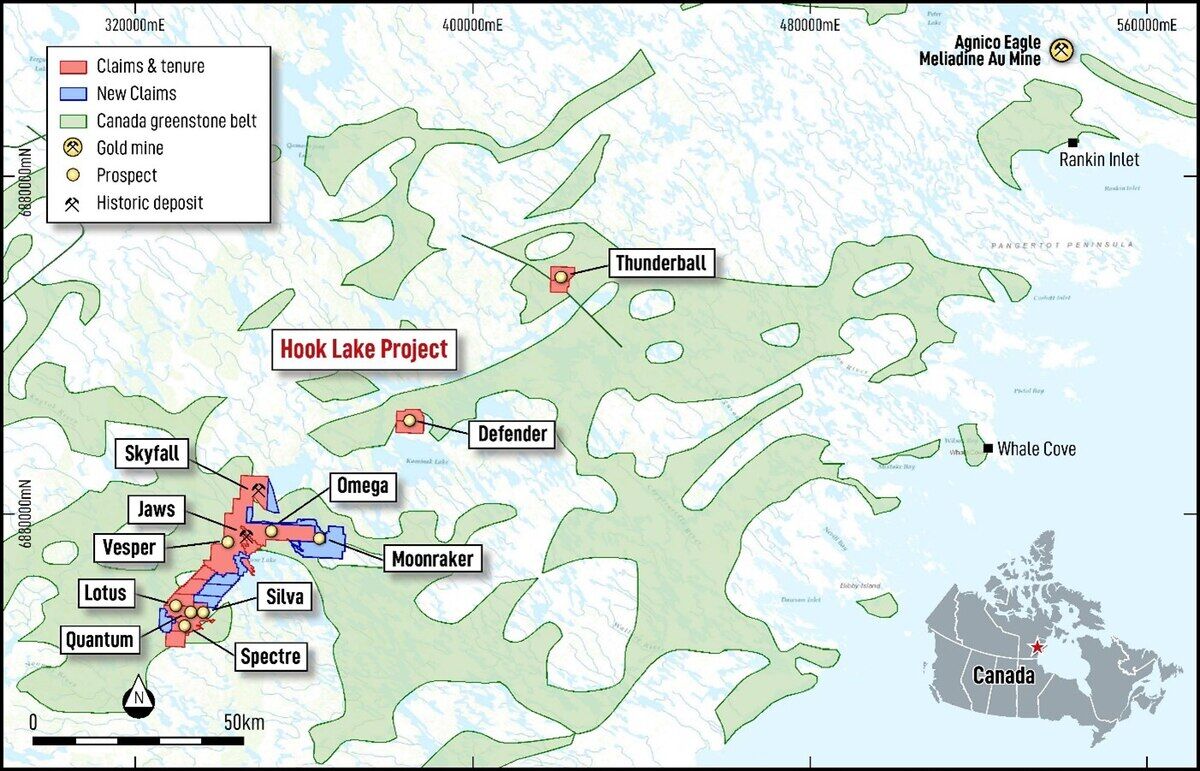
Manhattan Gold Corporation Ltd.
Lying about 225 kilometers (140 miles) southwest of Agnico Eagle Mines Ltd.’s 6.7-million-ounce Meliadine gold mine, the 665-square-kilometer (257 square miles) Hook Lake project hosts high-grade orogenic gold systems and volcanogenic massive sulfide (VMS) copper-zinc-gold-silver mineralization within the Rankin-Ennadai greenstone belt in southeastern Nunavut.
Australia-based Manhattan Gold acquired and carried out first-pass exploration at Hook Lake in 2025. Last year’s surface sampling and mapping program focused largely on Jaws, the most advanced of 11 deposits and prospects historically identified at Hook Lake.
Based on exploration carried out in the 1970s and 80s, Jaws hosts 285,000 ounces of gold in an estimated 3.4 million metric tons of historical resource averaging 2.38 grams per metric ton gold.
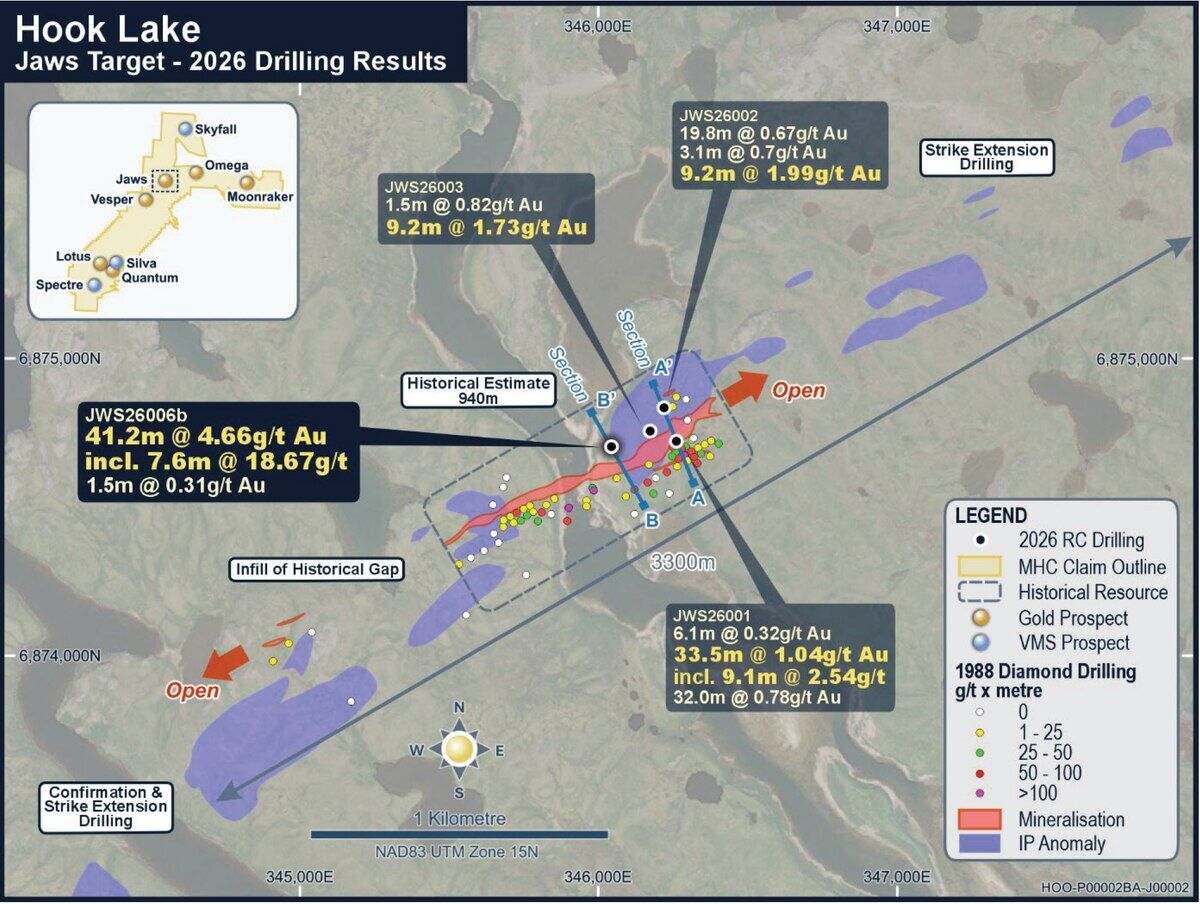
A planned 4,000-meter drill program launched by Manhattan in June began with testing in and around the historical Jaws deposit. Highlights from the first batch of assays from that drilling include:
• 79.25 meters averaging 0.78 g/t gold from a depth of 38.1 meters in hole JWS26001, including 33.53 meters of 1.04 g/t gold.
• 9.15 meters averaging 1.73 g/t gold from a depth of 153.9 meters in hole JWS26002.
• 9.15 meters averaging 1.73 g/t gold from a depth of 35.1 meters in hole JWS26003, including 1.52 meters of 4.13 g/t gold.
• 41.15 meters averaging 4.66 g/t gold from a depth of 83.8 meters in hole JWS26006b, including 7.62 meters of 18.67 g/t gold.
Manhattan Gold Corporation Ltd.
Manhattan Gold says the thick zone of strong gold mineralization in hole JWS26006b, which included sub-intercepts with grades as high as 41 g/t gold over 1.52 meters, indicates the main shear zone at Jaws is broader and higher-grade than was suggested by historical drilling.
“The result is materially wider and higher-grade than the nearest historic intercept and confirms that Jaws hosts very high-grade shoots within a broad mineralized envelope,” said Manhattan Gold Technical Advisor Eric Sondergaard.
The company says the drilling completed so far has also significantly improved its geological model for Jaws, indicating the main shear zone lies slightly northwest of historic plans, providing a stronger basis to target interpreted higher-grade cores and plunging shoots.
“Historic drilling was sparse and did not define the geometry or full extent of these high-grade zones,” Sondergaard added. “We now have a clear opportunity to build scale by tracing this mineralization along strike and at depth, while targeting additional high-grade shoots across the system.”
So far, Manhattan Gold has completed more than 3,000 meters of RC drilling at Hook Lake, and assays are pending from 13 of the holes.
In addition to Jaws, the company has completed two holes at Spectre, a volcanogenic massive sulfide (VMS) target about 25 kilometers (16 miles) southwest of Jaws.
Highlights from a six-hole program completed at Spectre in 1974 include:
• 10.51 meters averaging 2.91% copper, 6.7% zinc, 95.7 g/t silver, and 1.04 g/t gold from a depth of 41.8 meters in hole GMX-01.
• 13.71 meters averaging 1.51% copper, 2.06% zinc, 47.2 g/t silver, and 0.56 g/t gold from a depth of 70.3 meters in hole GMX-02.
In addition to drilling, Manhattan plans to carry out an expansive till sampling program to assess gold and polymetallic mineralization beneath shallow glacial cover across the more than 20-kilometer (12.5 miles) Vesper-Jaws-Omega trend, as well as the Moonraker prospect area to the east.
“The Hook Lake Project will see more exploration work this year than at any time in the past 30 years, a level of attention we believe is warranted given its potential to become Nunavut’s next major gold district,” Sondergaard said when the company’s inaugural drill program launched in June.
Author Bio
Shane Lasley, Publisher
Over his more than 18 years of covering mining and mineral exploration, Shane has become renowned for his ability to report on the sector in a way that is technically sound enough to inform industry insiders while being easy to understand by a wider audience.