
The Brooklyn Bridge was in the news recently due to small fires that broke out on temporary platforms on July 4 (and some briefly thought were part of the fireworks show!). I also recently read an article in the “Monsey Mevaser” that explained the fascinating story of the building of this bridge. I would like to share the story of the building of the bridge with the Jewish Link readers. The article I will be quoting from is by Shlomo Aviyaz and appeared on May 28.
In the 1860s, New York City and Brooklyn were still separate cities. New York City was the commercial capital of the country. Brooklyn was the nation’s third largest city, known for its quieter residential character and its waterfront industries.
The only way to travel between Brooklyn and New York City was by ferry across the East River. But the ferry was entirely at the mercy of the weather. During the winter of 1866-67, the East River froze solid and the economic lifeline between the two cities was severed. Aviyaz writes “The dream of a bridge, long dismissed as an engineering impossibility due to the river’s turbulent waters and heavy maritime traffic, suddenly became an urgent civic necessity.”
Along came John Roebling. He “was a pioneer in the use of wire rope and had successfully designed suspension bridges in Pittsburgh, Niagara Falls and Cincinnati. However, the East River project demanded a scale previously unimagined. Roebling proposed a bridge with a central span of 1,595 feet, one and a half times as long as any bridge ever built. To avoid disrupting the tall-masted sailing ships that crowded the river, the bridge’s deck had to be suspended 130 feet above the water … To support this immense weight and span, Roebling designed two massive stone towers that would stand 278 feet tall, anchored firmly to the riverbed.”
Roebling secured the necessary charters and funding. But then tragedy struck. In June 1869, while at the location, he had an accident where his toes got crushed and had to be amputated. Roebling dismissed mainstream medicine and refused further treatment. Tetanus set in and he died after a few weeks. Aviyaz wrote that the greatest engineering project of the century was now “without its leader before a single stone had been laid.”
Fortunately, his son Washington was also an engineer and took over the project. Aviyaz then goes into further detail about the dangerous work that was necessary under the water for the project. But I am going to spare you the details. He continues: “The physical dangers of fire and flooding were overshadowed by a much more insidious, invisible killer … When workers finished their shifts and returned to the surface, they underwent decompression … The medical science of the 1870s did not fully understand the physiological effects of moving too rapidly from high-pressure to normal-pressure environments. Nitrogen gas, which had dissolved into the workers’ bloodstreams under the extreme pressure, formed tiny excruciating bubbles in their joints and blood vessels if they decompressed too quickly … The agonizing joint pain caused (the workers) to walk with a stopped posture … today, we know it as decompression sickness, or ‘the bends.’ The symptoms ranged from severe joint pain and vomiting to paralysis, convulsions and death.” Hundreds of workers became incapacitated.
Washington worked at the site himself. Aviyaz continues: “In the spring of 1872, the bends finally caught up with him. He was brought out (of the site|) near death, suffering from agonizing pain, partial paralysis and severe nervous exhaustion. His vision and hearing were permanently damaged. At the age of 35, the chief engineer was left an invalid, permanently confined to his bedroom in Brooklyn Heights, overlooking the construction site he could no longer visit.”
Fortunately, his wife Emily decided to get involved. Initially, she acted as his secretary, delivering his instructions to the site. But she soon realized that this was not enough. Aviyaz writes that, “To truly understand the project and defend her husband’s decisions … she had to understand the science herself … Emily immersed herself in the study of higher mathematics, catenary curves, strength of materials, bridge specifications and the intricacies of cable spinning. She became the sole liaison between the chief engineer and the thousands of workers, engineers and manufacturers bringing the bridge to life. For over a decade, Emily Roebling was the de facto chief engineer. She masterfully played the political game, hosting social events and reassuring the projects’ wealthy backers, all while maintaining the necessary fiction that her husband was firmly in control… By the time the bridge was nearing completion, her expertise was so widely recognized that many assumed she had designed the bridge herself.”
Aviyaz also discusses a scandal involving the construction. The wire contractor had been bribing bridge inspectors to approve batches of inferior wire. Washington figured out how to continue the construction and compensate for this problem. (It seems that the public was not alerted to this near-disaster.)
In 1883, after 14 years, the bridge was finally completed. Opening day was May 24. President Chester Arthur and New York governor Grover Cleveland marched across the bridge alongside a massive military parade. After that, Emily Roebling was given the honor of being the first person to ride across the completed bridge. She crossed in a horse-drawn carriage, carrying a live rooster in her lap as a symbol of victory and triumph. (I admit I do not understand the rooster symbolism! Someone needs to look into that.) There was a spectacular hour-long fireworks display that night. Washington Roebling, too ill to attend, watched the fireworks from his bedroom window through a telescope.
But just one week later, on Memorial Day, a tragedy occurred. The bridge was packed with tens of thousands when a woman fell. In the crowded environment, someone panicked and screamed that the bridge was collapsing. A stampede ensued. Twelve people were trampled to death and dozens more were severely injured. This event severely damaged public confidence in the bridge.
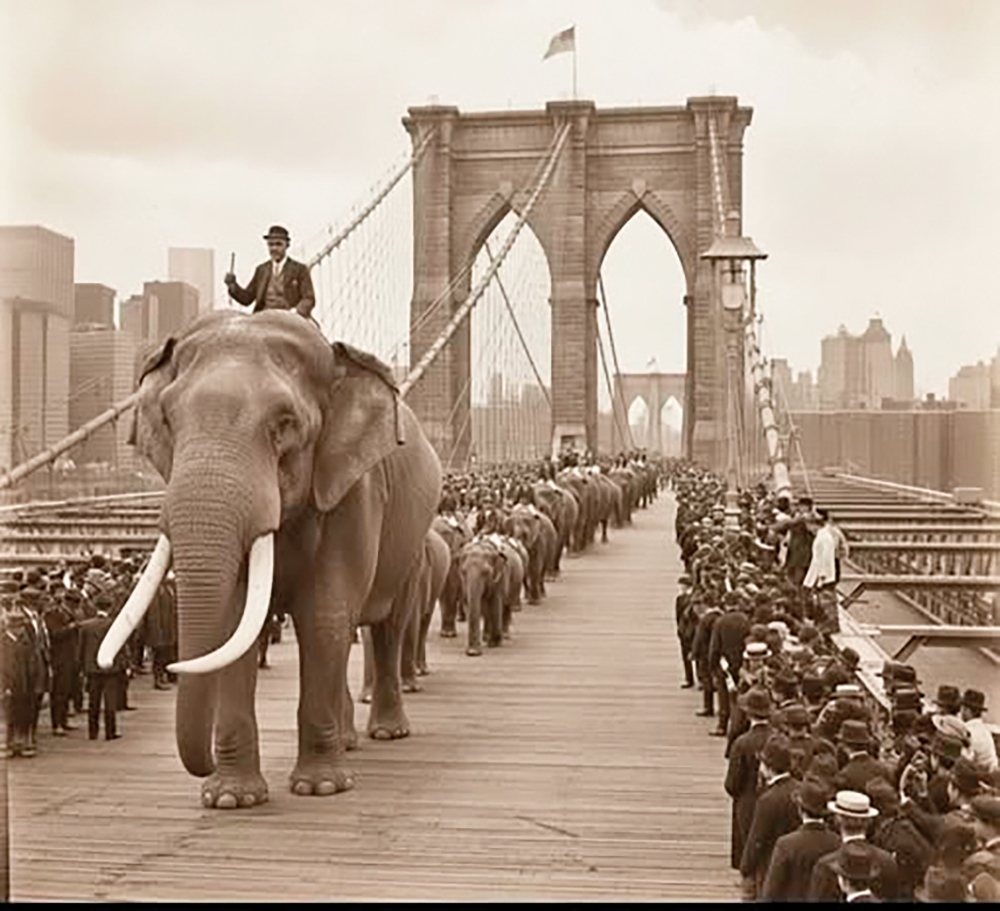
Aviyaz continues: “To restore faith in the bridge’s stability, authorities needed a grand undeniable demonstration of its strength. They found their answer in the legendary showman P.T. Barnum. Barnum had previously requested to march his circus animals across the bridge on opening day but had been denied. Now, a year later, the city eagerly accepted the offer. On the evening of May 17, 1884, Barnum marched 21 elephants, led by his famous seven-ton African elephant, Jumbo, along with a train of camels and dromedaries, from Manhattan to Brooklyn … (see the photo). The bridge did not sway or bounce. The spectacle successfully quelled the public’s fears forever, proving beyond a shadow of a doubt that Roebling’s masterpiece was built to last.”
———
Aviyaz summarizes what happened next: “The impact of the Brooklyn Bridge was immediate and profound. By providing a reliable, weather-proof link across the East River, it triggered a massive population boom in Brooklyn, transforming it from a quiet sister city into a sprawling urban powerhouse. The bridge’s success accelerated the movement to politically unify the surrounding municipalities. In 1898 … Brooklyn, Queens, Staten Island and the Bronx were officially consolidated with Manhattan …The true legacy of the Brooklyn Bridge extends far beyond its physical utility … From John’s fatal sacrifice to Washington’s crippling dedication, and ultimately to Emily’s brilliant, barrier-breaking leadership, the bridge was forged not just of stone and steel, but of unimaginable human resilience.”
———
Aviyaz also explains the bridge’s impact on the Jewish community. He explains that by the 1890s, the Lower East Side had become extremely overcrowded. Brooklyn was an agonizingly close but unreachable sanctuary. First came the opening of the bridge in 1883. But more important was 1898, “when electric trolley lines and elevated train tracks were routed directly over the Brooklyn Bridge’s promenade. Suddenly, the calculus of survival changed. For a single nickel fare, a garment worker could commute from a spacious apartment in Brooklyn directly to a factory in Manhattan … This migration completely transformed Brooklyn.” For example, “Brownsville, once a rural village of 250 people … (became a) neighborhood of over 100,000 Jews, bursting with Yiddish theaters, kosher markets and massive synagogues.“
———
In the spirit of my columns, here is an etymological note: The settlements in Brooklyn were initiated by Dutch settlers in the 17th century. The area was named after the town of “Breukelen” in the Netherlands. Most likely, the Netherland town’s name meant either “broken land” (from Dutch “breuk”) or “marsh land” (from Dutch “broek”).
Mitchell First can be reached at [email protected]. He certainly gave you a lot to think about now when you walk on Roebling Street!