
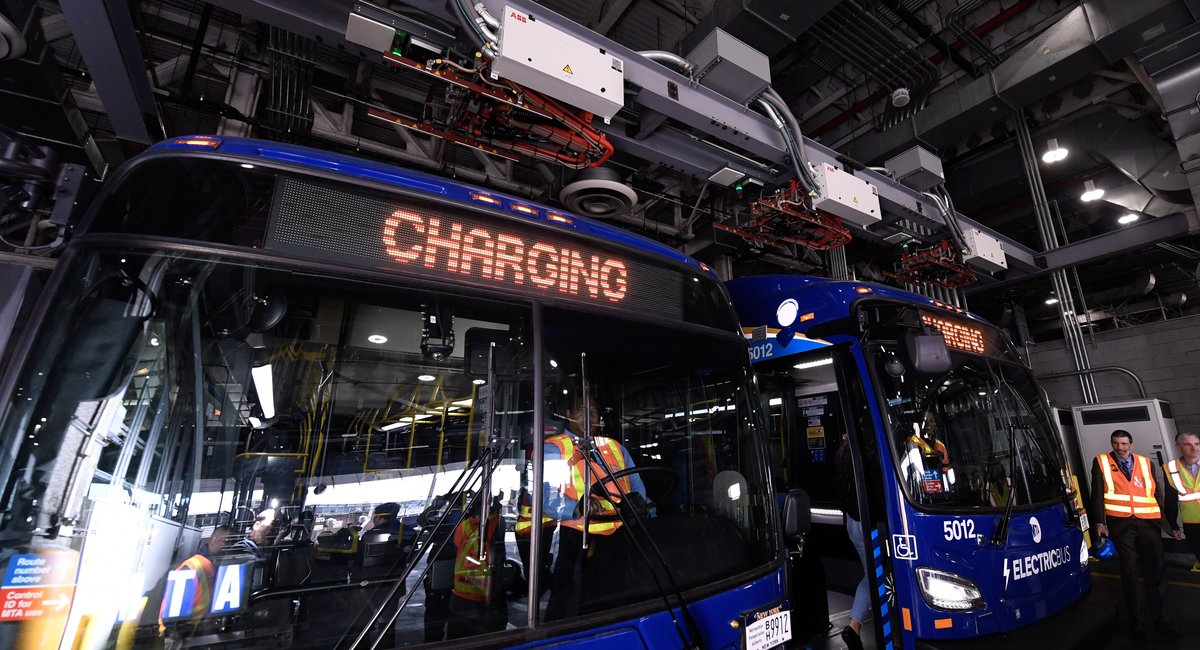
The MTA’s plan to convert its fleet of 5,700 buses to electric vehicles by 2040 has already fizzled, an audit published Wednesday by state Comptroller Thomas DiNapoli found.
The report highlighted a litany of obstacles the transit agency has faced in meeting its goal, including a shortage of manufacturers capable of building zero-emission buses and problems with electrical infrastructure at the MTA’s aging bus depots.
The report said the MTA has so far deployed fewer than 100 fully electric buses. It also found that the agency has received only one of the 500 buses it planned to purchase under its 2024 plan.
MTA officials earlier this year flagged many of the problems highlighted in the report but have not set a new timeline for converting all of the agency’s buses to fossil-fuel-free alternatives.
It’s the latest delay in the state’s effort to reduce greenhouse gas emissions. As part of the state budget passed in May, Albany lawmakers revised the state’s landmark 2019 climate law to allow more time for businesses and building owners to convert to clean energy. Lawmakers also pushed back the deadline for all the school buses in the state to be fully electric from 2027 to 2032.
In 2018, the MTA announced its plan to replace its diesel-burning buses with zero-emission models over the next 22 years. But the comptroller’s report shows the plan quickly faced issues, noting the buses were only deployed 60% of the time because they had to spend so long charging.
Responding to the audit at a news conference Wednesday, MTA Chair Janno Lieber said the electric buses the transit agency has tested “have not been up to standards.”
“They break down too frequently,” Lieber said. “We put the manufacturer on notice that in order for us to continue purchasing electric buses, we need that reliability to be met.”
The comptroller’s audit said the MTA stopped upgrading its bus depots with chargers and other electrical infrastructure as it began facing issues with the battery-powered buses.
“Bus procurement reductions have caused the MTA to pause work on the depots, including work to upgrade them to meet increased power needs,” the report said.
The report said MTA safety officials were not involved in developing a fire safety plan for electric buses and that the agency hadn’t provided enough training to bus operators and mechanics to operate the zero-emission models.
The MTA board has since 2020 planned to invest more than $2 billion in electric buses and charging infrastructure, and transit officials have said that would incentivize manufacturers to advance technology.
But battery technology has proven to be an ongoing challenge, especially in winter when heating systems draw significant power on buses.
Parents in the Lake Shore Central School District in Western New York complained in December that their children endured cold commutes on electric school buses after drivers said they needed to conserve the buses’ battery life.
In the interim, the transit agency has purchased lower-emission hybrid buses and “clean-diesel” buses to continue reducing emissions. As recently as May, the MTA board approved the purchase of 92 clean-diesel express buses to replace an aging fleet in Staten Island for $120.8 million. In December of last year, the board approved the purchase of 100 new clean diesel buses for local service for $97.6 million.
Patrick McClellan, policy director at the New York League of Conservation Voters, said those initiatives to opt for lower-emission buses are a good interim strategy for the MTA as it chases these ambitious climate goals. He also blamed the Trump administration for scaling back subsidies for clean energy programs.
“ There are factors outside of the state’s control that are making it harder for us to achieve our climate goals … [But] the MTA has not backed off of their commitment to this,” said McClellan. “They are obviously hitting a lot of, no pun intended, bumps in the road.”
MTA Chief of Rolling Stock Jesse Lazarus said in June that she was working on a new effort to find more reliable electric buses for New York City.
“We have the scale in the market, the purchasing power and we have a new strategy to better manage these challenges,” Lazarus said.