
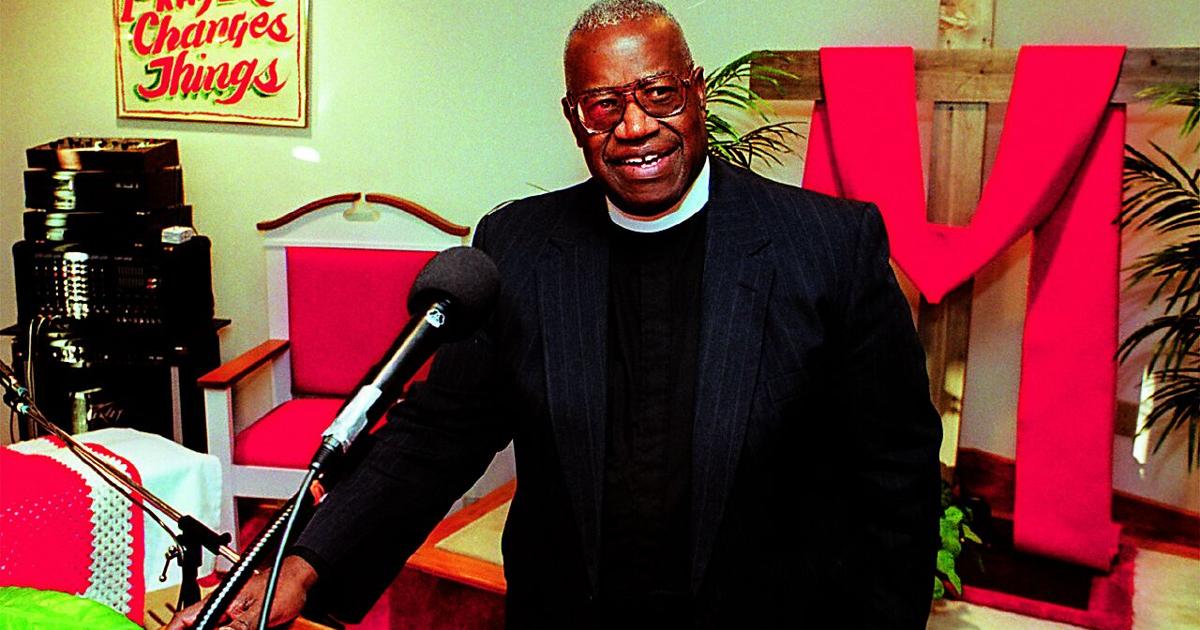
For more than four decades, the sound of gospel music carried the voice of Rev. James Boyer alongside it across Manhattan and beyond.
On Sunday mornings, James’ radio program filled the airwaves with gospel recordings and church announcements. Behind the microphone was a professor, pastor, musician and collector whose influence extended well past the radio studio.
Even after his death in 2017, music from his collection continues to play on Manhattan radios.
James’ family this summer donated his collection of more than 5,000 pieces of African-American gospel music to Baylor University, which established a collection in his name, preserving the music for future generations.
Born April 3, 1934, James came to Manhattan in 1971 to join Kansas State University’s faculty. He became the college’s first African-American tenured teaching faculty member, helped found the Black Faculty and Staff Alliance and advised graduate students whose work eventually took him around the world to teach.
But his life in Manhattan was not confined to K-State.
He also founded Fellowship Temple Church of God in Christ, with the congregation eventually establishing a church in the Northview area.
His son, Alan Boyer, remembers his father’s roles as pastor, musician and teacher as parts of the same life.
“My dad’s love for music coincided with his love for the church, love for teaching and love for family,” Alan said.
A collector from childhood
James’ connection to music began early. Alan said his father started collecting albums when he was 4 years old. Over the decades, that interest grew into a collection of roughly 5,000 pieces, including vinyl records, 78s, 45s, CDs, cassette tapes, VHS recordings, DVDs, books and writings.
Much of the collection eventually filled the family’s Manhattan home.
When Alan began sorting through it after his father’s death, he found albums in the basement, records behind curtains, additional collections in his old bedroom and thousands of CDs organized in cabinets. One storage unit alone held roughly 2,600 CDs.
“He was that organized,” Alan said.
The collection was more than a hobby. James used it for his radio program and his work as a gospel music scholar. It included recordings from influential artists such as James Cleveland, Andraé Crouch, Walter Hawkins, the Clara Ward Singers and Albertina Walker.
James also helped bring gospel musicians to Manhattan. In the 1980s, he arranged for Albertina Walker to conduct a gospel music workshop at McCain Auditorium.
His knowledge of gospel music became so extensive that people sought him out for information about particular artists and recordings.
Jerry Hutchinson, James’ longtime radio producer, said James could quickly locate almost anything in his collection.
“I could mention somebody and he could go grab the album,” Jerry said.
The Boyer Brothers
James’ connection to gospel music went beyond collecting.
He and his younger brother, Horace Clarence Boyer, formed the Boyer Brothers, recording and performing gospel music together. The brothers produced five albums, conducted gospel music workshops around the country and performed in Germany while serving in the military.
In 1952, they recorded “Step by Step,” which became a hit.
For Jerry, the recording remains an example of the brothers’ place in gospel music history.
“You can go back to YouTube and see that 1952 hit that started it back then,” Jerry said.
Records to radio
When KMKF — now known as K-ROCK — went on the air in Manhattan in 1972, James approached station manager Lowell Jack with an idea for a gospel music program.
He agreed to give James an hour for gospel music, beginning a radio partnership that lasted roughly 45 years.
Jerry eventually became involved in producing the program. James brought his records into the station, recorded his spoken portions and worked with Jerry to assemble the hourlong broadcast.
James used the broadcast not only to play music but also to announce events for churches around Manhattan, further connecting his radio work with his role as a pastor and community leader.
After Jerry and his wife, Cathy, launched Angel 95 FM in 1990, they invited James to bring the program to the station. He continued hosting it until shortly before his death.
Angel 95 continues to broadcast an hour of music from his collection at about 9:30 a.m. on Sundays.
“His voice isn’t there, but his music is,” Jerry said. “So we keep it going.”
A life rooted in Manhattan
For Alan, his father’s legacy is inseparable from Manhattan.
The Boyer family arrived in 1971. Alan grew up in Manhattan and eventually returned to K-State for graduate school.
His father served on human relations boards for the city and became deeply involved in both the university and the broader community. Graduate students he advised sometimes became involved with Fellowship Temple, further intertwining his academic and religious communities.
“The legacy of my family in Manhattan goes back to 1971,” Alan said. That legacy eventually became part of the city’s landscape.
In 2019, two years after James’ death, Manhattan officials renamed the street near Fellowship Temple in his honor. Dr. James Boyer Lane now runs alongside the church he helped establish.
For Jerry, the dedication reflected the breadth of James’ relationships.
“A wide diversity of people attended,” Jerry said. “Obviously, he was respected by all people.”
To honor his legacy, Alan and his mother, Edna Boyer, created a $50,000 “champion of diversity” scholarship in partnership with Community First National Bank for the K-State college of education.
In May 2021, the college of education honored James with an exhibit in Bluemont Hall.
James’ funeral was held May 19, 2017 at First United Methodist Church on Poyntz Avenue — a larger venue selected to accommodate the people who wanted to pay their respects.
Preserving the collection
After James’ death, Alan and his mother, Edna, faced the question of what to do with his enormous music collection.
Baylor University’s Gospel Music Restoration Center already had a relationship with James. He had previously loaned recordings to the university for preservation and research, making it a natural destination for the collection.
Alan drove the first portion from Manhattan to Baylor himself. A second shipment included hundreds of CDs and cassette tapes, DVDs, books, papers and other materials.
Baylor has the technology to preserve and reproduce the recordings, with the collection expected to eventually become available for listening and research.
For Alan, donating it was a way to extend his father’s work.
“He loved young people, he loved teaching,” Alan said. “The music allows Baylor to continue teaching, continue sharing the music, continue researching.”
The recordings James once used to prepare a Sunday morning radio program can now become resources for students and scholars studying gospel music history.
“It’s just a treasure trove,” Alan said. “Here is history right here that is being shared.”
Ongoing legacy
For those who knew James, the records are only one part of what remains.
His academic work, his church, the street bearing his name and the people he taught and mentored all form pieces of the same legacy.
So does the Sunday morning broadcast.
Jerry remembers James as someone who could move easily between conversations about music, education, faith and the community.
“I felt him a very conversational, very accepting person,” Jerry said.
Alan remembers something simpler: his father sitting at the piano.
He remembers Sunday mornings listening to the radio program and occasionally getting the chance to host it himself. He remembers his father teaching him songs on the piano in their living room and finding him at the organ at church.
Music was not simply something James collected. It was something he lived.
Now, thousands of recordings that once filled his Manhattan home are beginning another chapter, carrying his knowledge of gospel music beyond the community where he spent decades building a life around it.
His collection has left Manhattan, but his music has not.