
Photo-Illustration: Sean McCabe/Photos: Shutterstock, Getty Images, Alamy
This article was featured in New York’s One Great Story newsletter. Sign up here.
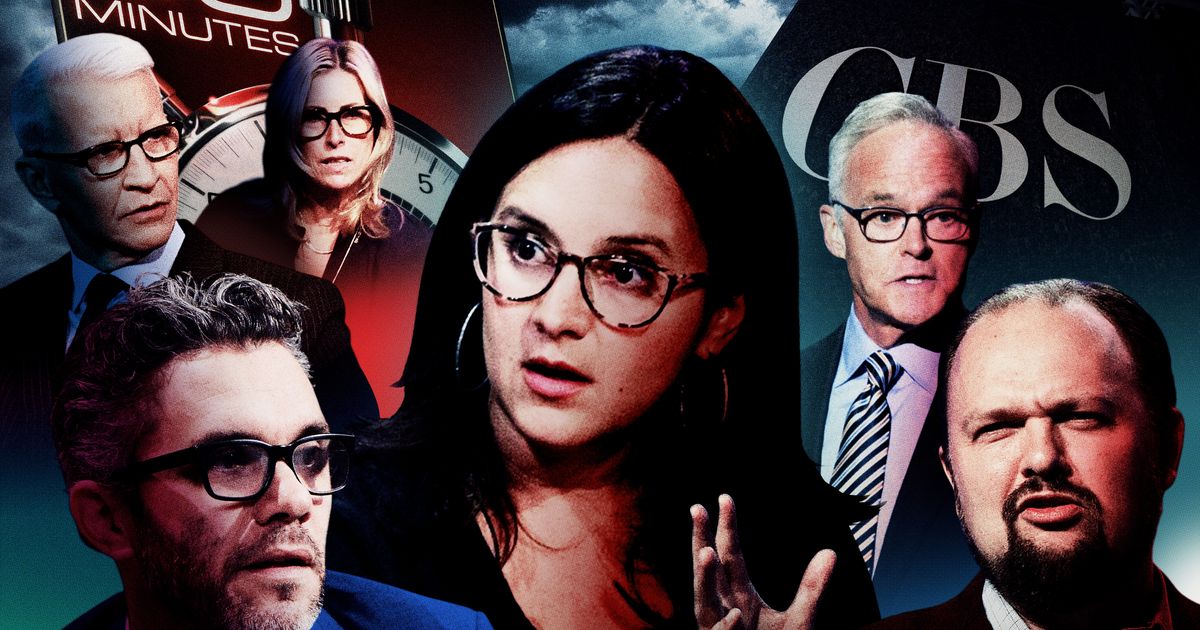
On the last Thursday of May, Tanya Simon’s staff packed up her office. They filled boxes with personal items accumulated over more than 25 years at 60 Minutes: Emmys, photos with celebrity interviewees such as Eminem, and portraits of the show’s legendary correspondents, including her father, Bob Simon. Tanya Simon had grown up at the show and for the past year had led it as executive producer. That morning, she was called into a meeting with her bosses, CBS News editor-in-chief Bari Weiss and CBS News president Tom Cibrowski, at 8:30 a.m., a strange time, given the standing CBS News 9 a.m. editorial meeting. She had been told to prepare for an autopsy of the season that had just concluded — to go over what went right, what went wrong — and to keep an open mind. Instead, she was fired. As she left 555 West 57th Street that evening, teary-eyed, her colleagues lined the hallways and applauded. “The last thing she said before the door closed behind her was ‘I fought so hard,’” one former staffer recalls.
Simon’s deputy, executive editor Draggan Mihailovich, was also fired that day, along with two producers, Guy Campanile and Matthew Polevoy, and two on-air correspondents, Cecilia Vega and Sharyn Alfonsi. (Campanile’s dismissal took place over Zoom as he was scheduled to leave for the airport to report a story with correspondent Lesley Stahl in Spain. Charles Forelle, one of Weiss’s deputies, told Campanile that, even though he was no longer a part of 60 Minutes, he could still shoot the segment if he wanted to. Campanile, shocked, declined Forelle’s offer.) The culling would quickly come to be known within the company as Black Thursday.
The future came in the form of Nick Bilton, Simon’s replacement, a technology journalist with no broadcast-television experience. Bilton arrived with all the subtlety of a dinosaur-killing asteroid. “I am here because the world outside this building has changed a lot since this show was conceived — and we have to talk honestly about what that means,” Bilton wrote in a memo to staff. “I’m here to lead this show, not preserve it under glass.” Bilton’s past crimes against journalism — credibly quoting a vaccine skeptic, claiming to break the Theranos scandal — were dredged up and recirculated, while media newsletters obsessed with Weiss’s moves went to work publishing staff complaints that she was wrecking the show as a favor to the Trump administration.
The scandal exploded on Monday at Bilton’s first all-staff meeting. He and Weiss had been trying to reach Scott Pelley all weekend, desperate to placate one of their last remaining stars, but Pelley had been ignoring their calls. He showed up at the meeting dressed in a suit and tie and alligator shoes, ready to put on a performance. He tore into the new boss over his “slender qualifications” for the job, claimed Weiss was “murdering 60 Minutes,” and paced around as he sipped from a coffee mug. Pelley was fired the next day. With the departure of Anderson Cooper in May, that left the show with just three correspondents: Stahl, Bill Whitaker, and Jon Wertheim, who, after staying quiet for a few days, announced their decision to remain in a joint memo. “We don’t want to see 60 Minutes die,” they wrote.
Black Thursday and its aftermath were the culmination of months of conflict between Weiss and the staff of the most successful news show in the history of American television. At first, some at 60 Minutes were optimistic about her appointment: The business of broadcast news was in need of innovation, and Weiss had been brought to CBS News by Paramount owner David Ellison in 2025 as a change agent, occupying the newly created position of editor-in-chief. Some at 60 Minutes were even fans of The Free Press, the heterodox “anti-woke” outlet Weiss founded in 2021. “People don’t talk about their politics here,” says one staffer. “It’s not this lefty, progressive place.” Almost instantly, however, the show was experiencing something like organ rejection. For the staff, Weiss at best was making poor, rash decisions because of a lack of television experience; at worst she was there to help Ellison get regulatory approval for Paramount’s merger with Warner Bros. Discovery. “What happened was not editorial disagreement; it was a hostile takeover,” says a former 60 Minutes staffer. “The people making decisions at CBS News do not know what they’re doing. This is amateur hour.”
And yet, since the firings, producers and correspondents from CBS News have been lobbying heavily for a spot. “There’s this public condemnation of what’s going on, but privately and quietly, a lot of us are saying, ‘It’s about fucking time,’” says one CBS News staffer. “Not for the leadership in the place to go down — Tanya was beloved — but she did represent a 60 that wasn’t open to other people. Privately, a lot of correspondents feel like, Huh, maybe my chance is coming now.”
While nearly everyone agrees Weiss & Co. could have probably handled things better, there’s a sense that changes at 60 Minutes were always going to be excruciatingly difficult. The very notion of an editor-in-chief was seen as an imposition. As the crown jewel at the Tiffany Network, the newsmagazine program had so much clout that it was literally located across the street from its parent company at 524 West 57th Street, which over time resulted in an idiosyncratic, insular culture that would have been tough for any incoming executive to crack. “Tweaking or changing or improving 60 Minutes is like defusing a bomb: You’ve got to move cautiously, and you must avoid cutting the wrong wire, because the thing will blow up in your face,” says a longtime network executive.
Now that the bomb has gone off so spectacularly, Weiss and Bilton have spent the summer rebuilding the show and preparing for the debut of its 59th season in September, all while much of the staff took its traditional July recess. Late last month, Bilton announced a slate of new correspondents and contributors, including CBS’s longtime anchor Norah O’Donnell and the conservative New York Times columnist Ross Douthat — a personal coup for Weiss, who rose to notoriety at the Times’ “Opinion” section. It’s also a coup for the new 60 Minutes: On his Interesting Times podcast, Douthat showed that he could land sought-after interviews with the likes of Vice-President J.D. Vance and Peter Thiel and was the rare Times columnist who commanded respect across the political spectrum. (The Times was so invested in the show that, just before he quit, the furniture arrived for the in-home podcast setup that the Times had built for him in New Haven.) And in August, Bilton announced that New Yorker writer Ariel Levy would come on as a contributor, another hire that seems to be taking 60 Minutes in a brainier, more highbrow direction.
What comes next will either vindicate the staff’s suspicions of Weiss or lay bare an uncomfortable fact: that 60 Minutes, as it existed under Simon, wasn’t much worth fighting for.
In 1968, CBS News veteran Don Hewitt created 60 Minutes in an effort to bring a version of Life magazine to television, utilizing a mix of serious investigative pieces and lighter celebrity interviews. Hewitt essentially wanted to create mini-documentaries. “I began to think we could make a three-subject hour and package it as attractively as Hollywood packages fiction,” he once said, “and also make the stories reporter-oriented, because I had noticed that what people liked most in newspapers was certain columnists or certain writers’ bylines. I thought if we could make personal journalism, people would watch.”
60 Minutes has always been an island. It was Hewitt who positioned the operation across the street, where it became rooted in its own institutional knowledge and hierarchy. “They are a priesthood. Go up to the 14th floor; it’s like entering a cloister,” says one longtime network executive. “They swear fealty to one another and to the mission.” Sometimes other CBS producers wouldn’t know that the show had a big get until the last minute. A former CBS News journalist recalls how using a clip from 60 Minutes for another show required going through eight levels of approval.
People spend many years as associate producers before getting promoted to producer. Until Weiss came along, the executive-producer role had been a master-to-apprentice transition. There have only been five over the course of the show’s 58-year history: Hewitt, Jeff Fager (who was Hewitt’s protégé), Bill Owens (Fager’s deputy), Simon (Owens’s deputy), and now Bilton. A photo of Hewitt from 1986 shows him pointing at his laughing correspondents; when Owens was photographed in his own office 37 seasons later, he, too, was surrounded by laughing correspondents and pointing. Some pieces of the furniture in the office are hand-me-downs, including a desk that belonged to Morley Safer and chairs from the original screening room. Artwork and editorial cartoons that once decorated Ed Bradley’s and Mike Wallace’s walls now hang in other people’s offices, and Fager’s list of forbidden words and phrases — newsspeak like “We sat down with” — remain on the wall in the screening room. “The objects reminded us of our responsibility to protect the legacy and serve our viewers,” says a former 60 Minutes staffer. “We all felt it was important to keep connections to the past.”
It can also be a snake pit. “Internal competition was one of the things that sharpened 60 Minutes as an institution,” says Rome Hartman, a former longtime producer of the show. Correspondents and their producer teams have fought bitterly over stories and at times stolen them from each other. In the early ’70s, Safer was set to interview the president of Haiti and was about to leave for his flight when he found out that Wallace was already in the country, conducting the interview. “Producer Harry Radliffe once described the place as a bunch of teams set up as terrorist cells, ‘ruthlessly and secretly operating in complete isolation.’ But actually 60 Minutes is a pretty collegial and collaborative place,” Fager writes in his book. “Part of the magic of 60 Minutes is the process, and part of that process is the competitiveness,” a former CBS News producer says.
Excellence is also sustained through the screening process, which “can be brutal — almost as if they are designed to make you feel like shit,” says the producer. Historically, once green-lit, correspondents and their producers work in isolation on a story. They screen their story for superiors after the piece is made and are then peppered with questions and feedback. A story is typically screened three times, sometimes more for a sensitive story. “By the end, you’re so worn out and destroyed,” says one 60 Minutes staffer. “Associate producers in particular pull all-nighters to respond to the notes.” But the results speak for themselves. “There’s a consistent look and production quality to 60. It’s like Ivory soap: You always know what you’re getting when you open the box,” says a former CBS News journalist.
“Not being able to tell 60 Minutes what to do has been the story for as long as time,” says a former 60 Minutes staffer. “That’s a feature, not a bug, and it’s worked.” For more than four decades, it was the newsmaking destination of choice for presidents, athletes, and celebrities. This was where Bill and Hillary Clinton went to address Gennifer Flowers’s allegations of infidelity; where a former teammate revealed Lance Armstrong had used performance-enhancing drugs; where Stormy Daniels detailed her affair with Donald Trump. The show’s investigations led to exonerations, indictments, and culture-defining moments. 60 Minutes has been the top-rated news program on television for 52 straight years. This season, under Simon’s leadership, the show was up 9 percent from the prior year, averaging 9.1 million viewers.
But everyone concedes that broadcast television as a whole is in irreversible decline. “The story of CBS is the story of people kicking the can down the road, deferring pain,” says one network insider. And the latter-day version of 60 Minutes has grown notably soft. The show pioneered a kind of television journalism that utilized hidden cameras, undercover correspondents, deeply sourced investigations, and hard-hitting interviews. Michael Mann made a whole movie about it. Now, Cecilia Vega was devoting two segments to the sherpas of Mount Everest and her ten-day journey to base camp. “What was the fucking point of that?” one CBS staffer asks. “If you’re going to go, climb Everest.” This past season included stories on the perfume capital of the world, the only active rare-earth mine in the U.S., and a dog study that may help pets and humans age well. Weiss thought the visual language of the show could evolve beyond sit-down interviews and walk-and-talks; she recently discussed filming a story that would open with footage shot on GoPros.
Simon’s detractors also say the recent bump in ratings can mostly be attributed to 60 Minutes’s place on the Sunday-night lineup right after football, which last year had its best regular season since 1989 with a 10 percent jump in viewership; that, factored in with changes Nielsen made in 2025 to its methodology, brings last season’s growth down to around 5 percent. And even with the NFL lead-in, the show still pretty much reaches only one audience: The average age of a 60 Minutes viewer is 67.
Weiss felt there were more things 60 Minutes could be doing — with social media, live events, and the main broadcast itself — to reach new viewers and remain relevant. “When you go out and look for the future Lesley Stahls, the future Diane Sawyers — they mostly don’t exist in legacy news organizations,” says one network insider. “They’ve been building YouTube channels or podcasts and newsletters, and they have bigger followings.” Unfortunately for Weiss, any such innovations have so far been totally eclipsed by her dysfunctional relationship with her new employees.
Weiss never took the opportunity to meet with the entire 60 Minutes staff when she started in October 2025 and wouldn’t introduce herself to some of the correspondents until she was in screenings with them later in the season. And the meetings she did take were controversial. In her first two weeks on the job, Weiss asked senior staff why much of the country thinks the legacy press’s coverage is biased. At the same meeting, Campanile, who was later fired on Black Thursday, asked her view of the settlement CBS News reached with the Trump administration over a lawsuit claiming the show had deceptively edited an interview with Kamala Harris — charges widely believed to have no merit. Weiss declined to comment, noting her answer could be leaked. “It was a litmus test she failed from the jump,” a former 60 Minutes staffer says. “Staff were stunned she didn’t have a clear answer that supported the journalists that she now managed.”
Weiss plunged into the show’s operations. She was personally involved in booking guests — unusual for top network brass — including Jared Kushner and Steve Witkoff. At the end of her first month, she traveled to Mar-a-Lago to observe O’Donnell’s interview with Trump, the first since he’d sued the network, and met the president for the first time. In December, Weiss personally screened a piece by Cooper in which he traveled to South Africa to investigate Trump’s claims of a “white genocide” against Afrikaner farmers, a narrative that the segment ultimately debunked.
Later that month, Weiss, at the last minute, pulled a story by Sharyn Alfonsi on the Trump administration’s deportations of Venezuelan migrants to CECOT, the notorious El Salvadoran prison. She felt that the Trump administration’s rationale for the deportations was not adequately represented and, on the Friday before the broadcast, asked producers to add an interview with Stephen Miller or another Trump official. Weiss’s intervention prompted Alfonsi to write an email to colleagues that alleged Weiss “spiked” the story “for political optics.” The piece eventually ran on January 18 with no significant changes. Weiss publicly acknowledged the controversy during a town hall with CBS News. “That specific logistical nightmare — that’s never going to happen again,” she said.
It was around this time that, Pelley would later allege, Weiss urged him to inject “falsehoods and bias” into a segment on the killing of Minneapolis protesters Renee Good and Alex Pretti by ICE and CBP agents. Vega later claimed that executives had asked her, among other things, to add footage showing protesters attacking people in plain clothes incorrectly identified as ICE agents but found “no credible examples” of such behavior at the time. CBS News disputed both of their claims.
For Weiss’s critics at 60 Minutes and beyond, her behavior presented a clear case of political interference on behalf of the Trump administration. Weiss and her defenders insist that, while she is more conservative than many people at 60 Minutes, the issue was not political — it was managerial. Weiss grew exasperated by the constant pushback. “She got very upset that Tanya wouldn’t consider stories Bari thought were worthy of the broadcast,” says one former 60 Minutes staffer. “Tanya would explain, ‘Well that’s not a 60 story; that’s an Evening News story.’” A network insider describes the attitude slightly differently:“That’s not how we do things, and I don’t want to be the one to break precedent.” Weiss wanted to go down lanes the show hadn’t before — to, say, spotlight a religious revival among young Catholics by sending a correspondent on one of their pilgrimages or a story on surrogacy, the latter of which was met with hesitation owing to concerns it would offend gay couples. Meanwhile, correspondents were openly disparaging her in messages to staff that were leaked to the public, often via the media newsletters devoted to publishing even minuscule developments at 60 Minutes and CBS News. Weiss’s closest allies reportedly began referring to the ceaseless criticisms of her as “Bari Derangement Syndrome.”
It became clear that many of the show’s staffers were not only opposed to Weiss’s politics or editorial suggestions but the very existence of an editor-in-chief who could tell them what to do. “Imagine if 60 was a separate country inside CBS, where they’re using horses and carriages and they’re operating in this kind of older way. And Bari’s like, ‘Oh my God, guys, there are these things called cars; you don’t need the horse and carriage anymore.’ And they’re like, ‘But we use the horse and carriage. It gets us where we need to go, and it’s great,’” says one network insider. “There is no media institution in America that has a philosophy of ‘That’s not how we do it’ more than 60.” She came to feel that this was not the right leadership team to build the new 60 Minutes and started to mull a change.
Simon held meetings with small groups of producers in which she tried to assure people of the sustainability of the show. “She was very frank about the difficulties that she was facing,” says a staffer who attended one such meeting. But she also tried to convey that she and Mihailovich, her deputy, had established a working relationship with Weiss. “Bill’s approach was ‘Don’t let anybody in the door. This place needs to be sacred,’” says another former staffer (referring to Owens), who departed before Weiss’s arrival, citing a loss of editorial independence stemming from the impending settlement with the Trump administration. “Tanya’s approach was more cerebral and diplomatic: Let’s try to work with these people.” Weiss could seem scattered, bouncing off the wall with ideas and suggestions. Says one 60 Minutes staffer, “Tanya was obviously trying to make management happy while still doing what she knew was right for the show. At times it could be frustrating because she would say things that we felt were influenced by Bari. She started asking questions in screenings like, ‘I mean, do you think we’ve gone far enough?’ Which is fine, but you could tell she was getting pushed.”
Weiss struggled to adapt to the rhythms of the show; at times a segment almost didn’t make it to air because she had requested changes so late in the process. (At one point, a CBS News executive advised Simon to have a backup episode ready to go, just in case.) “It feels like utter incompetence,” says one former CBS News journalist. “You have to be uniquely capable and adept at the intricacies of television to be able to put a political heavy hand on. They may want to, but they’re not even close to that — they don’t understand the basic blocking and tackling yet.” And she didn’t know what she didn’t know, says a current 60 Minutes staffer. “She’s a print person and doesn’t understand how it works, and she never seemed to give a shit enough to try and learn, which I think is what rubbed people the wrong way.”
But the staff weren’t eager to help her get her sea legs. On multiple occasions, Weiss and her deputies tried to be involved earlier in the process of a story and were told that it was still being worked on — only to, at the end of the week, get an invitation to the fourth screening.
In February, news broke that Cooper would not be renewing his contract with 60 Minutes after nearly 20 years at the show — a decision that Weiss felt she hadn’t been sufficiently looped in on. “Anderson’s decision to leave followed the difficulties around the South African piece and the CECOT controversy,” says a person familiar with his thinking. “He didn’t want to have anything to do with the chaos.” CBS had tried to keep him with a smorgasbord of options — an expanded role both at 60 Minutes and across CBS News that would effectively make him the face of the network, money — to no avail.
In March, Weiss booked Secretary of Defense Pete Hegseth for an interview and assigned the piece to Major Garrett, the CBS News chief Washington correspondent. She directed the interview to run on 60 Minutes despite Garrett’s being outside the show’s roster. Then, in May, Weiss personally booked an interview with Benjamin Netanyahu and again assigned it to Garrett, even though Weiss was aware that Stahl had for months been pursuing an interview with the Israeli prime minister. Simon pushed back against the Garrett assignment, but Weiss had made up her mind.
Later that month, Cooper taped his final episode. He also taped an exit interview with 60 Minutes Overtime, which offers a behind-the-scenes look, that had some parting words for the new leadership. “I hope 60 Minutes remains 60 Minutes,” he said. Weiss was furious she wasn’t given a heads-up.
At the end of January, Bilton flew to New York to meet with Martin Scorsese, who is set to direct a movie based on a book Bilton co-wrote with Dwayne “the Rock” Johnson. While in town, Bilton and his wife visited Weiss and her wife, Nellie Bowles, at their apartment; they’d become pals during Weiss’s time in Los Angeles, where she established The Free Press. The media coverage of Weiss had been relentless, and she expressed frustration with the opposition she was facing from staffers at CBS. Bilton, who like Weiss is something of a contrarian Energizer bunny, offered her some advice on how to handle an upcoming company all hands.
Weiss began to think she could use someone like Bilton at 60 Minutes. She was drawn to his mix of journalism and documentary experience and his eye toward the future — how to extend the brand beyond linear television and ways to visually refresh the program. She’d also come to feel that she needed an executive producer who was more of a story generator than Simon, and Bilton struck her as an idea-a-minute person. Come spring, she gauged his interest in taking over. “At first I wasn’t — You know, I’ve got this crazy Hollywood career, and I thought to myself, Well, you know, I love what I’m doing. But the more I thought about it, I literally couldn’t get 60 out of my head,” Bilton told the Washington Post. He presented his ideas to Weiss and the way he’d approach the gig — he wanted a new generation of correspondents, harder-hitting stories, an entirely new digital strategy — and they were aligned; so too, apparently, was Ellison, among those Bilton met with prior to his appointment. Bilton started figuring out how to move his family and two dogs from Los Angeles to New York.
After the Pelley blowup, Bilton spent his first few weeks meeting with staff, trying to convince them that he wasn’t going to turn the show into a series of made-for-TikTok segments. He promoted longtime producer Maria Gavrilovic, who had worked closely with Pelley for years, to senior producer, effectively making her his second-in-command. “There was a little bit of a sense of betrayal because she had been brought up by the people who were fired, but there was also relief because she knows the drill,” says a former 60 Minutes producer. Bilton is building an investigations unit made up of about six staffers, a mix of current employees and new hires, whose role will be to look into ideas that Bilton, Weiss, producers, and others have that could then be assigned to a correspondent.
He’s also working on revamping the system for assigning stories. Pitching a story at 60 Minutes begins by submitting a proposal known as a “blue sheet,” named for the color of the paper that producers used in Hewitt’s day. Blue sheets have also functioned as a way to call dibs on a story idea — even if, say, a producer didn’t yet have access to the subject they wanted to interview. Weiss started to understand “what was going to be on the show,” says a veteran 60 staffer. “That has never happened — that an outsider, somebody from across the street, determines what stories are going to be shot or what stories are going to be on the air on any given week.” Since firing Simon, she has gotten even more involved in the show’s day-to-day editorial decisions, not only reviewing all story ideas but at times assigning them to correspondents. “If you were running a newsroom and you were the editor, wouldn’t you think that the editor-in-chief would want to at least read the cover story every week? This is 60’s version of that,” says a network executive. “The idea that she would not be overseeing the most important brand that is seen by many millions of people at the premiere — of course she’s going to do that.” Bilton has killed 200 blue sheets after reviewing them with staff. He is now building an AI platform to better organize legitimate story ideas.
July is when 60 Minutes staffers historically take their vacations, a tradition Bilton was loath to upend given his uncertain standing with his new charges. So he spent the month in a mostly empty office, meeting with producer candidates, screen-testing potential correspondents, and discussing new ways to shoot stories with cameramen. He is planning to bring back Andy Rooney–style closing commentaries and has reached out to Stephen A. Smith and John McEnroe, among others, about the gig. The idea is that a handful of people will each contribute to a few episodes over the course of the season. Bilton has also been working on a digital-strategy presentation that includes simplifying the way the show is branded to make it cohesive across broadcast, digital, and audio and making greater use of its archive on social media when relevant to the current news cycle. Repackaging previous segments on Lindsey Graham, for example, or the World Cup have generated tens of millions of views. He’s toying with the idea of regularly putting entire interviews online or turning them into podcasts in addition to cutting them down for 13-minute segments. But the upcoming season 59 is likely going to be similar to previous seasons. Season 60, on the other hand, will supposedly be a different beast — assuming Bilton lasts that long.
Douthat’s hire, among others, was announced at the end of July. The pitch to him was relatively straightforward: If you’re already doing an interview television show, why not do it on a bigger stage with a more varied audience? Douthat was in England with his five children during the recent heat wave when he discussed this with Weiss, mulling his future from multiple un-air-conditioned Airbnbs, covered in sweat.
In August, Bilton welcomed staff back from their vacations in an email that contained housekeeping notes, including a new digital storyboard that updates in real time with what staff are working on, because “there is no reason in 2026 we should be tracking the No. 1 show in news using a dry erase marker.” He also extended his hand in friendship: Stop by his new office and say “hello” but “please don’t judge the furniture,” he said, explaining that he “stole it from the cafeteria and the hallway.” He struck a more combative tone on other subjects: “Since I started here there has been roughly a rumor a day. About me, about you, about what’s coming next — 95 percent of them are fabrications and blatantly incorrect. I no longer have the time or the patience for them, and I’d rather we spend that energy on the stories.” The email was leaked almost immediately.
One Great Story: A Nightly Newsletter for the Best of New York
The one story you shouldn’t miss today, selected by New York’s editors.
Vox Media, LLC Terms and Privacy Notice