
“Maternal offloading,” the authors write in the last lines of their discussion, “is best understood as a last defense.”
What it defends is the queen. Over ten days in small laboratory colonies, worker honey bees stripped 95 percent of a pesticide out of the syrup they were fed before storing it in comb, and by the end of the run they managed only 86 percent. In the same colonies the pesticide reaching the queen was turning up in her eggs at 81 to 141 parts per billion, five to ten times the concentration measured in her own body.
The study was published in Current Biology on 3 August, from a team led by Angela M. Encerrado-Manriquez and Sascha C. T. Nicklisch at the University of California, Davis, working with the USDA Agricultural Research Service and Lawrence Livermore National Laboratory. Its authors describe the egg transfer as a previously undocumented protective mechanism in reproductive individuals, write that maternal offloading has not been established or refuted, and say it has been largely ignored in social insects even though it is documented in aquatic and mammalian animals.
A carbon-14 label in a plastic-cup colony
Part of the reason nobody had measured it is sample size, in the literal sense. A honey bee egg carries so little carbon that the team needed 30 to 35 of them per sample, and conventional residue chemistry works in parts per million. They used biological accelerator mass spectrometry, which counts carbon isotope ratios and detects a radiolabelled compound at attomole levels, billionths of a billionth of a mole, in samples of a few milligrams.
The compound was methyl parathion, an organophosphate chosen as a model. Its toxic mode of action in bees is well studied, its molecular weight is 263.2 grams per mole, and its moderate fat solubility puts it in the same range as many organophosphates in current use. High-purity carbon-14 versions are commercially available, which enables precise quantification.
One consequence of the method runs through every figure below. The instrument counts the carbon-14 label, which is then converted to parts per billion using the pesticide’s molecular weight, so it cannot separate intact methyl parathion from whatever the bees metabolise it into.
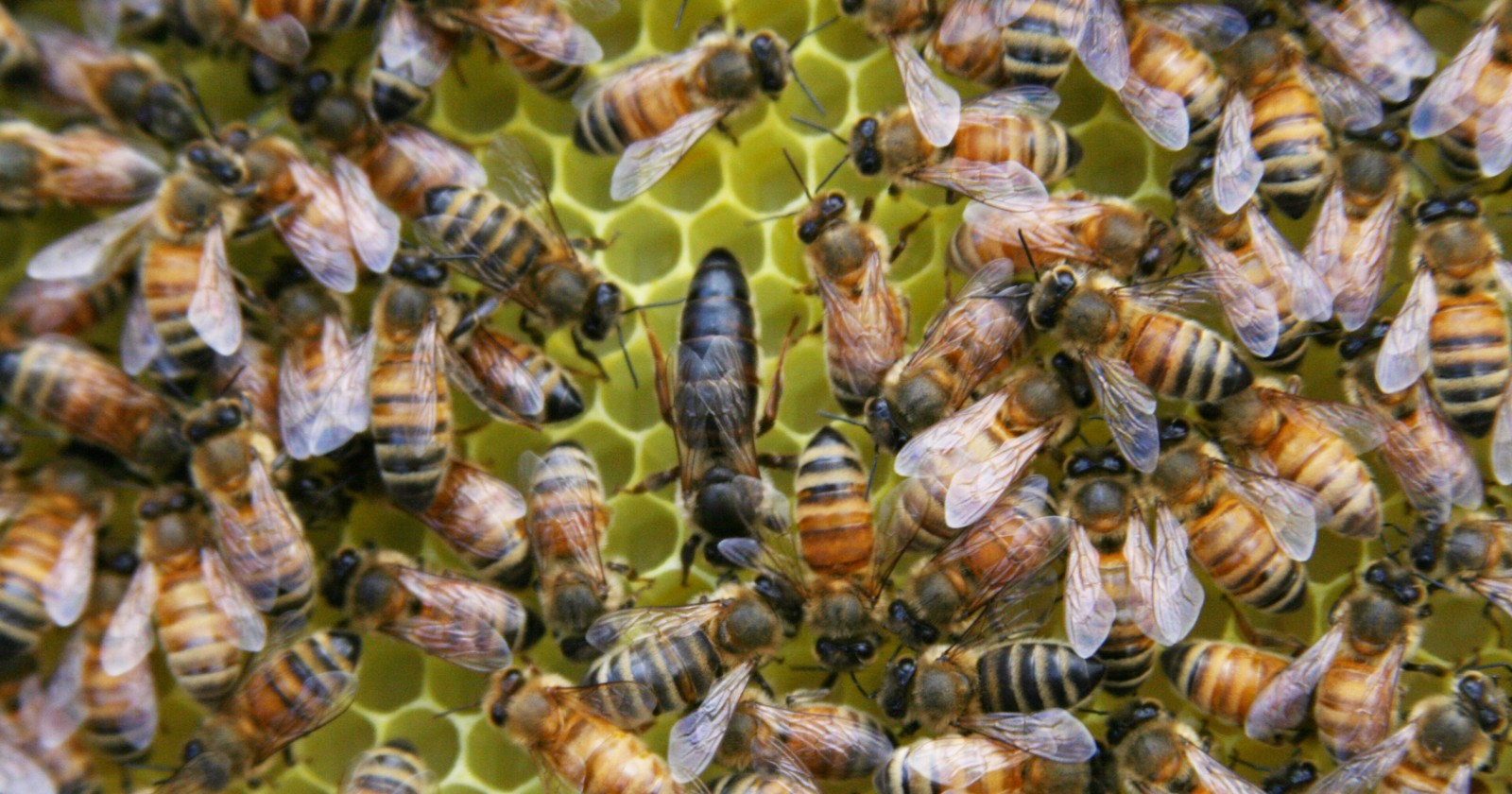
The colonies were small by design. Each cage held roughly 60 newly emerged bees over a paraffin comb about three inches by two and a half, half of them with a single newly mated Italian queen and half without, incubated at 34.5 degrees Celsius. Sixteen cages were built per round across two rounds in August and September 2024, four control and four treated in each set, with bees from three USDA colonies in Davis, California. The diet was a 50 percent sucrose solution prepared at 85 nanomolar, about 25 parts per billion, replaced daily. Cages were sampled at day two, treated as acute exposure, and day ten, treated as chronic.
Concentrations below are ratios of pesticide mass to sample mass, in parts per billion. These are not doses delivered, and they do not measure how much pesticide the colony removed from the world.
The filter wore out over ten days
The worker filtering function, as the team calls it, compares two places: the feeder the bees drank from, and the processed diet they had stored in comb cells. On day two the stored diet held 95 percent less pesticide than the source, a difference the authors put at about 118 parts per billion. On day ten the gap was still large and still statistically strong, but the efficiency had dropped to 86 percent. Both figures describe filtration efficiency, the amount by which the stored diet ran below the source, and the label itself stayed in the cage.
That 118 parts per billion implies a feeder concentration near the 131 parts per billion the discussion cites, roughly five times the 25 parts per billion the methods say the diet was prepared at. The paper reports both numbers and does not reconcile them, so the relative filtration figures are the reliable ones.
Concentration in the comb cells rose by about 40 percent between day two and day ten, while the feeders themselves drifted slightly downward, which the authors put down to the labelled compound degrading in solution, evaporating, or sticking to glass. So the rise in the stored diet was not fed by a rising input.
Passive leaching does not explain the day-two gap either. Wax measured around 2 parts per billion on day two, against roughly 13 in the stored diet sitting in the cells beside it, leaving passive diffusion into wax to account for only a small part of the difference between feeder and comb.
Young workers carry high levels of detoxification enzymes and use them while processing nectar, and the authors read the day-ten decline as that capacity saturating: cofactors depleted, or metabolism impaired by the stress of continuous exposure. The honey bee genome carries a thin complement of detoxification genes compared with other sequenced insects, which leaves little slack.
Worker bodies show what the filter cost them. On day two workers and queens did not differ significantly. By day ten workers averaged 1,049 parts per billion against 19 in queens, a 55-fold gap that opened and widened over eight days.
At the packaging step
Queens stayed low throughout, partly because they eat almost nothing but royal jelly, a secretion already processed through a nurse bee’s glands. Dietary filtering alone does not fully account for a gap that size, and the authors point instead to the eggs as a second route out.
Egg concentrations were significantly higher than either the ovaries or the queen’s remaining somatic tissue, reaching 81 to 141 parts per billion by day ten.
Four queens were measured at day ten.
Their whole bodies ran 16 to 23 parts per billion, their ovaries averaged between 1.71 and 9.67, and their eggs ran what the paper reports as five to ten times the whole-body figure, though the four day-ten pairs in its own Table 1 run from 4.9 to 6.3 times. Against the lowest per-queen ovary average of 1.71 parts per billion, the eggs ran more than forty times the ovaries.
The ovaries are the interesting negative. They climbed significantly over the run, by about 5.53 parts per billion, and they carry the largest fold ratio in the study, yet they were not significantly elevated above the rest of the queen’s body, which points the enrichment at the moment of oocyte packaging.
Fitting the day-two and day-ten averages against a day-zero value set at each sample’s detection limit, the authors calculate accumulation rates of 108.56 parts per billion per day for workers, 8.65 for eggs and 0.70 for queens, the queen fit the weakest of the three. On those calculated rates eggs gained more than ten times faster than queens, which is the observation the authors read as active concentration of the pesticide in reproductive tissue. The paper calls the transport mechanism a possibility needing further work.
One pattern in the four queens looks like arithmetic, and the paper labels it an observation. Of two queens who laid about 30 eggs, one put an average of 140.76 parts per billion into each; of two who laid about 90, one averaged 80.98. A queen laying more spreads the same burden thinner, which with four queens the paper calls descriptive.
Queen presence redraws the distribution
The third finding concerns the colony. Queenright cages consumed more diet than queenless ones, so more pesticide entered. Yet the total burden pooled across workers, wax, and stored diet did not differ significantly between the two conditions by day ten.
The partitioning did differ. Workers in queenright cages carried higher median body burdens in a tighter spread, and wax in those cages showed the labelled compound above quantification limits more often. Comb building runs on honey, and workers making cells to receive eggs eat more contaminated food while secreting a fatty material that concentrates the residue. That has a practical edge, because wax residues are commonly used as a record of a colony’s exposure history, and this result implies they read low when brood production is low.
The day-ten against day-two ratio was 49 for ovaries, 25 for wax, and 2 for eggs. The day-two ovary value sat at or below the limit of quantification, so the 49 is a lower bound. The low egg ratio has the opposite cause: the only queen who laid enough eggs for analysis on day two was already at 55.8 parts per billion across 90 eggs, which flattens the apparent change.
This comparison rests on four cages per condition per time point. The authors describe that setup as covering 56 workers, with 18 egg pools in total, though 56 is the queenright-only figure its own Figure 1B gives, and with 28 workers sampled per day per colony type Figure 4 puts the full worker total at 112. They say plainly that patterns within each treatment are well defined and that differences between treatments should be treated as descriptive of this cohort until larger replication is done. The raw measurements are posted.
The step the study does not take
Nobody followed the eggs. Hatching success, larval survival, and whether contaminated eggs get eaten by workers are all listed as open questions.
The paper says the egg concentrations approach or exceed published median lethal doses for organophosphates in larvae. It puts no number on that comparison, and the comparison sets a concentration against a dose.
The suggestion that this mechanism could explain colony losses arriving months after a spray is offered as a hypothesis, and the colonies here were 60 bees in a plastic cup over a paraffin comb.
The popular shorthand for the finding, that the queen sacrifices her brood to save herself, also overshoots the study.
The colony as the unit
Read narrowly, the result unsettles a working definition. Most cage assays use queenless workers and call the result the effect of the chemical on the bee. A colony where sterile workers absorb the burden first, and the single reproductive female moves what reaches her into eggs she can lay by the thousand, does not have an obvious edge where the individual ends.
The authors’ own conclusion is that honey bees have to be studied as superorganisms. The version of that argument this paper adds is an accounting one: the burden has to end up somewhere, and the place it ends up is the part of the colony that no other member can replace.