
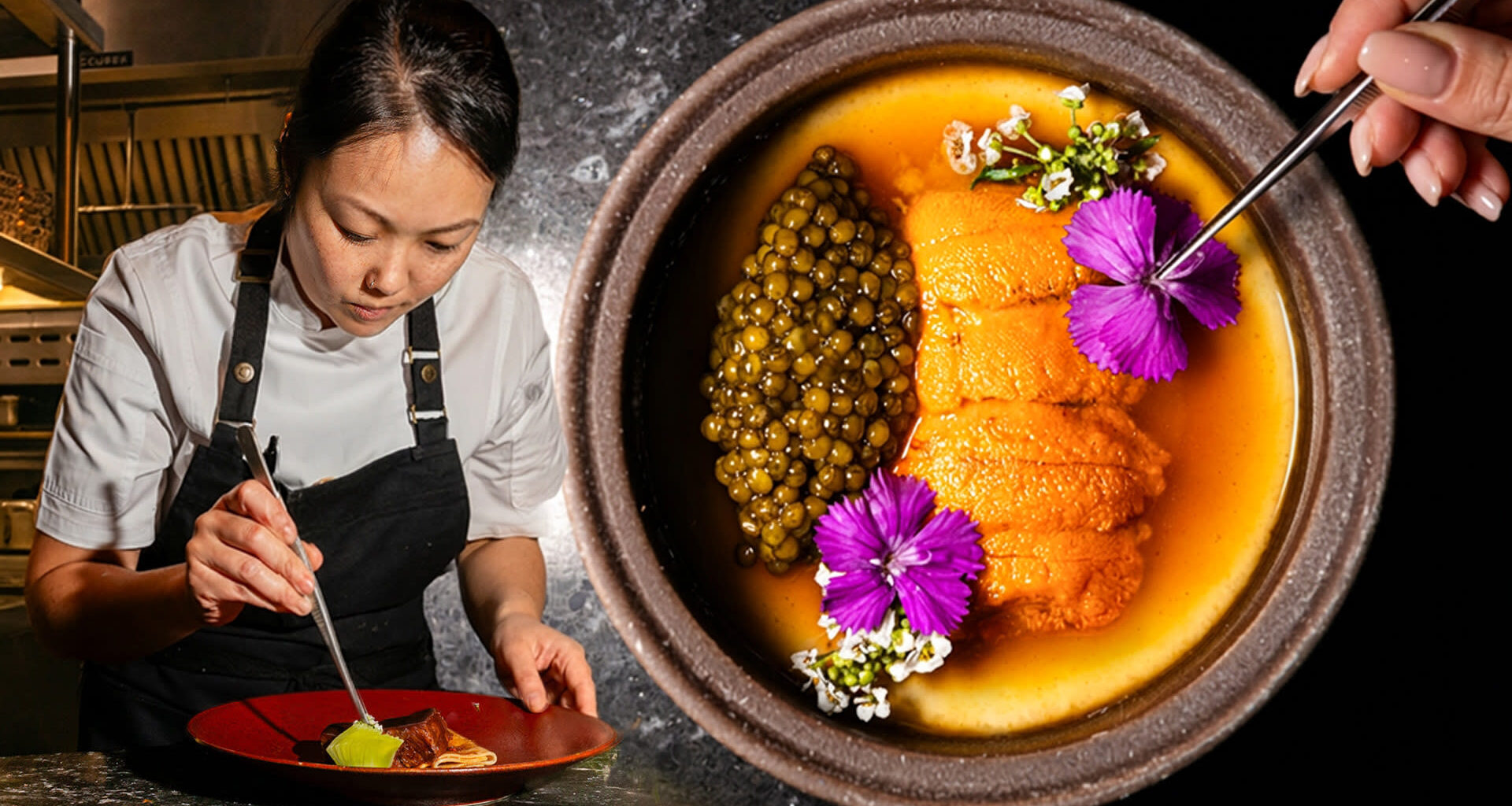
[upbeat music]
Ying Tao is the only Michelin-starred
Chinese restaurant in New York City.
A lot of Americans assume Chinese food is takeout food.
For us, we wanna change people’s minds and elevate it.
[upbeat music]
I love the guest reactions to our food.
I love when they ask me, like, What is a goji berry?
What is a cordyceps mushroom?
As a first-generation Chinese American,
I wanna make food that speaks to who I am,
still with Chinese flavors, but also done in a modern way.
Hi, I’m Emily Yuen.
I’m the executive chef of Ying Tao Restaurant.
It is 8:45, and we’re here at Po Wing,
and we’re picking up dried goods for the restaurant.
[bright music]
Hi! Hey, how’s it going?
Good, how’s it going? Nice to see you.
This is Sophia.
She is the owner of Po Wing.
Well, second-gen.
That’s my mom, actually.
Hey, mom, say hi.
[light music]
These dried scallops are the ones
that I usually get for the restaurant.
Dried scallops are really important to Chinese food
because not only does it concentrate the flavor,
I think in French food, you think fresh is best,
but actually, dried scallops are like a huge part
of Chinese preservation and history.
In the past, there’s no refrigeration,
but it concentrates the flavor.
The methods they use, actually,
it is prized more than a fresh scallop.
Well, I’m using these for my XO sauce.
I would say it’s an essential Chinese condiment.
It still has a lot of umami,
using a lot of dried shrimp and dried scallops.
You can put it on anything.
We use it at the restaurant
to make it into a French-ish sauce.
So I’m gonna go get some fish maw as well.
Okay, sure. Around the corner?
It is dried.
It is the bladder.
It has so much flavor.
We use it for, like, our superior stock.
The one I was previously using,
people were like, It’s a little bit strong.
Oh, okay. So I think this one
was like a great like
gateway fish maw. Yeah, yeah.
I think my goal is to, like, make people
who are not Chinese eat more of the delicacies
that we’re used to eating growing up.
[Sophia] Okay, so I think you wanna
get the goji berries as well.
Right? Oh, yes.
It’s just like garnish, but also on top of our wonton soup.
Perfect. I love people’s reaction
to it because they’re like,
usually, they use it in like a smoothie.
[Sophia] Yeah, yeah.
I think I need to get my cordyceps mushrooms, flowers.
When people eat it, they’re like, What is this?
I really love that.
That opens up a conversation
about all Chinese ingredients as well.
It has natural umami in,
so we just rehydrate it and put it in our wonton soup.
It’s really important to come here
to talk to Sophia and her family.
I can’t really find these anywhere else.
I can’t just order online for these ingredients.
I’m gonna bring all these things back
to Ying Tao so we can start our day.
[upbeat music]
All right, welcome to Ying Tao.
We are a Chinese contemporary restaurant.
We have about 38 seats and nine at the bar.
Today, we have Restaurant Week and also our regular menu,
so it is pretty hectic.
Restaurant Week is a way for New York restaurants to do,
I would say, like a cheaper menu, shortened menu,
three courses for $60 as opposed
to our regular seven courses for $150.
This is, we call our Grandma Ying Tao.
She overlooks us, but this is our owner, Bolun’s grandma.
The restaurant’s named after her.
We kind of like randomly pray to her,
ask for good service, less dietary restrictions.
[light music]
Okay, so I’m gonna change to my chef white.
We just got in our A5 Miyazaki Wagyu flowing from Japan.
It’s on our supplements, so it’s an add-on
from our regular tasting menu.
Maybe the side is better, actually.
Oh my God, this is like $800, you know?
It’s crazy.
So I’m gonna take this to our dry ager.
So we have a dry ager because my dream
is to start a Chinese charcuterie program.
Kind of put it in.
Here, I got some things started already.
Our housemade lap cheong sausage,
which you typically never see, you always buy.
Right here, we have some cured pork lap yuk.
So it’s like cured pork belly with a lot of spices,
soy sauce, so it’s been curing.
It’s almost ready.
You’ll see in here, this is our black cod that we dry age.
Preserving and dry aging is like a part,
integral part of Chinese food and Chinese cuisine.
Not only does it just preserve the food,
but it concentrates the flavors.
And for Chinese food, it’s all about like layers of flavors.
There’s a lot of depth to it as well.
[light music]
So this is a black cod.
We cut it up, dry aged it for a little bit.
We’re gonna marinate it.
This is a ginger scallion marinade,
blended-up ginger and scallion
that we a little bit saucing wine.
So we wanna marinate the fish for about 30 minutes.
When I transitioned it into fine dining,
I realized that each dish might seem simple,
but you need like 20 different layers
of what makes a perfect dish.
When I took the job here, it already had one Michelin star,
so it was a huge transition for me
because I worked in fine dining before,
but just as a line cook.
This is the first time I’m running
a Michelin-star restaurant.
So for me, it was like a huge learning curve.
We wanna put the black cod just on the bed.
We don’t wanna marinate the top
’cause I wanna keep it crispy,
’cause if we add extra moisture to the top,
it’s gonna not be as crispy when we sear it.
So we’re gonna leave this for about 30 minutes in the fridge
and then we’ll come back to it in a little bit.
[light music]
Thanks, Chef.
Well, now the fish is done.
I’m gonna move on to some tomatoes for our scallop dish.
[light music]
We start the first course with these refreshing scallops
with these tomatoes because I want people to open
their palate with a spicy cake
and also want them to realize what’s coming.
So they’re either ready for the ride or they’re not.
So this is huamei.
This is preserved plums.
It’s really good, I always eat one while we are cooking.
It’s kind of like a, it’s like a salty,
look at drinking snack.
I would say that even though I don’t drink.
We’re putting some raw sugar in,
some lemon peels, water.
So I’m gonna grab all that.
[light music]
Shit, do we have any more lemons?
Lemons. Maybe no, right?
Okay.
Let me make sure we put it on the order list.
This is our board for the day
where everyone puts down their orders, but obviously,
whoever took the last lemon forgot.
Super annoying.
So I’m gonna put it in now
so we can make it for tomorrow.
When life gives you no lemons, you use orange peel.
Substitutions are like a normal part of every chef’s day.
Being able to think on your feet
and adjust is like super important.
I mean, I always say my job is problem-solving.
And babysitting.
So I’m gonna put some water in it
and melt down the rock sugar.
Using rock sugar because it creates
a little bit more of a shine.
It’s a little bit milder.
It’s easier to control.
I don’t want it to be too sweet.
So I’m gonna peel all these tomatoes
’cause we don’t have a prep cook today.
So people think it’s a pain in the ass,
but I actually really love it.
It’s like therapeutic.
I don’t have to think about anything.
I’m doing the same thing.
And then it only takes about like five minutes
before someone yells my name and asks me for something.
So these tomatoes have been pre-scored and then blanched.
I tell them to do a little bigger cut
because marinade also enters the inside as well.
I wish there was a shortcut to this, but there isn’t.
I think that’s also what makes Michelin-star food.
You can’t really do shortcuts.
Whenever the cooks and I have a free second,
we’re peeling tomatoes.
Right now, it’s on the Restaurant Week menu,
so there’s no free seconds.
So I’m trying to help them out today by peeling tomatoes,
get them started for the day,
’cause I think we are at,
I’m gonna cry, 74 covers.
When it’s not Restaurant Week,
it’s probably about like 40 to 50 covers,
but it just depends of what kind of season we’re in.
So I’m gonna be doing this for the next
like half an hour to 40 minutes.
And then I’m gonna check in on the wontons.
[light music]
Okay, so I’m gonna help Linette.
So Linette’s our owner.
We’re a little bit shorthanded,
so she’s helping us today fold wontons.
She’s folding it into a form of a golden nugget.
It represents prosperity, wealth, so hopefully,
you’ll eat our wontons and you’ll be young and rich.
Yeah, there are a lot of different wonton folds,
and this is not the most efficient way.
[both laughing]
But we’re folding it, like chef said,
into a golden nugget or golden ingot
because we want to have a prosperous year.
For Chinese food, it’s not just about how good it tastes,
but it’s about what it represents.
So the filling is pork, shrimp, and then abalone sauce,
13 spices, garlic chives, white pepper, salt,
and then also egg whites.
So we whip it up so it’s nice and bouncy.
So the whole thing is capped off
with a tablespoon-size pour of our superior stock.
This is where I would say
our superior stock gets highlighted the most.
You can really like taste it,
and a good tip for when you know
you have a good Chinese stock
is like you put your lips together
and you have that like collagen.
And if your lips are like sticky and go like, [smacks lips]
then like you know that the chef made a really good stock.
So you’re saying you made a really good stock?
I made a really good stock.
Of course I made a good stock.
Okay, thank you so much, Linette.
Only 10 more dozen to go.
I’m moving on.
[light music]
So we have chicken feet, yellow chicken,
corn-fed with head and feet on for the extra collagen.
So we’re gonna start washing all these upstairs
so we can get ready for our superior stock.
Our superior stock is probably
about five of the dishes we use,
from our egg custard to our sauces for fish.
For the beef, we also use it as well
to mix it in with our veal jus.
These chickens are really special.
They’re heavily corn-fed.
It’s really hard to find.
So these are really essential to why
our superior stock tastes so good.
It’s a lot more fat in it.
It flavors this stock and makes the stock
taste so much better and rich.
This is kinda like a French chicken stock or veal stock.
We feature it in a lot of different ways.
If, like, that’s why it’s really important
that Chef Enrique or I make it.
We don’t let anyone else touch it
because if someone gets it wrong or something like that,
I know it’s a very simple thing,
but it’s also simple to mess up.
[water pouring]
We get chicken feet as well
because it’s all about that collagen.
I want all that gelatinous body into this stock.
So now we’re gonna do a first blanch of that.
So we wanna bring it up to a boil really quickly.
You see this superior stock, he started last night.
This one is almost ready to go.
You see that yellow fat on top?
That’s because of the corn-fed chickens.
We end up using that to flavor rice.
So that’s like something that you should never throw away.
This is going, we’re gonna leave it
until I bring it to a boil.
For my R&D project right now,
I don’t really have that much time or patience,
but I’m gonna challenge myself and make my own century eggs.
Let’s go check on them in the wine fridge right now.
[upbeat music]
My GM is not too happy that I put it in her wine fridge,
but we’re just gonna not tell her that.
We’re using the wine fridge because actually,
it’s perfect temperature.
I can’t put it in the fridge ’cause it won’t ferment,
and then I can’t put it in my dry ager
’cause it’s a little bit too cold.
Century egg is a fermented egg,
so it’s usually buried in clay and ash,
and there’s, like, it’s just a natural fermentation process.
My R&D project right now
is just making it a little bit crystal, so it’s clear.
I don’t want it to be, like, black.
So I figured out that if I’m able to ferment it
a little bit less, it won’t turn black on the outside
and a little bit more palatable and visually appealing.
I’m just washing one off to check it.
I just wanna see what it looks like on inside,
how many more days, when it’s time for a chicken anyway.
Oh, okay.
So I mean, really cool, but it’s like starting
to jelly around the outside.
We’re in the right direction,
so I’m gonna peel the whole thing anyway and see.
This is like actually way cooler
than I thought it was gonna be.
I mean, this was what I always think about in my head.
I can tell it’s like not totally ready.
Inside, it’s like a little bit liquid.
That is so cool.
I really want that fierce century egg.
And so I think it needs a couple more weeks at least.
So I’m just gonna bury it in the corner here
and like, you know, just pray that my GM
doesn’t yell at me today.
We’re hurdling for service.
So Nayeli has made a new dessert,
so we’re gonna try that out and see how that goes.
[light music]
Nayeli has made the dessert because we wanted
a new dessert seasonally.
We wanted to change and do something different.
So we have three, our GM, Linette, our owner,
and our pastry, Nayeli.
So Chef Nayeli, can you explain what you made for us today?
So it’s a sesame oil cake, sesame Chantilly
with the soy sauce caramel, red bean paste,
and red bean ice cream with black sesame tuile.
[Emily] Visually already, I think this is like
so much better than the first one.
I’m super excited to try it.
The taste was already almost there.
[Linette] So should we try?
[Emily] I think this is like the first dessert
I’ve ever had with sesame oil in it.
Yeah, me too. Right?
What do you think, Linette?
No, I really like the nuttiness of sesame.
I like the thickness of it this time,
but I would like a little bit more red bean
in the ice cream.
How is it during service?
Piping is already set beforehand.
So as soon as the table’s fired,
all I do is the brush of the caramel
and place the cake and then just the red bean paste
and then quenelle the ice cream.
[Linette] And then what about the prep side of things?
Prep side, it’s a bit heavy.
First, I have to bake the cake and then make the cream.
Then I can build and it has to be frozen enough
for me to be able to get the clean cuts of the cake.
As far as service goes, like once I’m able to get that
out of the way, it’s pretty fast.
Let’s put it on the menu.
Yeah, I think we’re ready to go
if you can start prepping it
and have it on the menu for this weekend.
Let’s go. So did a good job.
Thank you.
It’s about 4:15 now, so we’re gonna have
our pre-shift with our front-of-house staff and brief them.
[upbeat music]
Good afternoon.
Good afternoon, chef. Good afternoon, chef.
Okay, so how many do we have in the books for tonight?
[Tteur] We have about 74 tonight.
We have six tasting menu and-
No more urchin we can add on as a supplement.
So only saving up for-
For tasting menu. Yeah, tasting menu only.
We did do a tasting with Nayeli today
at the sesame oil cake.
We will be rolling that out for this weekend,
and you guys will have a taste of that, so.
Okay, let’s survive.
Day three, Restaurant Week.
Sounds good.
All right. Okay.
Happy Thursday. Happy Thursday.
[light music]
Dear grandma, please have a good service
for Restaurant Week.
Please, please.
So we have about 15 minutes before service.
I’m gonna be doing last-minute sauce checks,
and then during service, I’ll be at the pass here
and then checking all the dishes and making sure
everything goes out on time and pushing the cooks.
And one of the last things I like to do
is FaceTime with my daughter.
Hey, mama. [indistinct]
Have a good service.
I love you Tteur and mom.
Love you too.
Bye, see you later.
[light music]
Really close to five.
We’re heading to a really busy service,
so please get the [bleep] out.
[light music]