
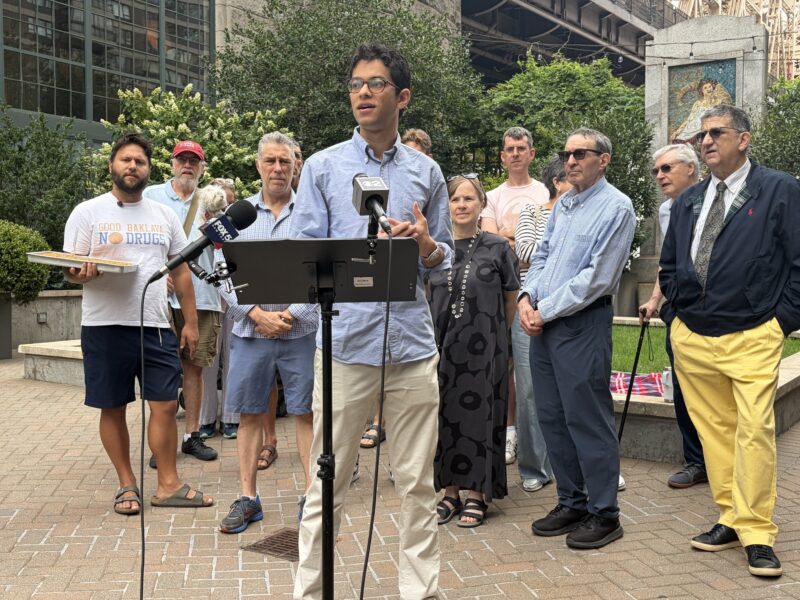
MANHATTAN (CN) — Iskander Khan grew up on the east side of Manhattan. He was a child when he and his father were kicked out of a small park beneath the Queensboro Bridge on 59th Street and First Avenue — and in the years that followed, avoided entering the rare dot of green space on the densely populated island.
“When I’ve been here since, it’s always felt like I’m trespassing,” Khan said in the park Tuesday.
Now 21 years old, he’s one of the named plaintiffs suing Guastavino’s, a luxe event venue that abuts the park, accusing the business of treating a publicly owned plaza as its own private event space.
“This neighborhood doesn’t have that many nice, green, sort of peaceful places to, you know, sit and think for a while, and so I think it’s really important to get clarity in the situation,” Khan said.
Khan and two other plaintiffs filed suit as a class alongside attorney Sean Basinski, who’s individually suing Guastavino’s and New York City after being booted from the park and, on one occasion, arrested by NYPD officers.
Basinski, 54, lives near the park and started visiting the space during the Covid-19 pandemic, seeking a place to work out while gyms were shut down.
Over the years, he said Tuesday, “about half the time” he’s been there he has been asked to leave. He posted a video earlier this month showing a Guastavino’s security guard ordering him to leave and telling him, “You’re going to the hospital, then you’re going to jail.”
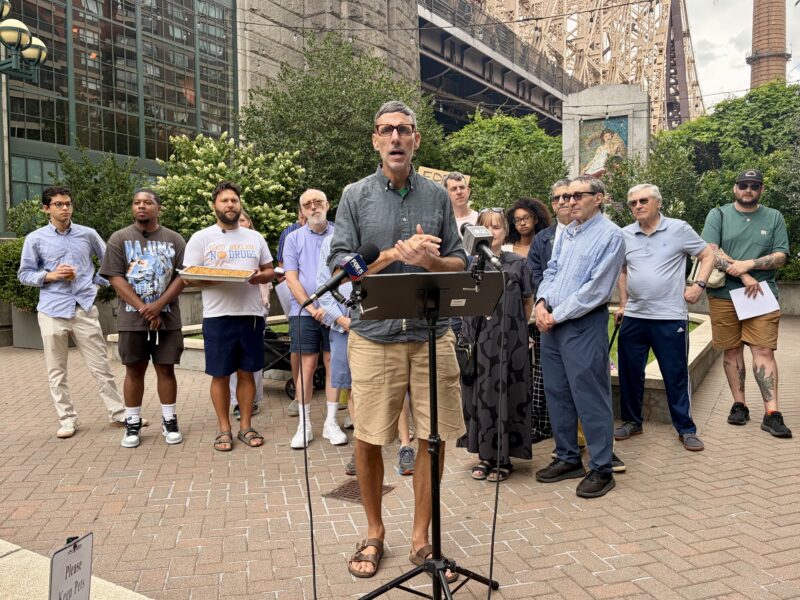 Sean Basinski speaks in the park outside Guastavino’s event venue on Aug. 25, 2026. (Nina Pullano/Courthouse News)
In the lawsuit, Basinski, a former attorney for Street Vendor Project, accuses Guastavino’s, where the cost for hosting a wedding starts at around $150,000, of profiting off public space, noting that the venue advertises outdoor space on its website.
“You can’t sell our public space. Their space is inside, so have your events inside. The brides and grooms can still come out here and take pictures, and they should. But we can be here too,” Basinski said.
Guastavino’s has not yet responded to the lawsuit, filed on Monday, or to a request for comment from Courthouse News. But the business has removed two previously installed plaques in the plaza proclaiming it to be private property.
“We don’t exactly know why or how — I didn’t do it, I swear, judge — but they were removed. Maybe that’s a good sign,” Basinski said.
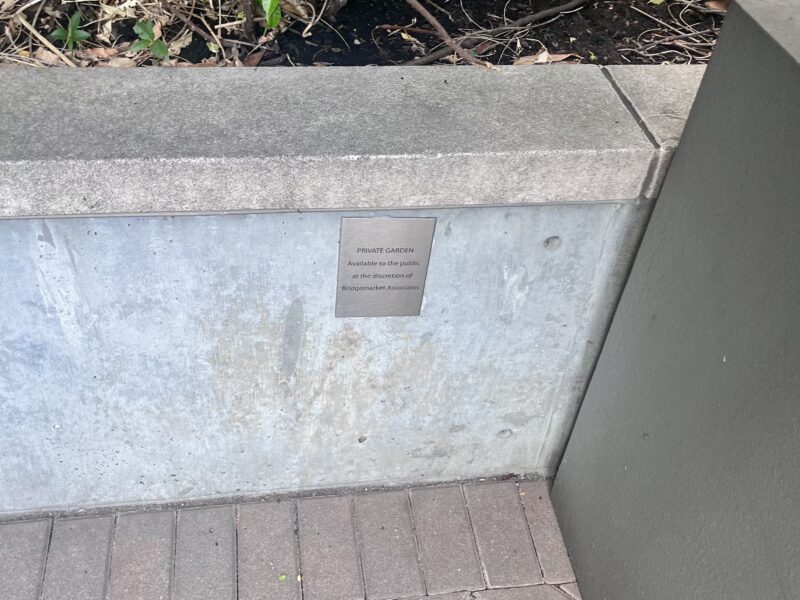 Now-removed plaques declaring that the park outside Guastavino’s event venue is a “private garden.” (Sean Basinski via Courthouse News)
Beyond stopping the venue from “hassling people” for using the park, Basinski said the city should “look into how much they made, and whether there should be a fine or a penalty paid back to the neighbors and residents of our city.”
New York City Council Member Virginia Maloney, who represents the area including the disputed plaza, has supported efforts to enforce its status as a public space. Her office’s director of community affairs, Brice Peyre, joined the plaintiffs and neighbors — and the Baklava Guy, who handed out the imported treats for free and stood with the speakers — at Tuesday’s press conference.
“We all know the old expression, ‘Get off my lawn.’ In this case, the people telling us to get off their lawn don’t actually own the lawn, so to speak,” Peyre said. “This is public space that the public is now, over time, slowly being denied … and it’s got to stop. We got to start enforcing the law.”
Even beyond the now-removed placards, speakers noted that Guastavino’s has signaled ownership of the park by installing tall trellises and roping off the entrances during events.
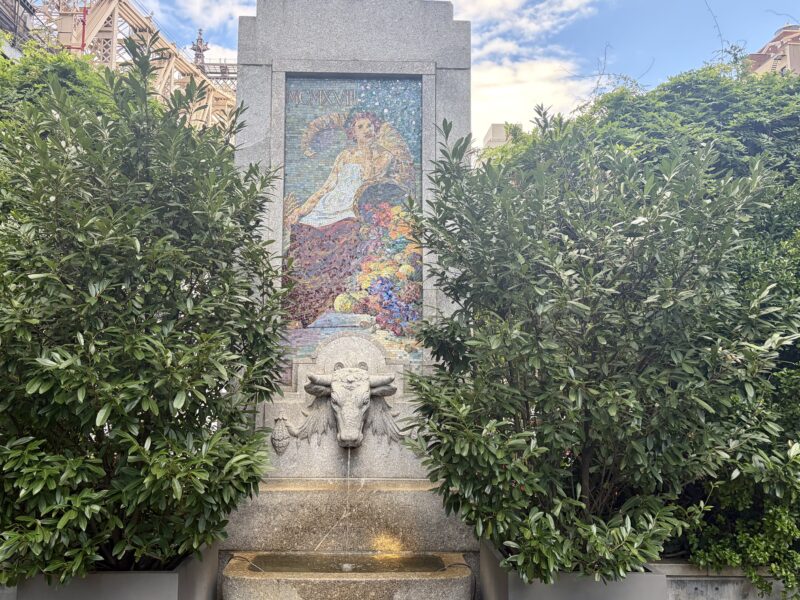 The Evangeline Blashfield fountain. (Nina Pullano/Courthouse News)
Named after Spanish architect Rafael Guastavino, Guastavino’s opened in 2000 as a restaurant, then reopened in 2006 as a private event venue.
According to the plaintiffs, the city purchased the area around 1900 in order to build the Queensboro Bridge, which opened in 1909. In the decades that followed, the open-air plaza beneath the bridge housed a public market where farmers and fishermen could sell their wares without paying a stall fee.
In 1973, the city designated the Queensboro Bridge as a landmark — the market closed in the 1940s — and in the intervening decades, amid legal challenges from public space advocates, the city began to rent out commercial space beneath the bridge.
The plaza lacks the signage at many New York City parks declaring it property of the Parks Department — one of the reasons Khan said he’d always assumed it was indeed private.
But it’s still home to a mosaic fountain, designated in 1919 and donated through the Municipal Art Society of New York by Evangeline Blashfield, who, according to a plaque on a wall to the right of the piece, “sought to beautify public space and provide water for vendors at the open-air marketplace.”
A spokesperson for the NYPD did not immediately return a request for comment. Neither did Guastavino’s.

Follow @NinaPullano

Follow @ninapullano.bsky.socialSubscribe to our free newsletters
Our weekly newsletter Closing Arguments offers the latest about ongoing
trials, major litigation and rulings in courthouses around the U.S. and the world,
while the monthly Under the Lights dishes the legal dirt from Hollywood,
sports, Big Tech and the arts.