
A project to restore a secluded reservoir in one of Queens’ biggest parks highlights New York City’s changing relationship with its wetlands.
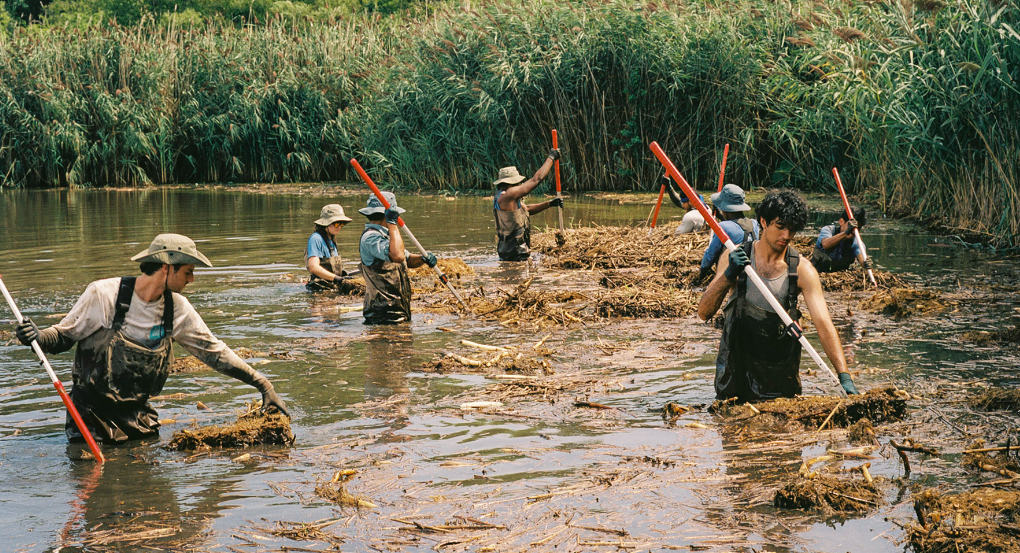
Volunteers have spent the summer wading in the Ridgewood Reservoir in Highland Park alongside snapping turtles, lizards and fishing spiders as part of a tireless effort to remove 15,000 cubic feet of invasive plants called phragmites. The work has helped bring native wildlife and fauna back to the tranquil basin, which sits in an area of the park that’s off-limits to the public.
During the mid-19th century, the reservoir supplied drinking water to the city of Brooklyn. Now, volunteers say their preservation work will help keep water off the streets in surrounding areas. That’s because healthy wetlands can act as natural sponges to blunt the impact of intense rainfall and flooding that are becoming more frequent in the city due to climate change.
“Otherwise, it would go downhill and flood the neighborhoods down the hill, mainly Cypress Hills and East New York. So this is also an incredible piece of green infrastructure,” said Matt Malina, director of the group NYC H2O that’s leading the Ridgewood Reservoir restoration work.
A 2021 report published by the parks department and Natural Areas Conservancy found that New York City’s remaining 1,100 acres of freshwater wetland play a critical role in reducing the impact of storms. The city is increasingly cultivating a system of “bluebelts,” which rely on natural waterways and wetlands to absorb rainwater and keep it out of the city’s aging sewer system. Roughly 850 acres of freshwater wetlands remain on city parkland.
New York state designated the Ridgewood Reservoir as a Class 1 freshwater wetland in 2018, meaning its three basins are permanently protected natural areas.
When the group started restoring the area about six years ago, the water’s surface was choked by phragmites, a 10-foot-tall grass that grows rapidly and is difficult to uproot.
Volunteers like Soph Hart said their work has allowed wildlife to flourish in the park. She recently found a bryozoan — a gelatinous blob of an invertebrate — in the reservoir, which she said is a sign of a healthy ecosystem.
“ I was like rinsing off my arms earlier and I’m like, ‘What is this?’ It’s so bumpy. It, like, moves,” she said.
Chris Cazares, a volunteer with NYC H2O, said that giant snapping turtles have become more prevalent in the waters following the work. He said one of them killed a swan earlier this summer.
“Yeah, they murked the swan. It was dead in the water,” he said.
While the basin of the reservoir remains off-limits to the public, parks department officials said they hope to one day build access paths, boardwalks and offer guided kayak tours on the water.