
On any given Saturday in the summer, Carolina Salguero watches the hordes of mostly young Manhattanites disembark from the New York City ferry at Atlantic Basin, a South Brooklyn inlet serving Red Hook.
Salguero lives on the Mary A. Whalen, the rusty, 1930s-era red oil tanker permanently moored in the basin, just opposite Governor’s Island.
“I look up, I’m like, ‘Oh my god, here come another 150 of them,” Salguero said of the day-trippers.
The New York City ferry, the Hornblower, arriving into Red Hook’s Atlantic Basin, alongside the Mary A. Whalen, which is headquarters for Portside, a maritime nonprofit.
Willow Higgins/Gothamist
For business owners in Red Hook, which was ravaged by Hurricane Sandy in 2012 and two major fires within the last year, the ferry is proving a difference-maker – for the arts community, entertainment, restaurants and jobs.
The historic maritime port is home to Brooklyn’s largest public housing development, and also home to trendy and expensive restaurants, hundreds of art studio spaces and the city’s only IKEA. Those who live there acknowledge they are relatively isolated – there is no subway stop nearby – but say that is also part of the neighborhood’s appeal.
The ferry from Manhattan only started coming to Red Hook in 2017. After a slow start, ridership on a typical summer weekend day approached nearly a thousand last summer, almost triple the first summer’s count. Local business owners say the crowds have only grown since.
Views from Strong Rope Brewery on a Saturday, where bartender Gordon Taylor works.
Willow Higgins/Gothamist
Summertime visitors are mainly Manhattanites who, thanks to ferry stops in Murray Hill, the East Village, and Wall Street, are making Red Hook a favorite summertime daycation. Those who have caught word of the jaunt say that a day in Red Hook feels like an escape to a funky beach town a world away without having to leave the city.
“It doesn’t quite feel like you’re in the city anymore,” said Gordon Taylor, who moved to Red Hook during the pandemic. “It feels like you’re living in a small sort of seaside town just squished right up against the side of Brooklyn.”
But the boat ride itself is only the beginning of the popular pilgrimage, which includes stops at any number of Red Hook staples, both historic and new-aged, that have gone viral on social media in recent years. And while most people who live and work in the neighborhood admit that the summers can be overwhelming, they acknowledge the local economy depends on it.
The Red Hook ferry port, with a Hurricane Sandy water mark.
Willow Higgins/Gothamist
Salguero said Red Hook wasn’t always like this. When she first moved to the neighborhood in the late 1990s, she said there was a whole lot of nothing around. The cobblestone roads were so empty, neighbors would catch up with each other through their car windows in the middle of the street.
“It was like being on a country road,” she said. If anyone drove by, you could just wave them around. There weren’t any parked cars to dodge.
It’s a totally different scene this August.
Twenty-somethings, some in kitten-heel sandals, others in trucker hats, flood Van Brunt Street, which offers a straight shot from the dock to the waterfront bars. Along the way they pass local boutiques, the Red Hook Tavern – which is known for its burger and for the usual line down the block – and a museum of unlocked vintage pinball machines that you can play for a suggested donation.
Getting visitors to stray from the typical foot traffic pattern requires a creative approach: Drew Villano, who grew up in Red Hook, advertises her vintage pop-up in sidewalk chalk from the ferry port to the doors of her business, just a few blocks off the main street.
“Sexy vintage THIS WAY,” her signage reads alongside large arrows.
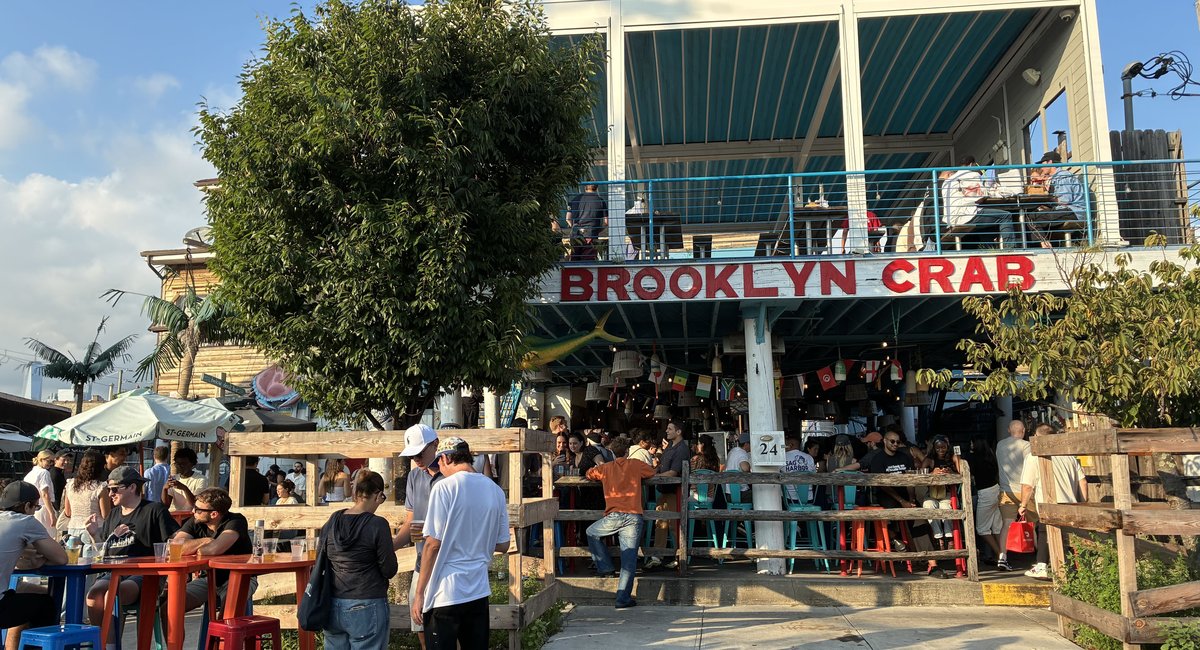
Mostly, local residents say, visitors head toward the same few bars and restaurants. Brooklyn Crab is one of them. The triple-decker crab shack was so crowded on a recent weekend that people overflowed into the street, where they played corn hole with pina coladas in hand.
Brooklyn Crab on a Saturday afternoon.
Willow Higgins/Gothamist
“We didn’t even need to look up directions to the Brooklyn Crab cause we followed all the babies in the light wash jeans and the black tank tops,” said Nadia Wilemski, who came to Red Hook via the ferry. She referred to the stereotypical “West Village girl,” as defined by The Cut last October. (Wilemski lives in Bushwick, but traveled to Manhattan to take the ferry with her Manhattan-based friends.)
Gordon Taylor lives in Red Hook and works at the neighborhood’s Strong Rope Brewery. He acknowledged that the weekend visitors tend to wear a similar “uniform,” as if they were all dressed for vacation. It’s a sharp contrast, he said, from the Carhartts and overalls the local artists, metalworkers and woodworkers wear out and about during the week.
When a ferry lands in Red Hook, Gordon said, “you can tell that it’s like the Manhattanites coming through.”
“Everybody shows up in waves at the brewery,” he said. “You’ll see the crowds of people all walking down the alley together.”
Extreme seasonality
Unlike some stories of gentrification in New York City, where long-timers are upset about their coffee costing $7, the Red Hook residents and employees who spoke to Gothamist said they’re glad to see people enjoying their slice of the city. It helps, they admit, that their local economy depends on it.
Carly Baker-Rice, who runs the Red Hook Business Alliance, said that “while it might feel like it’s doing great on the weekends, the actual story is a lot more complicated.” The economy’s seasonality, Baker-Rice said, is “pretty extreme,” and dependent on “crazy levels of popularity during good weekends.”
The patio at Strong Rope Brewery on a Saturday early evening.
Willow Higgins/Gothamist
Victor Castillo, the general manager of Brooklyn Crab, said in the wintertime, when it’s 10 degrees, people forget their business exists.
Each year, he transforms the space to make it cozy: they tent their sprawling decks, light candles and highlight a lobster bisque, rather than lobster rolls. Even still, he called the winter season a complete loss.
“ We try to go ahead and, you know, do the best we can in the summer months, because we know in the winter months it’s not gonna happen for us,” Castillo said.
Most of his employees are seasonal, he said, and work other jobs during the rest of the year.
“It’s like a summer camp to our employees,” Castillo said. “They work hard and, you know, they make their money, and then they leave for the winter, and they come back the following summer.”
Castillo added that the seasonal staff comes back excited to see their friends and colleagues that, come June, they haven’t seen for the better part of the year.
The line outside Hometown BBQ.
Willow Higgins/Gothamist
Strong Rope Brewery, where Taylor works, is a high-volume bar that shares a large waterfront property with a cidery and winery. The patio has views of the Statue of Liberty, Manhattan’s skyline, and, locals say, one of the best sunset views in the city.
Taylor said that he has to budget his summertime earnings to last through the year. On a good shift at Strong Rope, Gordon says he can bring home $800 in tips. In the dead of winter, it’s more like $50.
Any little thing can ruin it
Baker-Rice said that Red Hook residents understand how fragile their local economy is.
“ Any little thing can ruin it, whether it’s, you know, a little bit of bad weather,” or “horrible traffic that makes it so hard to get there.”
Hurricane Sandy just about knocked the neighborhood out in 2012, and businesses had to rebuild. Now, there are water markers throughout the city, with signs 5 feet off the ground that say things like “Sandy was here.”
The neighborhood was hit with a major fire in 2025, and another one at the beginning of this year. All told, about 150 businesses were hit, Baker-Rice said. While some of those were small artist businesses and studios, it still had a major impact on the economy.
“When we lose a bunch to a disaster, it affects everybody,” she said. So in her mind, increased traffic from the ferry is a big help.
“ It really greases the non-wheels of getting to Red Hook,” she said.
Everybody loves Sunny’s
Whether you’re a real Red Hook local or a local tourist, Sunny’s Bar, which sits at the very end of the peninsula, is often the last stop of the night.
The saloon has been around, albeit through various iterations, since the 1890s. On the weekends in the summer, the bar feels like it belongs in Bushwick, if Bushwick were nautical. A bluegrass band plays in the backroom, but the crowds are so loud you can hardly hear them.
Patrons pile into a vintage green pickup truck that is permanently parked out front, American Spirits resting between their mustaches. There, people drink late into the night, while others come and go on their motorcycles, parked just behind them.
The sunset from Strong Rope Brewery.
Willow Higgins/Gothamist
Gordon said he loves Sunny’s. But he’s said he’s more inclined to go there when he won’t be shoulder to shoulder with the crowds he spent his day serving. When winter comes, it’s bittersweet, he said. He says he knows he has to say goodbye to his summertime paychecks, but in exchange, he looks forward to enjoying his local dive bars with his friends and neighbors.
“Winters are brutal down here ’cause it’s so quiet, windy and cold,” he said. “But also there is a coziness where, like, that’s the quiet time.”