
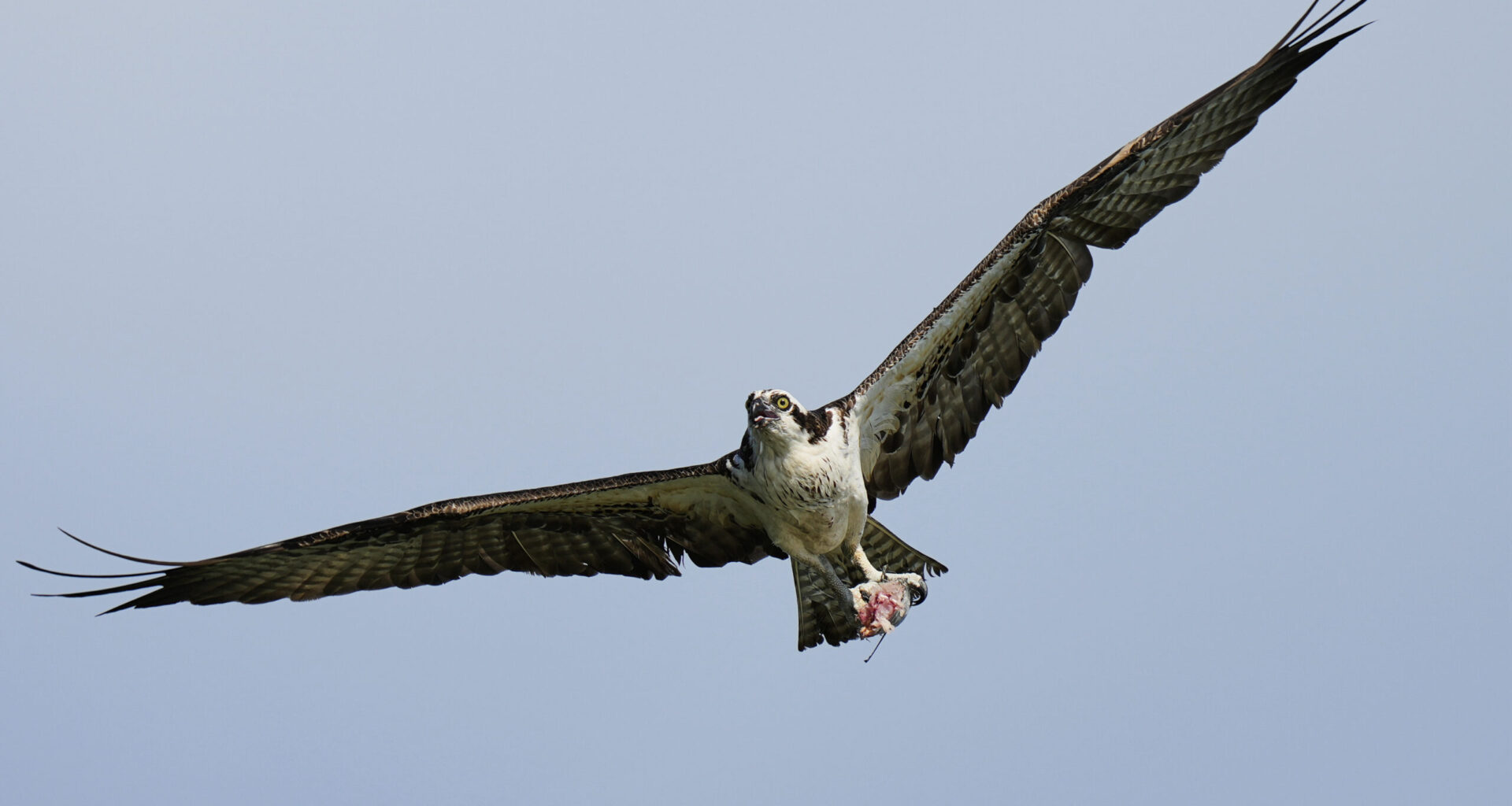
The osprey is a handsome creature, built exquisitely for what it does. It is found on every continent except Antarctica. In the Northeast, they are abundant during warm weather in the Chesapeake Bay area. Like many Marylanders, they head south to Florida for the winter. So what? Well, there’s a reason I’m telling you this. Ospreys are found plentifully in several places dotted around Brooklyn, and they need your help.
But first let me introduce you to this handsome neighbor. The osprey is a fairly large bird, 22 to 24 inches in length. It builds huge nests. It is a nest you are not going to miss if you are looking up and it is in your line of sight. It is unusually large relative to the bird’s size. An interesting factoid is that they often return to nests they previously built, doing some updating and redecorating before moving back in. They add new material to them each season. While ospreys prefer nests near water, especially in large trees, they will also nest on artificial platforms.
Ospreys are raptors in the hawk family and are called by some fish hawks. Fish make up 99% of what they eat. They sport blended coloration, making them look like well-turned-out socialites — nothing bright, shiny, or garish. The Blackwater National Preserve describes the birds as having a dark brown back, a white belly, and a white head with a dark stripe running from its yellow eyes to the back of its head. Female ospreys are slightly larger than males and may sport a dark speckled necklace. They range in weight from 2.5 to 4 pounds. Unlike most of Mother Nature’s creatures, the female is slightly larger than the male.
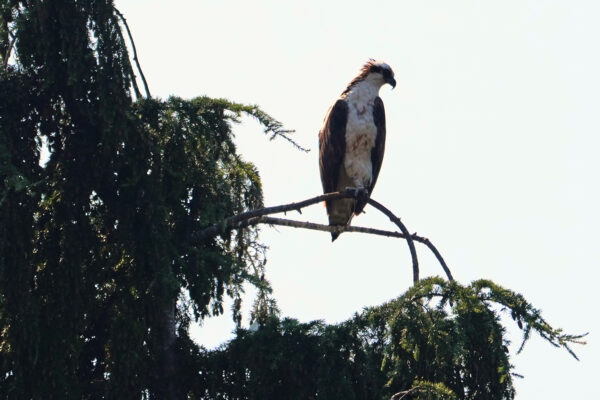 An osprey looks down at the water at the Ballard Locks, Tuesday, Aug. 18, 2026, in Seattle. Photo: Lindsey Wasson/AP
Ospreys are usually monogamous. A female looks for a male who has built a nice nest, a trait not unknown to we humans. If the first attempt at a brood is unsuccessful, they may divorce. No lawyers needed. It is part of the birds’ natural contract. It is innately understood. The female usually lays one egg the first time and then 3 to 4 eggs once a year. The eggs are speckled and about the size of a chicken’s. According to the Scottish Wildlife Trust (Scotland is teeming with ospreys), the eggs take a month to a month and a half to hatch.
This is interesting. The eggs hatch in the same order they were laid. At a certain point, the parents will begin to withhold food, giving only enough to sustain the chicks. This is to “encourage” them to leave the nest and engage the world. They grow quickly, reaching 75% of their full size in a month. In the “it takes a village” mode, ospreys in nearby nests are often visited by another’s fledglings when they begin to fly. The neighbors make sure the little ones are well fed before sending them home. The female is the first to leave the nest and begin her migration. The male plays Mister Mom, teaching the fledglings how to fish. Then he too begins his migration.
Ospreys are built for what they do. They have a 4- to 6-foot span that enables them to glide above the water for long periods. As it dives for its prey, a third, waterproof eyelid slips into place. Blackwater describes it this way: catching its meals by hovering over the water at an altitude of 50 to 200 feet, the bird then dives feet-first into the water to capture its prey. The Osprey’s feel is uniquely adapted to “air fishing.” Is it genetics or intelligence that makes the bird position a fish aerodynamically, headfirst in its talons before it returns to the nest? It’s probably eons of wiring.
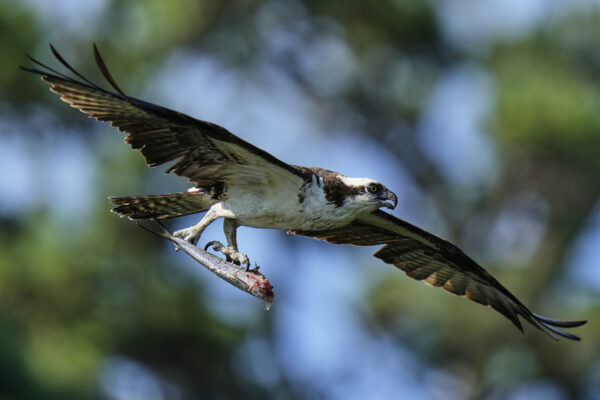 An osprey flies with a half-eaten fish in its talons above the Lynnhaven River, June 30, 2025, in Virginia Beach, Va. Photo: Stephanie Scarbrough/AP
Once it grabs a fish, that fish is not going anywhere. The large, strong, curved talons make sure of that. It can also turn one of its toes inward, adding another talon that keeps any extremely slippery catch in its grip.
Hopefully you have begun to become enamored with this handsome creature, enough so for me to tell you where to find them in Brooklyn. Bush Terminal Park is an excellent choice. Sunset Park has dedicated osprey nesting structures along the waterfront. Calvert Vaux Park is another site, as is Jamaica Bay Wildlife Refuge. So is the East River. The New York Bird Alliance website provides locations and directions, leaving one with the feeling that it is easy enough to get the full osprey experience with just a little effort.
In Asian cultures, to peek into the future one resorts to reading the tea leaves. Well, there are tea leaves to be read north of us, along the east coast, particularly in the Nutmeg State, where scientists have begun to notice a diminishing population of ospreys. They are finding fewer eggs, eggs with thinning shells, and eggs that haven’t hatched. Something is amiss. The Audubon Society and other local birding organizations have begun to reach out to their sister agencies and the Bronx Zoo (I know — the Bronx Zoo isn’t in Brooklyn, but its scientific staff is key to figuring out what is going on.) So, what is going on? Let’s start with American agriculture’s love affair with pesticides.
Chemicals like DDT previously caused severe eggshell thinning, nearly wiping out local populations before being banned. Like many birds of prey, the osprey suffered during the ’60s and ’70s due to its rampant use, and the use of other dangerous pesticides. Research done at Maryland’s Patuxent Research Refuge was used in Rachel Carson’s classic “Silent Spring,” and alerted citizens, scientists, and politicians to the fact that DDT was harming bird populations. Patuxent’s scientists discovered that DDT was working its way up the food chain and thinning raptors’ eggshells. Remember, if the bird eats something that has poison in its system, that poisons the bird. Fortunately, DDT was banned in the U.S. in 1972, and thanks to the hard work of many dedicated people, birds of prey are beginning to rebound. However, that is a long, slow slog when it’s done at the pace of three to four eggs a year.
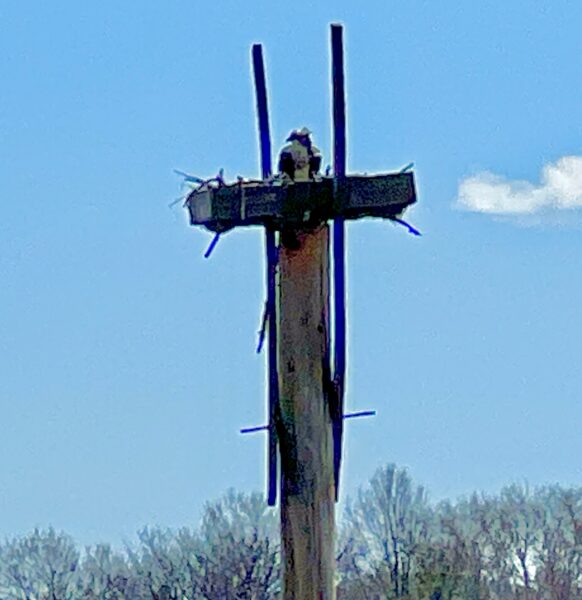 An osprey is sitting high on its nesting site at the Salt Marsh Nature Center in Marine Park. Photo: Loretta Chin/Brooklyn Eagle
But there’s always a but. That but is newer and deadlier pesticides.
Then there is pollution. Discarded fishing nets, plastic rings, and trash can entangle or poison ospreys. Their nests have been known to contain hula hoops, rag dolls, toy boats, and fishing line, all of which are dangerous to the birds and are found during necropsies. A fish snatched from polluted water sickens the bird that eats it, which in turn will harm the eggs or the health of the hatchlings.
Another issue, which is a plague on all migrating birds, is collisions. Power lines, wind turbines and human structures pose structural hazards during flight. Look at this stunning figure: We lose about a billion, yes, a billion, birds a year as they migrate from one part of the globe to another. Ospreys are part of that. For you home researchers, other illuminating facts about ospreys can be found in Alan Pooles’ “Ospreys: A Natural and Unnatural History.”
So, what can you do, sitting in your air-conditioned space, trying to keep cool and not wanting to go outside to find these feathered friends? Actually, you are in a perfect place to help. Go online and search for websites of organizations that protect birds. They will tell you what to do. Here’s a hint: Contact the office of your city commissioner, the mayor and your congressional representative. Let them know that you, a voter, think their involvement is crucial. Also check the zoos and the Brooklyn Botanic Garden. You will also come across seminars you can watch without having to deal with the heat. Then once things have cooled (hopefully), you can go scouting.
Believe me, seeing one of Mother Nature’s marvels soaring above you, then searing the air as it plummets to the ocean or river’s surface and then, remarkably, at seemingly the last moment, turning upward before splashdown with its prize in hand — well, catch that show, and you’ll be hooked. And this is a way that being hooked is good for the osprey.