
New York City faces a complicated math problem, and how officials solve it will decide the fate of one of the nation’s most ambitious and expensive criminal justice reforms.
One year from Monday, on Aug. 31, 2027, the city faces a self-imposed legal deadline to shut down Rikers Island, a micro-city in the East River with its own bakery, gas station, firehouse — and 10 jails.
By the latest count, New York was incarcerating 6,541 people. That’s almost 1,400 more than four new jails, now under construction across the city, are designed to hold.
And those new facilities, part of the $16 billion Borough-Based Jails Program, won’t be completed for years, Straight Arrow has learned.
So Rikers, a jail complex where conditions are so bad that it has been under a federal court’s supervision for 11 years, seems destined to remain open for the foreseeable future, despite years of promises from politicians to find new ways to lock up people accused of crimes.

Download the Straight Arrow app today to get the stories that matter free from manipulation, bias or agenda.™
Point phone camera here
In a statement to Straight Arrow, the Urban Justice Center, a nonprofit legal services organization, blamed “foot dragging, lack of political will and outright obstacles” erected by former Mayor Eric Adams’ administration for the city’s likely failure to meet the deadline to close Rikers.
However, the organization said that under a “newly committed and proactive mayoral administration,” New York could close parts of Rikers by next year while reducing the overall jail population by thousands.
New York City Mayor Zohran Mamdani, who has expressed frustration with the pace of efforts to close Rikers, signed an emergency executive order shortly after taking office in January that directed city agencies to improve conditions in the jails, said Sam Raskin, Mamdani’s deputy press secretary.
“Since then,” Raskin told Straight Arrow, “the administration has paired immediate operational reforms with long-term investments to reduce the jail population, improve conditions for people in custody and staff, advance the borough-based jail plan and move the city toward finally closing Rikers.”
But when?
The quandary
Mamdani aims to dramatically reduce the city’s jail population while accelerating construction of the new jails.
“The vast majority of New Yorkers who are held on Rikers Island are being held pre-trial,” Mamdani said at an April press conference. “And the inability of our city to move quickly at the pace that’s required has meant that there are individuals who have been languishing on Rikers Island not just for months but sometimes for years.”
But with construction delays, costs that have doubled and a system that incarcerates even people charged with minor crimes if they cannot afford bail, the math is increasingly difficult.
Replacing Rikers’ 10 jails with four smaller facilities in Manhattan, Brooklyn, Queens and the Bronx is key to the city’s plan. Combined, the new jails will have 4,160 beds — barely a third of the system’s current capacity.
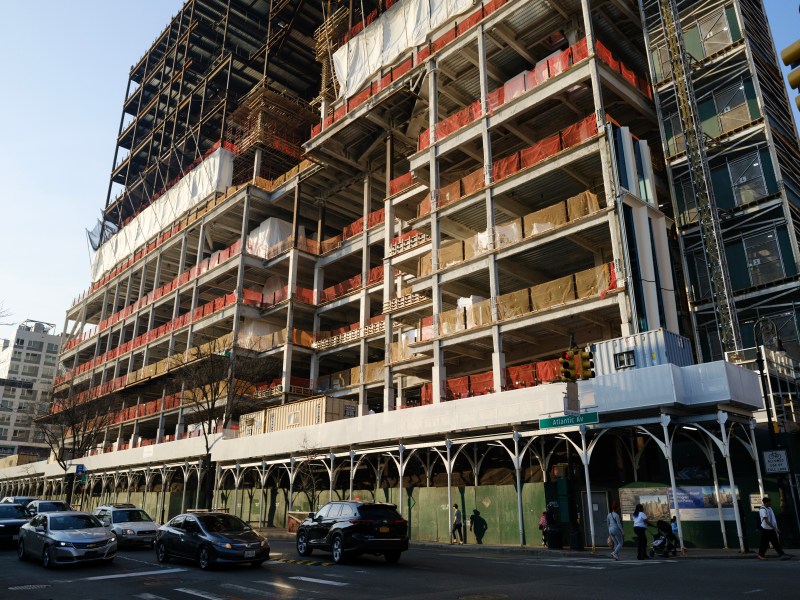 Construction is continuing on a new jail in Brooklyn, one of four facilities that will replace New York City’s Rikers Island jails. Credit: Andrew Lichtenstein/ Corbis via Getty Images.
Those new jails are years behind schedule.
Raskin, the deputy press secretary, told Straight Arrow that the Brooklyn jail is not expected to be finished until 2029, while the Bronx and Queens jails may open by 2031. Raskin said Manhattan’s jail in Chinatown won’t be completed until 2032.
Regardless of construction delays, critics of the Borough-Based Jails Program say new buildings will not fix the problems that have plagued Rikers for decades.
“We fear the Borough-Based Jails program will simply transfer many of Rikers’ existing failures into four new buildings,” said Jan Lee, a co-founder of Neighbors United Below Canal, a coalition that opposes the new jails.
“In addition to the prolonged jail foundation-building process, which can destabilize local properties, and the long construction period of the jail itself, we may not survive this process,” Lee told Straight Arrow. “Without first solving the severe staffing shortages, building four new jails does not solve the underlying problem. It risks dispersing the same understaffing, abuse and neglect of detainees across four new locations.”
What happens if Rikers doesn’t close?
City officials acknowledged in June that they would not be able to close Rikers Island by the deadline, set in 2019 by the New York City Council.
But the council did not say what would happen if the legally mandated deadline wasn’t met. And, at least for now, council members have done nothing to extend the deadline.
As a result, “the City will be in violation of its own law,” Lee told Straight Arrow. “It is our understanding that the City Council is debating how to move this deadline, and by how much.”
But any change will require new legislation from the council.
The failure to close Rikers on time could potentially invite further intervention by a federal judge.
For years, the Rikers jails have operated under court supervision after a lawsuit established that the poor conditions in the facilities violated the constitutional rights of detainees and that officers had used excessive force on incarcerated teens.
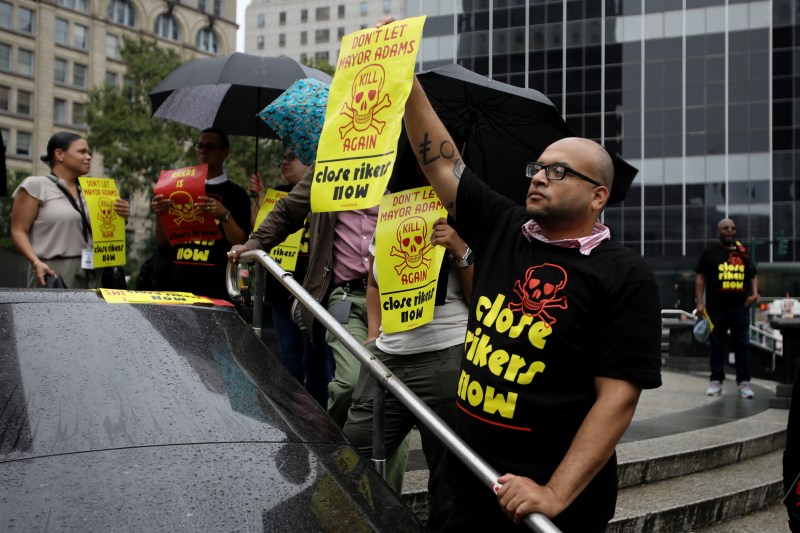 Protesters called for the closure of New York City’s Rikers Island jails in 2023. The city faces a 2027 deadline to replace the facilities with four new, smaller jails. Credit: Leonardo Munoz/VIEWpress/via Getty Images.
In 2024, Chief U.S. District Judge Laura Taylor Swain found the city in civil contempt for not following orders to improve conditions. Swain brought in a remediation manager to work with the city’s Department of Corrections to ensure court orders are followed. The manager has broad authority to make crucial decisions and shape operations on Rikers.
Hernandez D. Stroud, a senior fellow at the Brennan Center for Justice, said the judge may be reluctant to fully take over Rikers — but the city may give her no choice.
“Chances are, Swain doesn’t even want to be at the helm of Rikers Island,” Stroud wrote. “That’s because running jails isn’t a court’s job — it’s the government’s job. But if the government fails, courts must eliminate the ensuing constitutional violations and uphold the rule of law.”
Round out your reading