
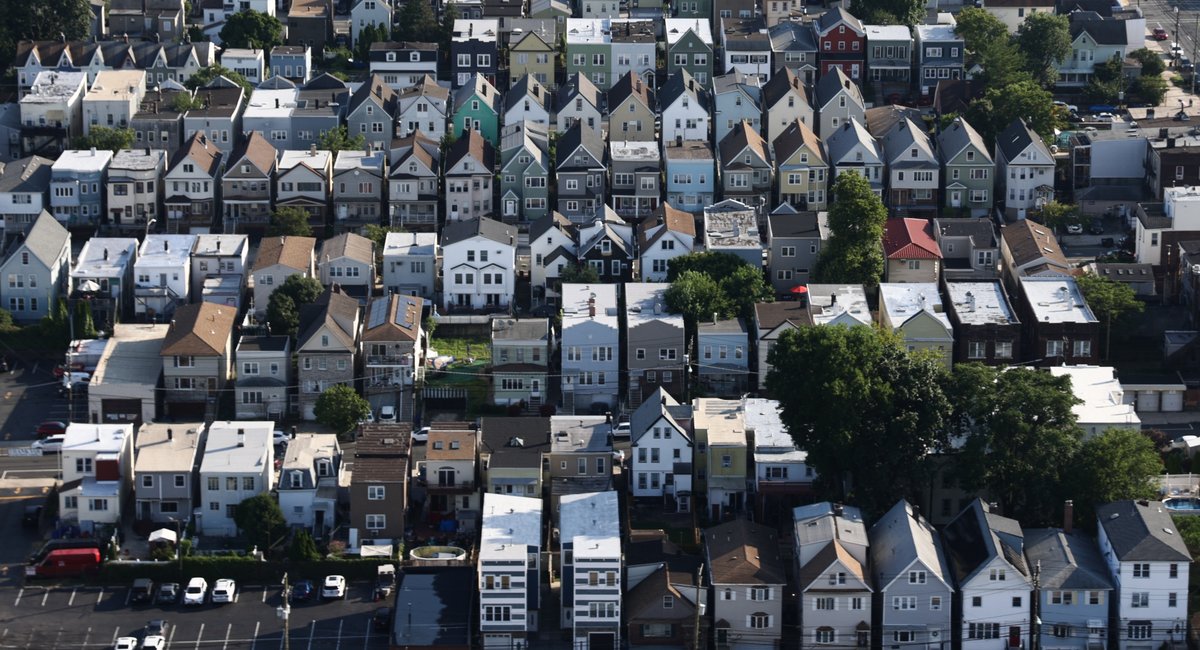
Jersey City’s steep property tax increase is official, after city leaders ended a dramatic budget process amid a local financial crisis.
The City Council approved a new $886 million budget for New Jersey’s second-largest city at a special meeting on Wednesday. The spending plan raises local property taxes 15.15% while making major cuts to most city departments.
The budget’s adoption finalizes a grueling, monthslong process for city leaders and state officials grappling with a $255 million deficit. It’s a drama that unfolded in numerous town halls, city council meetings and backroom discussions in Trenton. It’s taken a historic amount of state aid to go along with the tax hike and cuts to close that gap.
Every city councilmember acknowledged the pain the tax hike would cause residents and local businesses, but expressed they felt they had no choice but to adopt the measure to satisfy state authorities and stabilize the city’s finances.
“ It was a lot, but that’s the job,” Council President Denise Ridley said. “Every vote isn’t going to be an easy vote, but I think the council made the best vote with the position that they’re in.”
Eight of the nine councilmembers voted to pass the budget. Councilmember Michael Griffin, who holds an at-large seat, abstained from the vote. He said he made the decision in the moment, because he couldn’t bring himself to support the tax increase “knowing that people are going to be pushed out of their homes and there’s no real relief for the homeowners.”
“ I grew up in a community which at one time was 80% below the poverty rate,” Griffin said. “I know what it’s like to struggle, and I know the type of struggle that we’re putting on people.”
Nathaniel Styer, a spokesperson for Mayor James Solomon, called the budget a “significant step” towards fixing Jersey City’s budget crisis. He noted the budget cuts spending by $58 million and limited the tax increase to its lowest possible amount.
“There are no easy solutions to a budget crisis of this magnitude, and the mayor fought for and won a historic $120 million aid package from Trenton to lessen the burden on Jersey City taxpayers and protect vital city services this year – like right to counsel, safer streets and public safety,” Styer said. “While both the cuts and tax increase are painful, we believe they are the first steps towards getting Jersey City’s finances back to healthy and stable.”
Inheriting a hole
The budget crisis has dominated Jersey City politics since Solomon revealed the scope of the deficit shortly after taking office in January. Solomon has placed the blame squarely on his predecessor Steve Fulop, who Solomon says relied on one-time cash infusions, spending deferments and accounting tricks to balance city budgets.
An annual audit released this month found the city had overspent on health benefits in 2025, Fulop’s last year in office, while lacking adequate internal controls for tracking revenue and spending. The audit also found the city doesn’t have a complete inventory of all the land, vehicles and equipment that it owns.
That audit landed just days after Gov. Mikie Sherrill called Fulop “a very bad mayor” who put the city “in a lot of debt.”
Fulop served three terms as mayor, holding the office for a dozen years before choosing not to seek re-election last fall in order to run for governor instead. He lost that campaign and now leads the nonprofit Partnership for New York City. He did not comment on the new budget, and referred Gothamist to a previous statement in response to the criticism of his tenure.
“Had I chosen to run for re-election, we would have introduced another budget with no tax increase for Jersey City residents as we did nearly every year,” Fulop previously said. “It’s also worth noting that [Solomon] served on the City Council for eight years with full budget responsibilities. During that time, he never raised these concerns and voted for virtually every contract and resolution that came before the Council.”
Historic state aid, with a catch
Solomon’s administration asked the state for $150 million in transitional aid shortly after he took office. Months of negotiations between local leaders, state lawmakers and the Sherrill administration ultimately led to a deal. The city got a $120 million aid package comprising a $105 million loan and a $15 million grant.
That aid package comes with strict conditions that give state authorities at the Department of Community Affairs final approval on the city’s spending decisions. The state has the power to set the city’s tax rate unilaterally if it is not satisfied with the measures taken by local leaders.
The DCA did not immediately respond to a request for comment.
The state originally demanded a 20% tax hike. Solomon proposed that in late June, before withdrawing the proposal and returning with a 15.5% hike after fierce public pushback. That increase was lowered slightly to the final 15.15% after the City Council made its final amendments to the mayor’s proposal.
The administration and city councilmembers have repeatedly said state authorities would not approve any spending plan with a tax hike less than 15%.
“ If we don’t pass a budget doing this, not only will Jersey City be hamstrung by an enormous budget hole, but the state could then take over entirely and raise taxes as much as they want,” said Councilmember Eleana Little, who represents Downtown Jersey City. “There is no good option here, only bad options and less bad options.”
The 15.15% increase in city property taxes comes as the Jersey City Board of Education raises school taxes 14% and Hudson County leaders raise county taxes 14%.
It all means that the average home in Jersey City, with an assessed value of $480,000 according to state data, will now pay $12,813 in taxes. That’s up from $11,203 in 2025. That’s a harsh pill for property owners to swallow, and it’s an increase that landlords are likely to pass on to renters.
“ I heard the fear about being homeless,” at-large Councilmember Rolando Lavarro said while choking up. “People are rightfully asking if they can still afford to live here.”
Councilmember Joel Brooks, who represents the city’s West Side, said years of city leaders eschewing smaller increases made this budget’s sharp tax increase unavoidable.
“ The hard truth is our city operations, as imperfect as they are, were not fully funded from year to year, which created an illusion that no tax increases on the municipal levy were possible from year to year,” Brooks said. “ We were living in a mirage, and it was not sustainable.”
Widespread cuts
The Solomon administration took major steps to cut city spending earlier this year, even before releasing a budget proposal. That included scrapping the controversial Centre Pompidou art museum project, changing health insurance providers and scaling back the city’s microtransit service.
Solomon laid off 31 provisional city workers last month as part of the cuts. Council-led changes to the budget restored funding to rehire some of those people, including the driver for the city’s senior bus service. Councilmember Thomas Zuppa, who represents the Journal Square neighborhood, was outspoken for weeks about getting that driver’s job back.
“ If our priorities are are to protect our seniors and our most vulnerable residents, we should look for other cuts besides firing someone like the senior bus driver who was taking our residents out of the city to Walmart and other shopping and excursions,” Zuppa said.
The city council also secured a funding boost for the right to counsel program, which offers legal aid to people facing eviction in Jersey City, while making a $200,000 cut to the police overtime spending.
Progressive councilmembers, including Jake Ephros, who represents The Heights, had sought to reallocate $3 million from police overtime to fund cut programs in other departments.
“ These are all compromises. Nothing that I feel very deeply inspired to do any victory laps about,” Ephros said. “They’re not all the cuts that I fought for and not all of the reallocations I fought for either.”
What comes next
City leaders say they’re now focused on helping residents face the tax increase, boosting outreach efforts to make the most vulnerable aware of resources available to help them stay in their homes.
Solomon will also have to navigate union negotiations with a workforce that has been asked to bear a heavy burden. Eight of the city’s 11 public workers unions are out of contract. Some of those workers have been laboring without a contract for more than six years. The new budget has reserved money to cover increased labor costs in anticipation of salary increases under new labor agreements. City officials have said they expect to resume bargaining with the unions this year.
City councilmembers say they’re already starting on the 2027 budget, hoping to pass it earlier in the year. Some, including Lavarro, said they hope the next budget process will be less focused on past actions.
“ The blame game ends with this budget. For months, we have heard whose fault this is, the last administration, the state, forces beyond our control,” Lavarro said. “This final budget and this 15.15% tax increase now belong to us.”
The city’s structural gap remains, though it will not be as wide next year. Ridley said it’s too soon to speculate on what a tax increase may be in 2027.
“ I think that all depends on the revenue we get in this year,” Ridley said. “I can tell you this council is not looking to do 15% next year.”