
Get stories like this delivered straight to your inbox. Sign up for The 74 Newsletter
Every year, New York City surveys families, teachers and students about their experience with the public schools. The questionnaires are designed to “support a dialogue among all members of a school or program’s community about how to make the school or program a better place for learning.” Unfortunately, they reveal a large disconnect between what parents think is happening and where students actually stand academically.
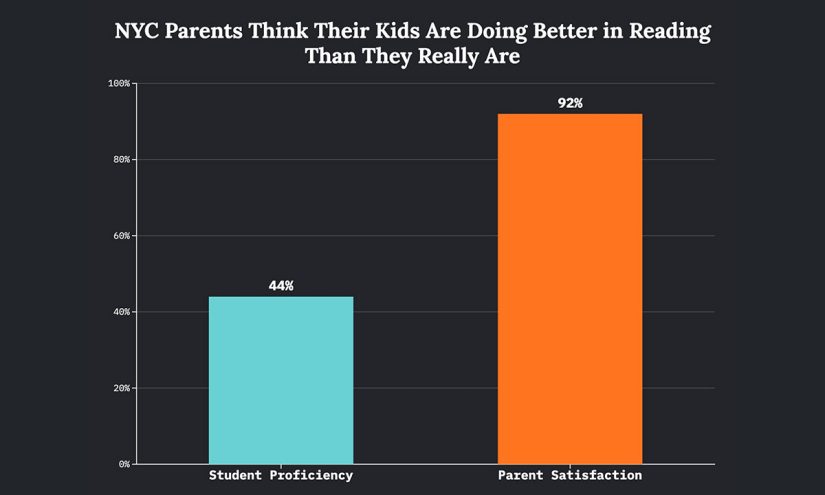
This year, the survey went out from February to April. Of parents queried, 446,743 responded, and they were strongly positive about their children’s learning experience. For example, 92% of parents of third grade students agreed or strongly agreed with the statement that, “My child is progressing in reading the way I would expect.” Such high rates of agreement were consistent across grade levels and subjects.
RelatedMany Parents Value Grades Over Test Scores, Missing Signals to Intervene
At the same time the surveys were wrapping up, the kids were sitting down for state tests. And those results painted a much less rosy picture. In third-grade reading, just 44% of students scored proficient or above. To be sure, a child who starts behind can make meaningful progress while remaining below grade level. But the size of the gap is still remarkable.
In the early grades, for example, 92% to 94% of parents said their children were progressing in reading as they expected, and 92% to 95% said the same in math. Meanwhile, just 43% of New York City’s students in grades K-2 scored at or above the national median in reading, and just 42% did so in math.
Of course, Big Apple parents are hardly alone. The national nonprofit Learning Heroes has been working to raise awareness about the disconnect between inflated classroom grades and objective learning outcomes. Still, as The 74’s Jessika Harkay reported earlier this year, many parents value grades over test scores. According to a recent study, 71% of parents said grades are more important than tests in making decisions for their children, compared with just 8.5% who said test scores are more important.
RelatedWhen Getting Good Grades and Working at Grade Level Are Not the Same Thing
But test scores are important, and early grade results are strong signals of future performance. A recent longitudinal study from NWEA found that only 14% of students who started kindergarten in the bottom 20th percentile eventually read proficiently by third grade. The chances were even lower in math. Those results reflect the current status quo, but they underscore how important it is for parents and schools to identify learning gaps early and act quickly to address them.
The problem is that many parents may not be getting a clear signal that anything is wrong. If schools tell parents their children are progressing, classroom grades reinforce that message and parents discount standardized tests, then the students who most need additional help may be the least likely to get it.
Disclosure: The author consults with NWEA, but the conclusions drawn here are his own.
Did you use this article in your work?
We’d love to hear how The 74’s reporting is helping educators, researchers, and policymakers. Tell us how