
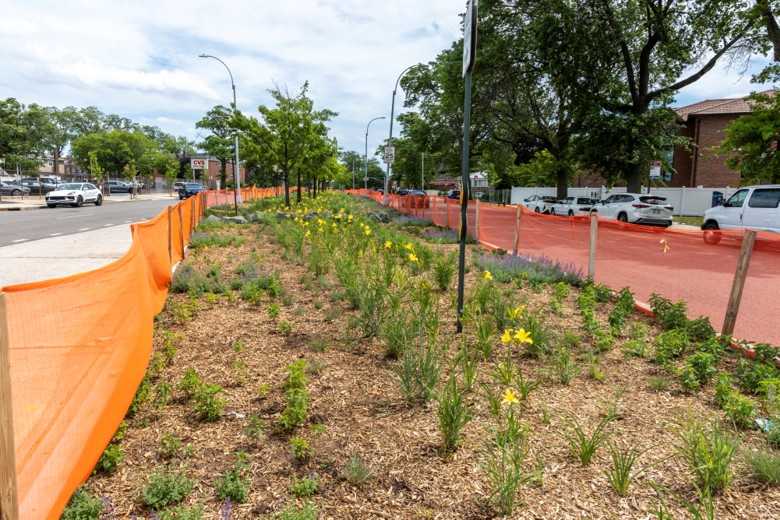
Mayor Zohran Mamdani and Gov. Kathy Hochul have announced a new $8.4 million initiative to create flood resiliency infrastructure across Queens by converting concrete roadway medians into green infrastructure “sponges” that can absorb excess stormwater and help prevent extreme flooding.
The transformed medians, which will be located in Whitestone, Forest Hills and Queens Village, will capture an estimated five million gallons of stormwater each year, alleviating pressure on local sewage systems.
The initative, announced by Mamdani, Hochul and Department of Environmental Protection (DEP) Commissioner Lisa Garcia Thursday afternoon, also aims to improve the quality of local waterways, including the East River, Flushing Bay and Jamaica Bay.
The investment is partly funded through New York State grants totaling $5 million from the Green Innovation Grant Program, administered by the Environmental Facilities Corp., and the Water Quality Improvement Project, overseen by the state’s Department of Environmental Conservation.
As part of the initiative, the city is planting native species and wildflowers above existing stormwater storage networks, including a stretch of Francis Lewis Boulevard between 21st Avenue and 20th Road in Whitestone, which estimated to capture 1.11 million gallons of stormwater each year.
On Union Turnpike between Metropolitan Avenue and 71st Road in Forest Hills, the new green infrastructure is anticipated to capture 2.43 million gallons of stormwater per year, while green infrastructure on Springfield Boulevard between Merrick Boulevard and Lucas Street in Queens Village is estimated to capture 1.44 million gallons per year.
The work on Francis Lewis Boulevard is nearing completion, while work on Union Turnpike is slated to begin in fall. Work in Queens Village is expected to begin later in the year.
The initiative will remove old concrete medians and curbs, clear overgrown or dead trees, weeds and accumulated debris to transform the medians into green corridors planted with native species, shrubs, grasses and wildflowers. To ensure water flows into the newly-planted medians, new inlet openings will be built to divert water off the streets and directly into the planted areas.
The initiative involves installing specially-engineered soils and underground storage systems to absorb stormwater.
The project aims to provide stronger flood protection for local Queens communities as well as cooling and beautifying the streetscape. It also aims to enhance neighborhood aesthetic and improve pedestrian safety with new ADA-compliant ramps and detectable warning surfaces.
Mamdani said the new infrastructure would help the neighborhoods deal with “more intense and unpredictable bursts of rain” brought on by climate change.
“Climate change is bringing more intense and unpredictable bursts of rain, and without action, those storms will continue to overwhelm New York City’s sewer system,” Mamdani said in a statement. “By planting native species and wildflowers above an underground stormwater storage network, we will capture five million gallons of stormwater each year, easing pressure on our sewer system and keeping New Yorkers safe.”
Hochul, meanwhile, said flash floods have become the “norm” in New York City and added that it is imperative that both city and state invest in green infrastructure to protect local communities.
“Here in New York, we are implementing innovative solutions to strengthen our infrastructure and better protect our communities,” Hochul said in a statement.
Garcia said the city must respond to climate change “reshaping our world” by reshaping its infrastructure to cope with new challenges.
“By trading hard concrete for living landscapes, we are not just managing stormwater but reimagining what our streets can be,” Garcia said in a statement.
She added that the initiative will transform expansive concrete medians into “vibrant green corridors” that can soak up millions of gallons of rainwater.
“This is how we transform everyday spaces into innovative flooding solutions that both protect communities and beautify neighborhoods,” Garcia said.