
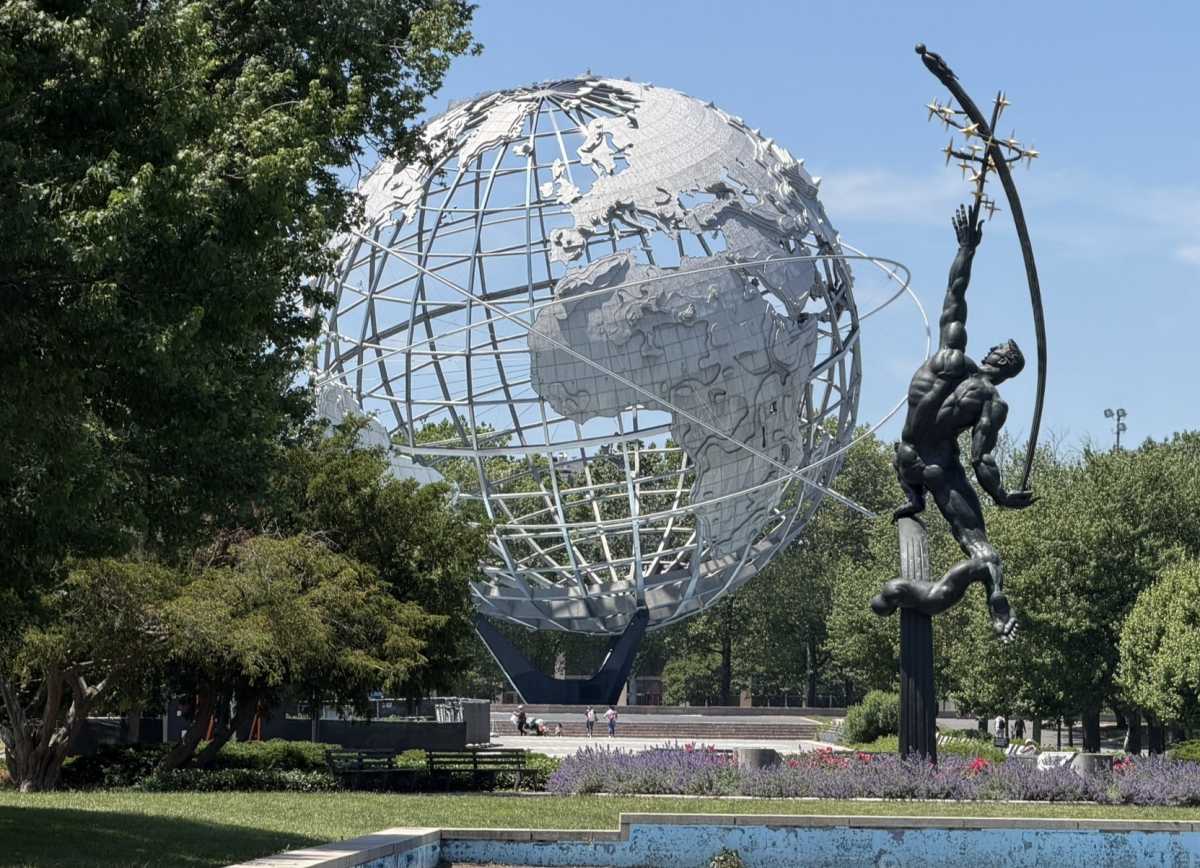
Nonetheless, altruistic volunteers and stewards across the Queens community have eagerly poured their heart and soul into revitalizing the once-glowing park, spearheading beautification projects and giving everything they can to maintain all 897 acres of the public green space.
Yet those efforts, and the flow of revenue to ensure Flushing Meadows’ upkeep, are not nearly enough. It is estimated that each acre of Central Park receives about 277 times the amount of private funding as each acre of Flushing Meadows, despite recent investments in the park that are supporting programming and some capital improvements.
That equates to about $138,000 per acre at Central Park compared to just $497 per acre at Flushing Meadows.
Nonprofit organizations like the Alliance for Flushing Meadows-Corona Park (AFMCP) and the Queens Community House (QCH) have made strides securing crucial programming and beautification initiatives, and the Central Park Conservancy has even extended a helping hand to the park through its Five Borough Program.
Advocates say the disparities between the parks will never close without support from community partners, private entities and, most importantly, City Hall.
The current state of affairs
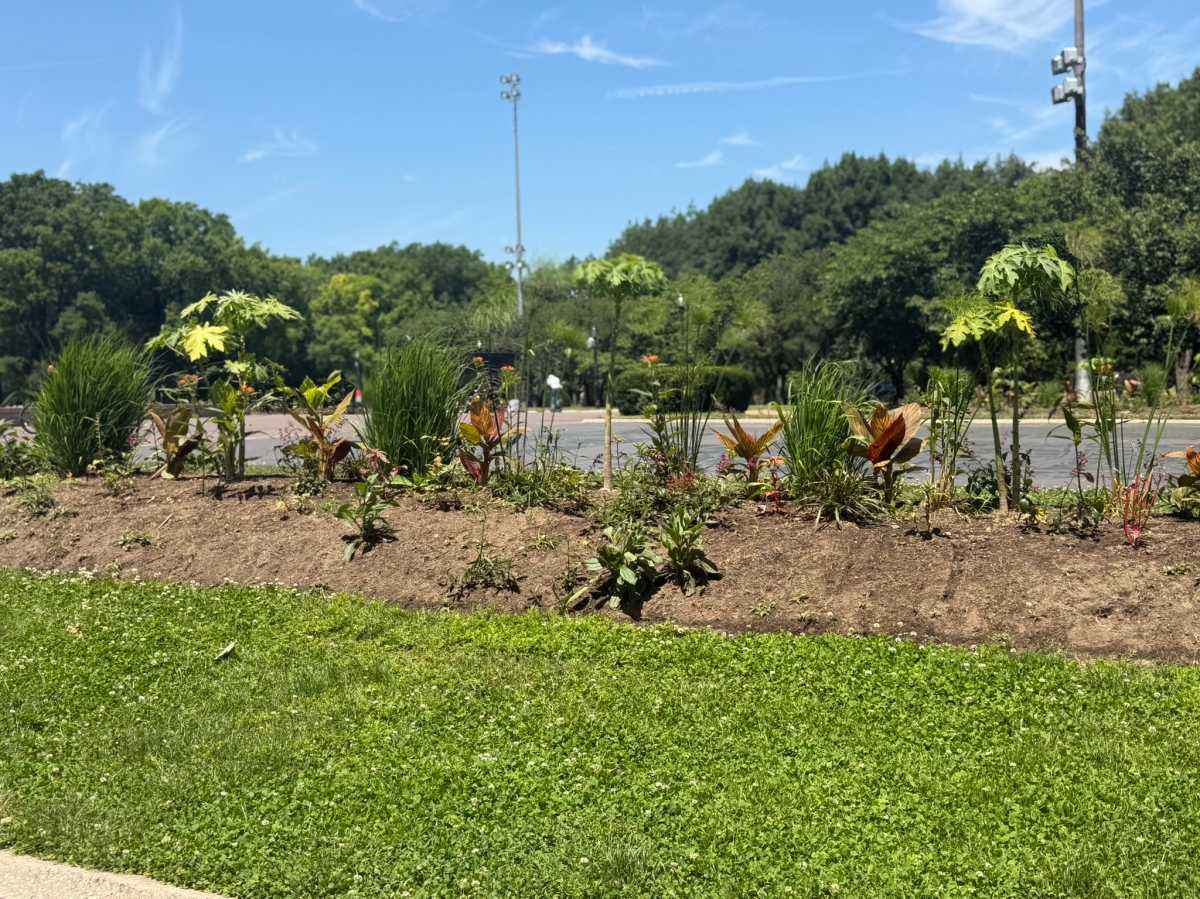 Landscaping and plants, some wilting in the heat, lining the Etched Granite Pavement. Photo by Renee DeLorenzo
Jonathan Bowles, executive director of Center for an Urban Future (CUF), co-authored a report in August 2025 titled “The Park Queens Deserves,” arguing that not only is Flushing Meadows the most important park in Queens, but it’s the most underappreciated one.
The park is over 50 acres bigger than Central Park and is the fourth most visited park in New York City, with an estimated 54 million visitors each year. It is also the only expansive green space in Queens, which many apartment-bound residents view as the backyard they don’t have.
In the report, Bowles argued the park needs more long-term capital funding and a commitment from the City Council to dedicate city funding to the park, which it does not otherwise obtain through donors with deep pockets as many of the parks in Manhattan do.
“It’s often been in the shadow of other city parks,” Bowles said. “It’s in Queens and mainly being used by working-class immigrant New Yorkers. It’s never had the resources that Central Park or even Prospect Park has.”
According to Statistical Atlas, over 70% of Flushing residents are Asian and over 70% of Corona residents are Hispanic.
The population of the communities surrounding Central Park, however — the Upper West Side and the Upper East Side — is 67% white and 78% white, respectively.
“If you dig a little deeper, it has to do with the populations that use the park,” added Anna Dioguardi Moyano, director of community engagement at Queens Community House. “It’s predominantly immigrant, non-native English-speaking communities that are often marginalized and neglected.”
Median income in Flushing and Corona both sit around $48,000; on the other hand, the Upper West Side sits at $119,000 and the Upper East Side at $130,000. However, those numbers only include taxable income and not accumulated wealth or net worth.
Even the wealthiest households in the top 5% of Flushing and Corona, which earn an average of around $200,000, earn significantly less than the top 5% of households in the areas surrounding Central Park, which both exceed an average of $1 million.
Aside from private donors, CUF’s data shows only $100 million in city funds have been allocated to the park in the past 13 years, although federal funds briefly supported the park after Hurricane Sandy blew through downstate New York and caused heavy flooding.
“It might sound like a lot, but that’s over a 13-year period,” he noted. “Even just one playground is going to take $22.5 million to renovate — and it might not be the whole thing… It is not enough to keep up with the fundamental infrastructure challenges that the park has.”
While QCH and the Alliance have made many improvements at the park possible, Moyano admitted that addressing the many issues faced by Flushing Meadows is too large a project for the nonprofits to take on alone.
After meeting with the park administrator, she said she was told the park needs at least $15 million in baseline funding every year just for maintenance. As of now, however, it’s unclear how much the park receives for those operations.
“This park has many, many issues that will take maybe decades to resolve,” she said. “We started to talk about how the only way we’re going to tackle this chronic underfunding is through an increase in both private and public investment.”
Advocacy at Flushing Meadows
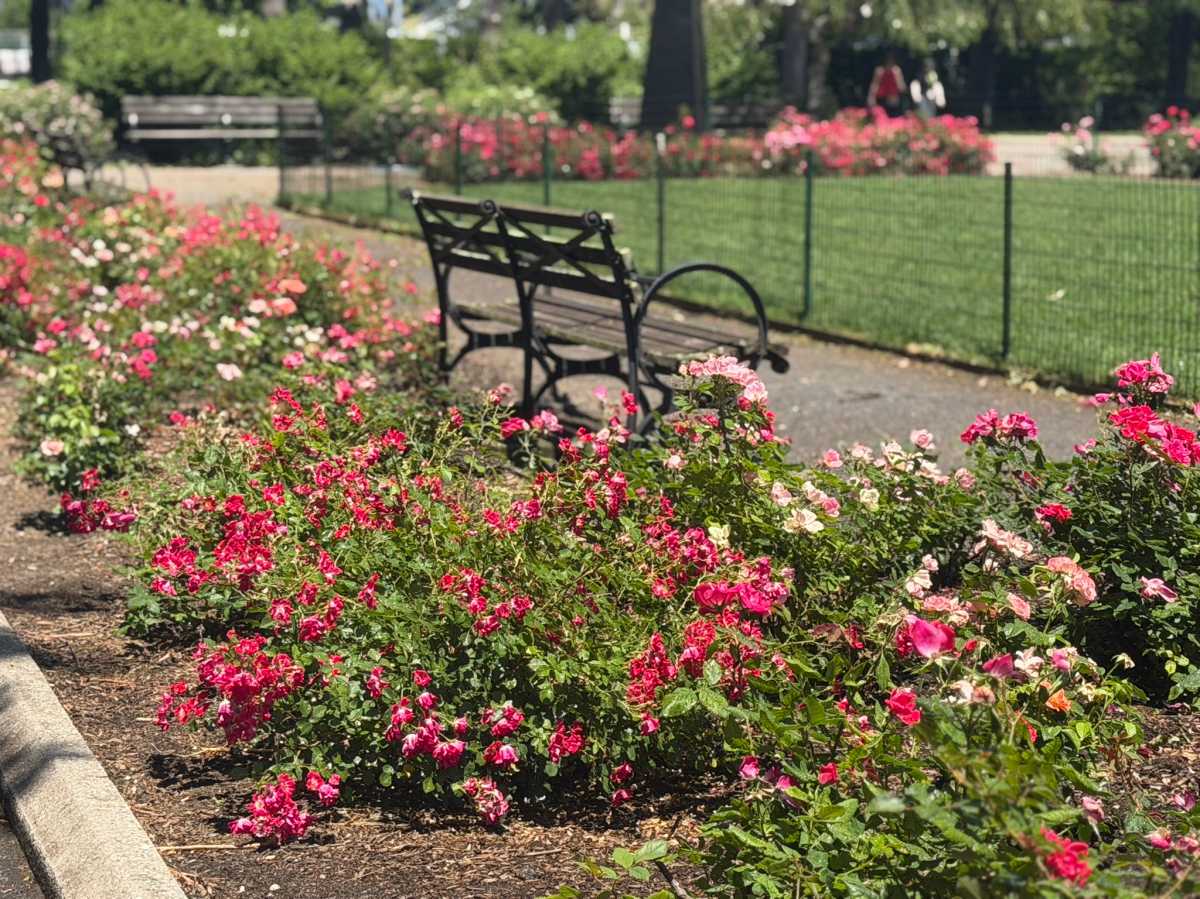 Pink flowers and benches line a courtyard in the park. Photo by Renee DeLorenzo
Over the years, several advocacy organizations have fought for Flushing Meadows and taken on the responsibility of maintaining it. Moyano, for example, helps keep the park alive through QCH beautification efforts.
The organization has a long history with Flushing Meadows, she explained, dating back to 2012 when it served as part of the Fairness Coalition of Queens — a grassroots collective of local civic groups, small business owners and residents — to advocate for protection of the park from private development.
Eventually, QCH helped create the Alliance — one of the park’s key advocates — as well as the Neighbors in Action community engagement initiative.
The Alliance operates much like the Conservancy, hosting volunteer events and drumming up support in the community to care for and maintain the park. However, the Alliance has only been around for 10 years, while the Conservancy will be celebrating its 50th anniversary in 2030.
According to Anthony Sama, a parks administrator and executive director of the Alliance, the time over which the Conservancy has built its community greatly boosts its power and influence.
He said it’s also important to contextualize the conditions under which the Conservancy was founded and the surrounding communities it first relied on for donations.
“The Conservancy was established when the city was practically bankrupt and needed to rely heavily on these nonprofit partnerships in order to do just basic maintenance,” Sama said. “Flushing Meadows is surrounded by a diverse community that has arguably been marginalized over the decades. It makes it difficult to fundraise compared to Central Park that has neighbors whose income and capacity to give are greater.”
The Alliance also has significantly less full-time staff and members. It only has two full-time employees — a director of development and a director of programming — along with Sama’s role that he said is largely volunteer-based.
There are also 26 board members, including appointees from elected officials — and over 2,000 volunteers who attend events throughout the year.
Sama explained that the Alliance does not have major funding for operations in the park, but rather raises funds to provide the park with anywhere between 8 and 12 seasonal staff members to supplement the existing park staff. Those staff members, however, are managed by the New York City Department of Parks and Recreation.
A model that works for Central Park
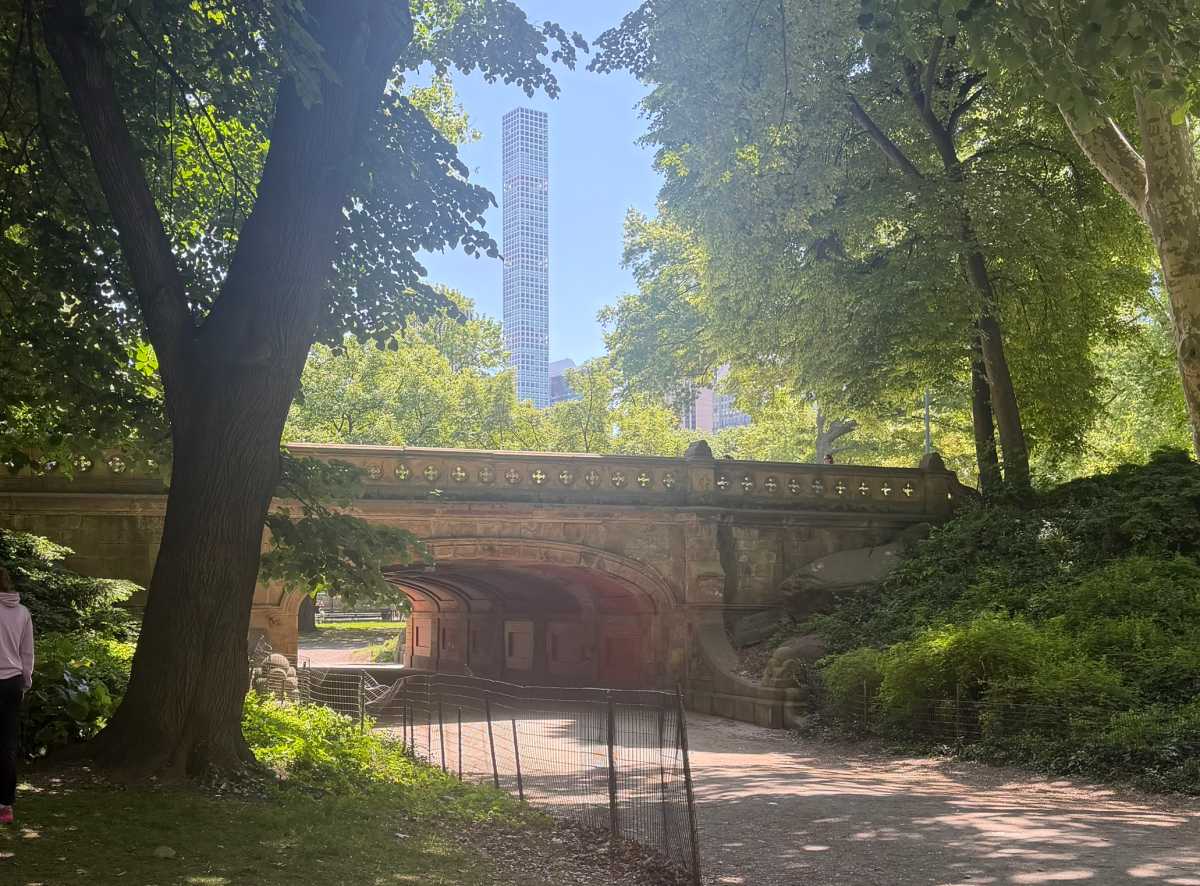 The Greyshot Arch in Central Park. Photo by Renee DeLorenzo
According to the Conservancy, the nonprofit is responsible for raising the majority of Central Park’s annual operating budget — around 80% — through individual donations and private support. The team works year-round to generate funds needed to care for the park, whether it be daily maintenance, arboriculture, restoration, visitor services or long-term preservation.
The Conservancy said every dollar invested by the city is spent on park operations, which is outlined in its operating agreement with the City of New York.
While the Conservancy receives no revenue from concessions in the park operated by the Parks Department, it does derive revenue from the two licensed premises the Conservancy operates — the Dairy Gift Shop and the Davis Center. Those funds, the spokesperson continued, are used to fund the two facilities’ maintenance and operations.
In general, the Conservancy has built strong relationships with citywide partners. The success of its model has given it the opportunity to extend a helping hand to other parks like Flushing Meadows. For more than 20 years, it has supported parks throughout New York City through its Five Borough Program.
The Conservancy recently announced a partnership with NYC Parks at Flushing Meadows in early 2025 and has since helped restore landscapes, improve access and create a better experience for visitors.
“We believe every park deserves excellent care, and we’re proud to use the resources and expertise we’ve built through that model to support parks across New York City, including through our Five Borough Program partnership at Flushing Meadows,” the spokesperson continued.
A different story in Flushing Meadows
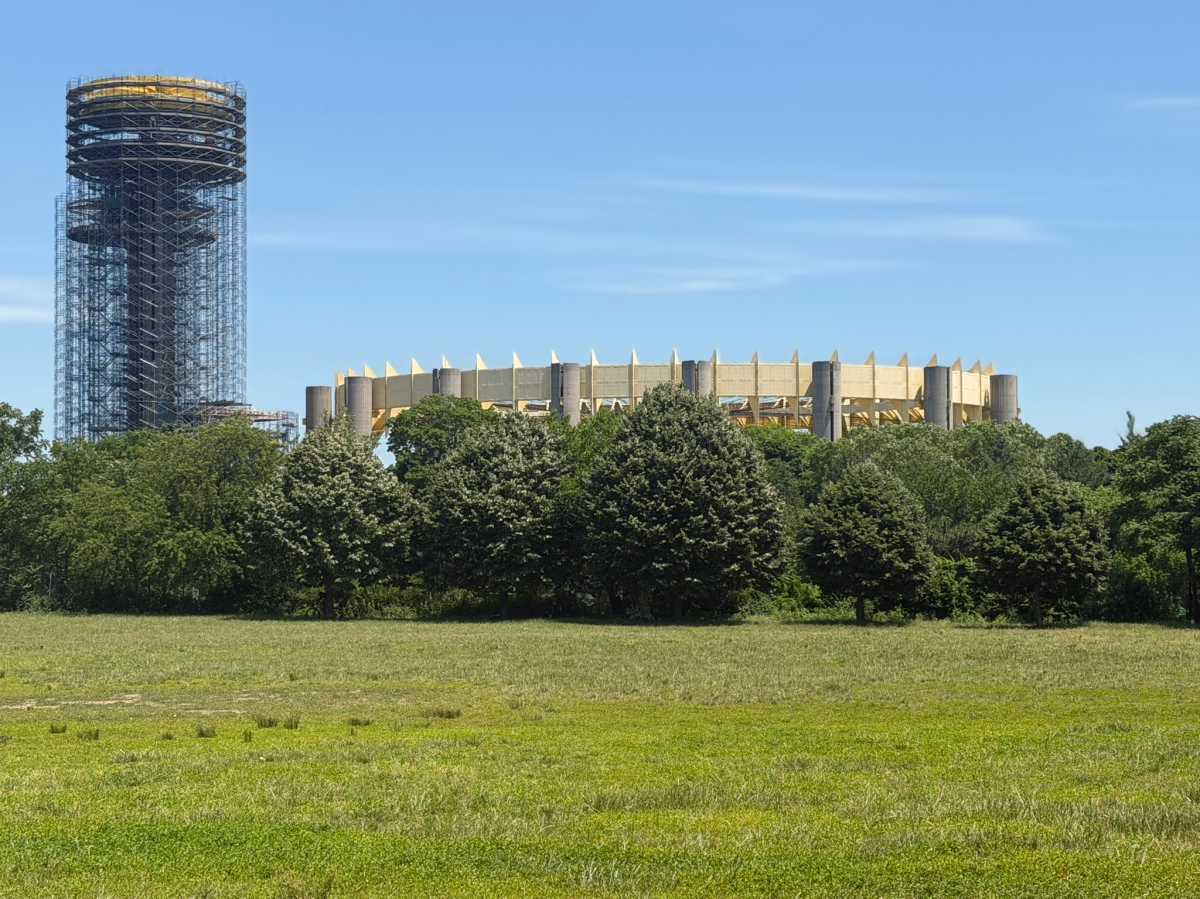 The New York State Pavilion Observation Towers and the Tent of Tomorrow, which can be viewed from around the park. Photo by Renee DeLorenzo
Bowles said it’s hard to compare Central Park’s private partners to those of Flushing Meadows, such as the USTA and the New York Mets, who operate Citi Field. While both entities have done great things for the park, he continued, it’s not the same as having numerous wealthy donors as there are in Central Park.
“Queens has yet to be able to turn more of the borough’s affluent people into supporters of the park,” he said. “I think the Alliance is trying to do that, but it’s not happening to a large extent right now.”
According to Bowles, both the USTA and Citi Field could do more to help support the park. He pointed to efforts by organizers of the Governor’s Ball, which is hosted at Flushing Meadows each year and donates $1 per ticket sold for the three-day festival to the park. At roughly 40,000 tickets sold per night, that equals nearly $120,000 for the park in just one weekend.
The Flushing Meadows Alliance also requested $1 per ticket be donated from ticket sales for other upcoming concerts hosted by “The Bowery Presents,” owned in part by AEG.
Bowles said he sees the main obstacle to securing funding at the park to be city law. Money that is generated inside the park, such as lease payments or catered events at Terrace on the Park, goes into a general fund managed by the city — not directly to the park. It’s not guaranteed that the same amount of money that goes into the general fund will be reinvested in Flushing Meadows.
“You could renegotiate that,” Bowles pointed out. “It’d be kind of a convoluted, long process, but it’s totally possible to change that.”
The long-term solution
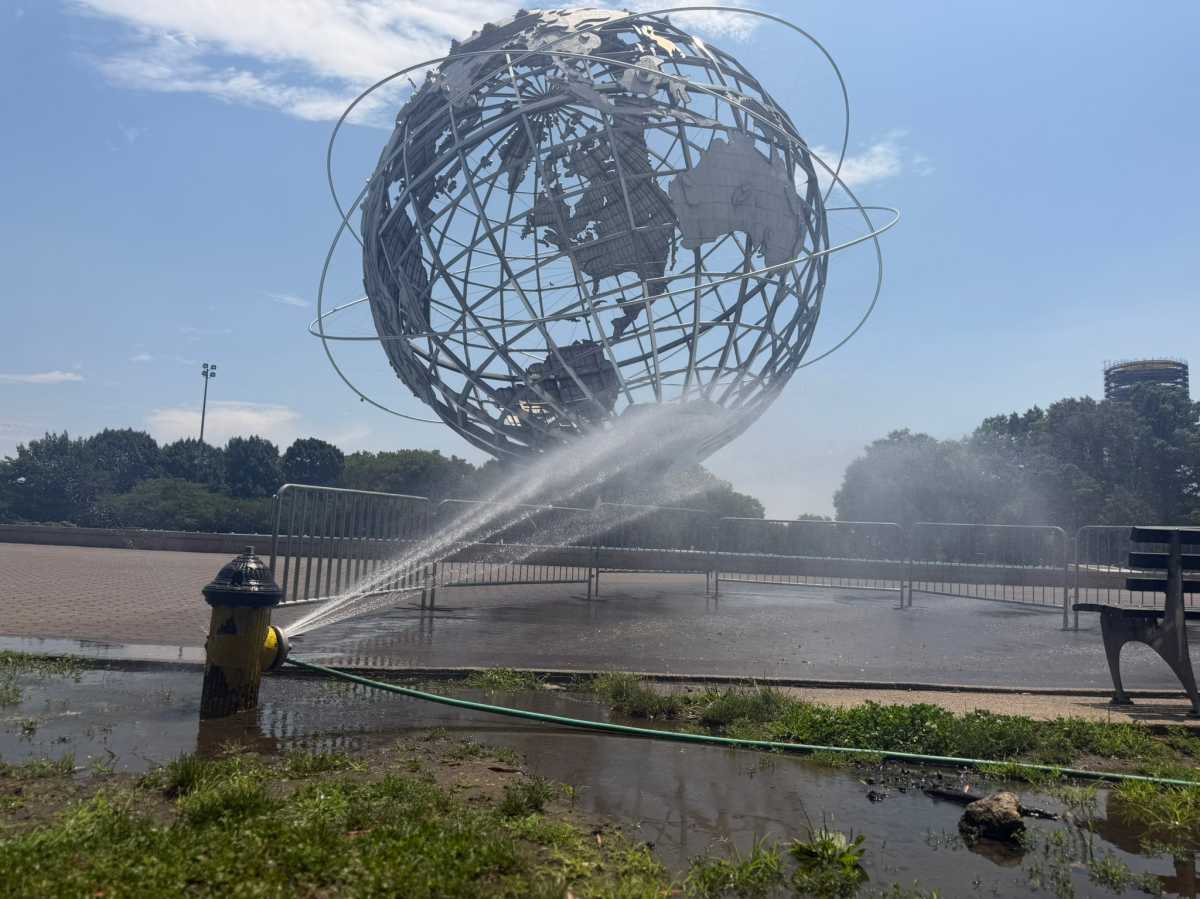 A fire hydrant turned into a sprinkler during the hot summer months near the Unisphere, whose fountains remain deactivated. Photo by Renee DeLorenzo
According to Moyano, the solution lies in collective listening across agencies and governing bodies that oversee the park. Through consistent advocacy and funds, she said short-term improvements can lead to long-term solutions.
“When people see those changes, they’ll be more invested in dreaming about what can be for its future,” she said. “We need to reinstate a sense of respect and dignity about the park and show that we can reverse those years of neglect and underfunding.”
The park could even bring in new private investment, she added, simply by taking inventory of what events are already hosted at the park.
Sama pointed out that what works for Central Park might not work for Flushing Meadows. “It’s like comparing apples to oranges,” he said.
Instead, Sama said it’s important to establish and maintain connections with the elected leaders of the four council districts and five community boards that surround the park. He also said the park should explore more arrangements with private entities that use the park as a venue, similar to the agreement the park has with the Governor’s Ball.
“I think our flexibility and nimbleness here in Flushing Meadows, which allows us to host a multi-day event, creates an opportunity for us to build a strong connection with an entity and establish a revenue stream that we could rely on year after year,” Sama said. “It’s about thinking of ways to create these foundational building blocks for us in a different way.”
He said he hopes the recent support the park has received the past few months — Queens Borough President Donovan Richards’ new inter-agency task force, rallies around the park advocating for more funding, capital improvement projects that have received millions of dollars in funding — will continue to gain momentum and lead to long-term change.
At the end of the day, Bowles called on city leaders to invest public dollars — not just rely on private dollars — to fund the parks.
“We think there needs to be some kind of generational commitment to Flushing Meadows from City Hall,” he said. “This park really has significant infrastructure challenges that require investment. We think the city should be putting in a whole new level of support for Flushing Meadows.”