
by Olivia Young
An Aug. 14 report from the city’s department of health and mental hygiene found congestion pricing had no significant impact on air pollution, but Bronx environmental activists say more data is needed.
Congestion pricing is a program implemented last January by the Metropolitan Transportation Authority that charges drivers entering Manhattan south of 60th Street during busy traffic hours. It’s intended to reduce traffic and generate revenue for public transit improvements.
But in the Bronx, a borough that has long struggled with traffic-related air pollution and high asthma rates, opponents worried the tolling program would divert vehicles through the borough and worsen environmental and public health problems.
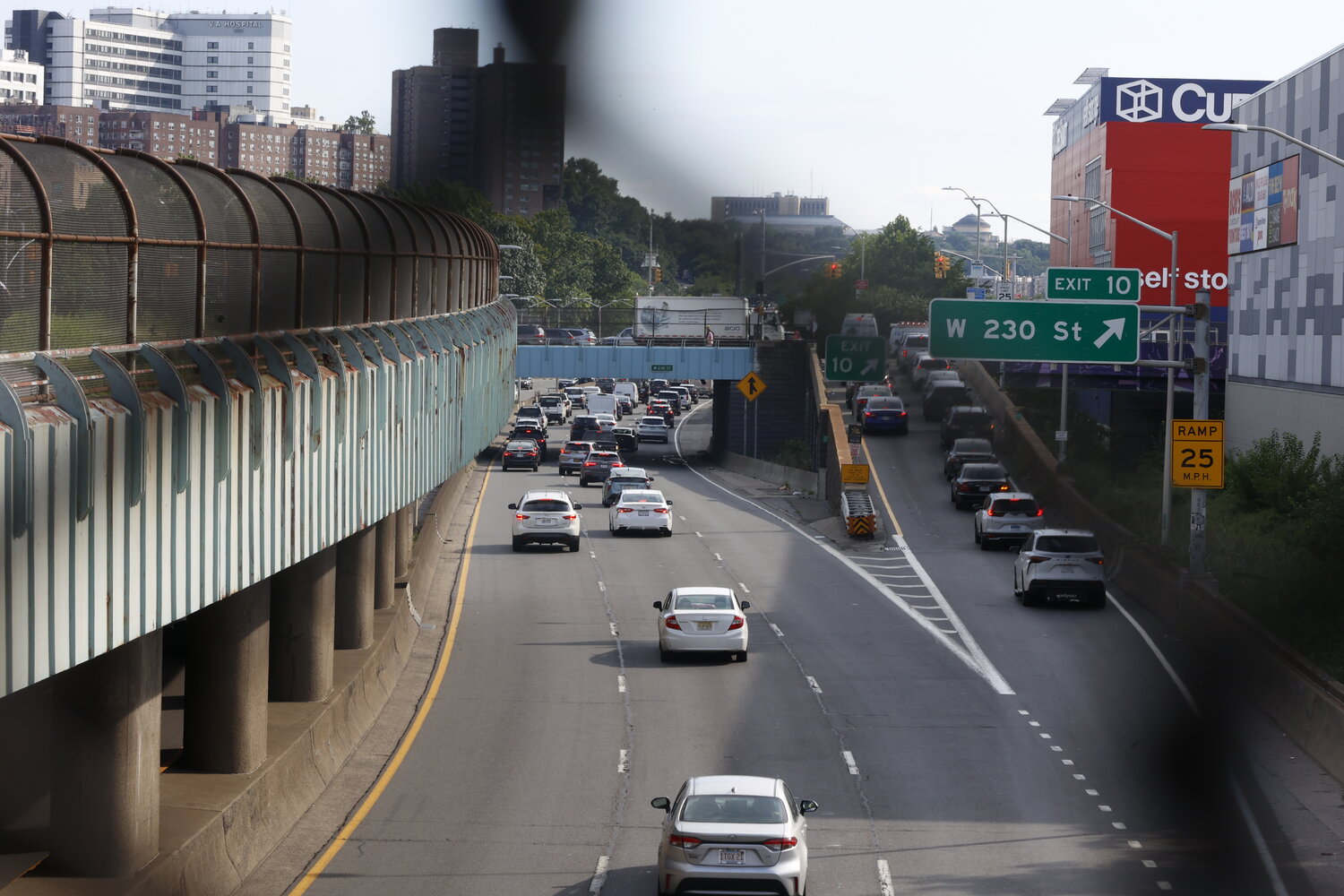
For a year before and a year after congestion pricing, the department collected data from dozens of air quality monitors across the city, including two along the Major Deegan Expressway — which runs through the South Bronx along the Harlem River, up through Kingsbridge Heights and Van Cortlandt Park. There was also a monitor near the Henry Hudson Parkway.
The Major Deegan is among major Bronx highways, such as the Bruckner Expressway and Cross Bronx Expressway, that have constant traffic and massive pollutant emissions, according to the Office of the Bronx Borough President.
But the Bronx’s air quality issues are disproportionate between greater Riverdale and the rest of the borough.
The Riverdale area emits less PM 2.5, which is a harmful fine particulate matter containing bits of dust, dirt, soot or smoke that penetrates the lungs, according to data from the city’s department of health. Traffic, manufacturing, building density and building emissions — when buildings burn fuel to produce heat and hot water — all contribute to disparities in air quality.
In 2024, Bronx Community District 8 — made up of Riverdale, Spuyten Duyvil, Kingsbridge, Marble Hill and part of Kingsbridge Heights — produced 6.3 micrograms per cubic meter of PM 2.5. Nearby in Kingsbridge Heights and Bedford, the amount was 6.5 micrograms per cubic meter. Farther south, in Hunts Point and Longwood, the amount was 7.2 micrograms per cubic meter.
The source of air pollution differs between northwest Bronx neighborhoods, according to city department of health data from 2019, 2022 and 2023. In Riverdale and Spuyten Duyvil, the most prevalent pollutant was commercial cooking density, or pollutants produced when restaurants use charbroilers or open-fire grills without trapping smoke. In Kingsbridge, Marble Hill, Kingsbridge Heights and Van Cortlandt Village it was both building emissions and traffic density.
Robert Fanuzzi, Riverdale resident and president of nonprofit Bronx Council for Environmental Quality, said despite differences in air quality levels, greater Riverdale still surrounds the Major Deegan and is part of a community that should push for greater research.
When it comes to the Aug. 14 report from the city’s department of health on congestion pricing’s impacts on air quality, Fanuzzi said he believes the findings don’t hold much weight when the air quality in the Bronx is already substandard.
The city’s department of health used monitors to measure four traffic-related pollutants: PM 2.5, nitrogen dioxide, which can cause respiratory issues, nitrogen dioxide’s precursor nitric oxide and black carbon, which is soot.
Near the Major Deegan, the department recorded average decreases in PM 2.5, black carbon and nitric oxide, all a difference of less than one microgram per cubic meter.
Nitrogen dioxide did increase on average by 0.21 parts per billion. Ultimately, the department said the changes were insignificant. Total traffic, however, decreased by 4 percent. Truck traffic remained the same, according to the report.
Another Bronx Council for Environmental Quality member, Karen Argenti, lived in Van Cortlandt Village for 30 years, and said she believes there is not enough data to determine how significantly congestion pricing impacts air quality.
There is also existing research that differs from the city’s findings. In May, nonprofit South Bronx Unite released a study in partnership with Columbia University’s Mailman School of Public Health.
Based on data from 19 air quality sensors in the South Bronx, between January 2024 and December 2025, researchers found average PM 2.5 levels increased by 0.22 micrograms per cubic meter after congestion pricing began. The overall increase was statistically significant, according to South Bronx Unite, but substantial changes varied across monitor sites.
Differences between the city and South Bronx Unite findings could stem from their monitoring locations and methodologies, according to Mychal Johnson, a founding member and board member of South Bronx Unite, and Micaela Martinez, its director of environmental justice and research.
Johnson echoed local activists’ concerns, saying the city’s data seemed premature. Martinez noted that air pollution patterns are complex, and neither the city nor South Bronx Unite has had much time to collect data since congestion pricing began.
The focus, Martinez said, should not be on deciding which study is better, but on addressing poor air quality and its disproportionate impact on the Bronx.
A spokesperson for the city’s department of health said the city study aimed to prove there was not a significant correlation between air quality and congestion pricing. The findings were consistent with the mandatory federal environmental review, which didn’t predict a big difference, they said.
The department continues to closely monitor the impact of congestion pricing on air quality, especially in neighborhoods like the South Bronx that were previously identified as having potential for an increase in truck traffic, the spokesperson said.
“Citywide, it’s continued a 20-year trend of improving air quality,” the department spokesperson said in a statement to The Press. “The benefits of congestion pricing — including investment of over $120 million into the city’s air quality and public health initiatives — continue to demonstrate its value.”
The $120 million investment refers to the MTA’s congestion pricing mitigation program. It includes about $100 million for New York and New Jersey communities with pre-existing high pollutant and chronic disease burdens, as well as $20 million toward childhood asthma outcomes in the Bronx, according to the MTA and the mayor’s office.
Keywords
congestion pricing,
Bronx air quality,
Riverdale,
Spuyten Duyvil,
South Bronx,
Major Deegan Expressway,
PM 2.5,
air pollution,
asthma,
NYC congestion pricing,
New York City Department of Health,
MTA,
Bronx environmental activists,
Robert Fanuzzi,
Karen Argenti,
South Bronx Unite,
Columbia University,
Micaela Martinez,
Mychal Johnson