
By Ryan Schwach
Earlier this month, the City Council voted unanimously to make Staten Island’s decade-old flag official, codifying it under the city charter. In doing so, the “forgotten borough” became the third of the five boroughs to have its flag enshrined in the annals of city law.
Meanwhile, Queens’ flag, which is more than a century old, remains off the books.
Codifying the flag in city law would be nothing more than a gesture. But for Staten Island Councilmember Frank Morano, who pushed the codifying of his borough’s flag, it was even more than that.
“I think that there is something meaningful about symbols,” he said.
The World’s Borough has had its blue and white, flower-adorned flag unofficially representing the county since 1913. It’s a beautiful but rogue banner with no legal legitimacy behind it.
But that may soon change.
Three Queens councilmembers recently submitted separate legislative requests to codify the flag, beginning the process that could end with it being enshrined in law alongside the banners of Staten Island, Brooklyn and the Bronx.
“I strongly support codifying an official Queens flag into law,” Councilmember Selvena Brooks-Powers, who filed a request to make the flag official in June, recently told the Eagle. “Queens deserves an official symbol that reflects our history, identity, and pride, and when this legislation comes before the Council, I am confident it will receive broad support from my colleagues.”
Councilmember Phil Wong has also filed a request, inspired by the successful efforts of Staten Island’s three-person delegation.
Councilmember Joann Ariola put in a request to make the flag law after the Eagle asked about her thoughts on the effort.
“Queens deserves a flag of its own,” Ariola told the Eagle in a statement. “It is well past time that Queens is properly represented as well, and I have submitted a legislative request to make it happen.”
Councilmembers Vickie Paladino and Jim Gennaro also both told the Eagle they would support a bill to make Queens’ flag official.
“The flag of Queens is actually quite lovely, with very simple symbology in commemoration of our history and founding as a borough,” said Paladino. “I keep one behind my desk in my district office, in fact, and I love to explain its meaning to people who ask about it. I honestly had no idea it was never actually codified, but I’d be happy to sponsor legislation to do that.”
Queens Borough President Donovan Richards, who flies the flag over Borough Hall, also said he would support the efforts.
“Our flag has always and will forever fly high at Borough Hall and all across Queens,” said the BP. “But should legislation be officially introduced to codify our borough’s flag into law, I would happily support it.”
A sewer scandal and the history of Queens’ flag
Queens’ flag was created in 1913, around 15 years after Queens, Brooklyn and Staten Island consolidated with Manhattan and the Bronx to form New York City.
But despite its age, it’s never been put on the books.
While the flag seemed destined for official status at the time of its inception, a scandal and decades of political inertia killed all momentum toward cementing the banner into law.
The flag began as a joint effort between the newly formed Queens Chamber of Commerce and then-Borough President Maurice Connolly, whose powerful political career would soon end in scandal.
The officials began crafting the flag when Queens was “becoming a real entity in the world, in the country, in the city of New York,” said Queens Borough Historian Jason Antos.
Connolly hired Rodman J. Pearson, a designer with the New York City Department of Sewers, to sketch out the first designs of the banner, along with a committee of other bureaucrats and prominent Queens figures of the time.
The New York Historical Society acted as a governing body of the project, and had final say over the design’s approval, which would be granted based, in part, off of the design’s historical accuracy.
The society shot down the committee’s first draft of the flag, which depicted two coats of arms on a light blue background. One was the family crest of Willem Kieft, the Dutch governor who purchased Queens from the indigenous population living there. The other belonged to the English governor who lorded over Queens when it was made a county in the late 1600s.
“They semi-rejected it,” Antos said. “They felt that it made sense, but they made improvements upon it.
The committee’s next attempt proved to be more successful – and became the flag that flies over the borough today.
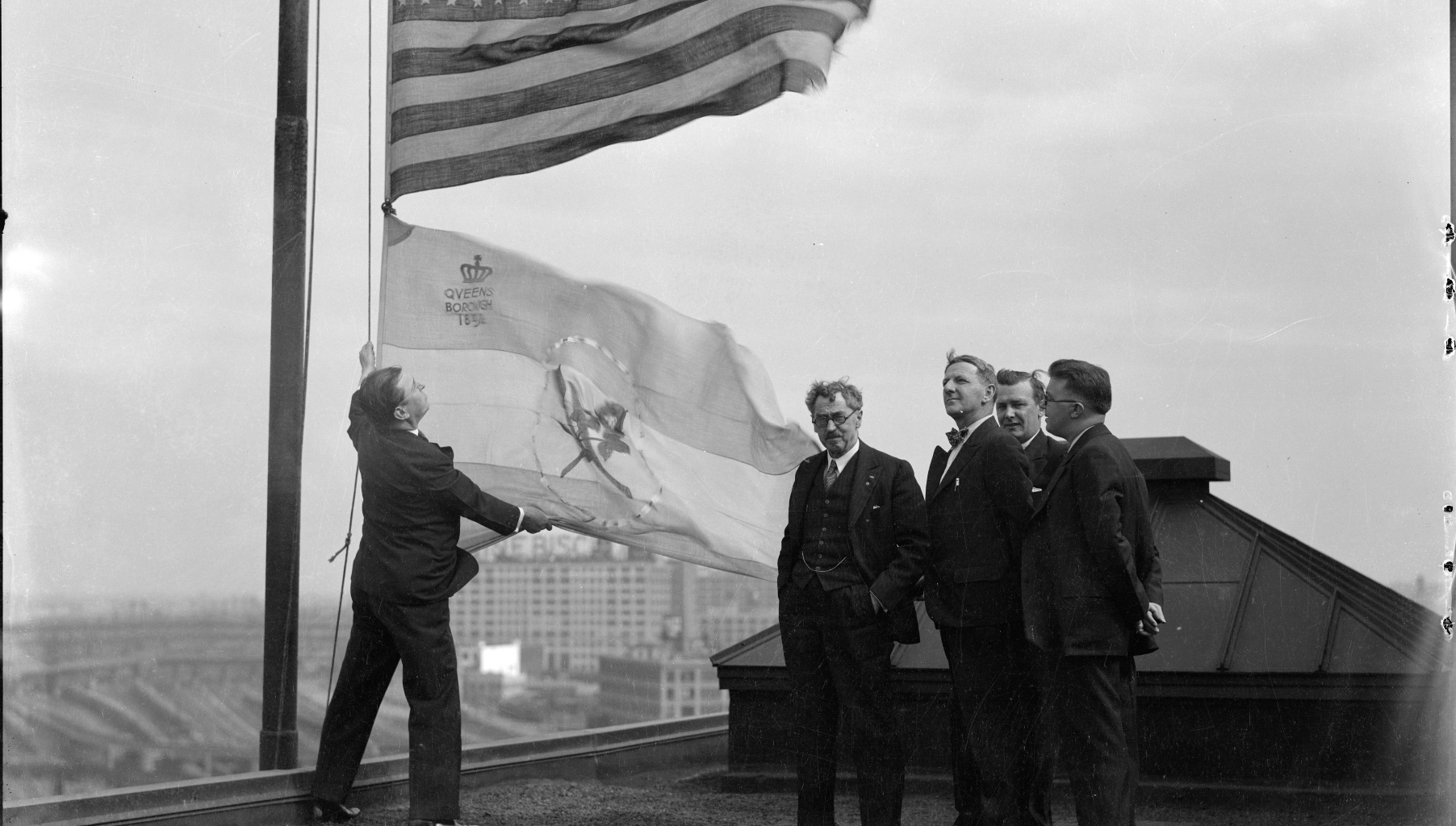
The design introduced the blue and white stripes, representing the old flag of New Amsterdam, and was adorned with a yellow tulip to represent the Dutch, and a red rose for the British. The flowers had additional meaning – one of the borough’s first major industries was commercial plant nurseries, Antos said.
The flowers on the flag were surrounded by wampum beads, in honor of the indigenous tribes of Queens. The flag also included the British crown in its top left corner to honor Queen Catherine of Braganza – the English monarch who the borough is reportedly named after – and the year 1898, when Queens became a part of the developing metropolis of New York City.
Connolly wanted to use the flag as a “rallying point,” of sorts, a beacon of a new Queens that coincided with a surge of development in the borough that included the creation of the subway system.