
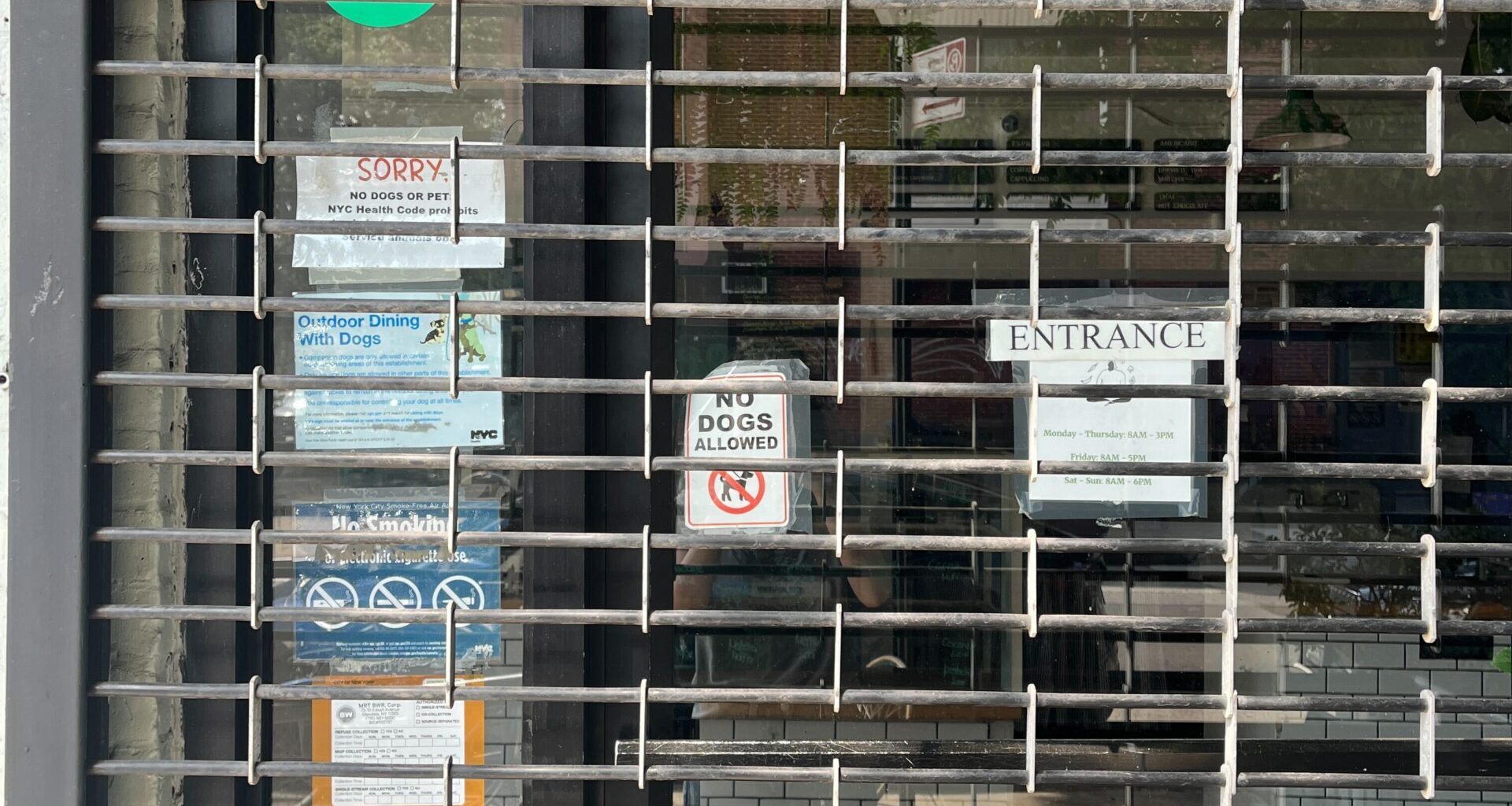
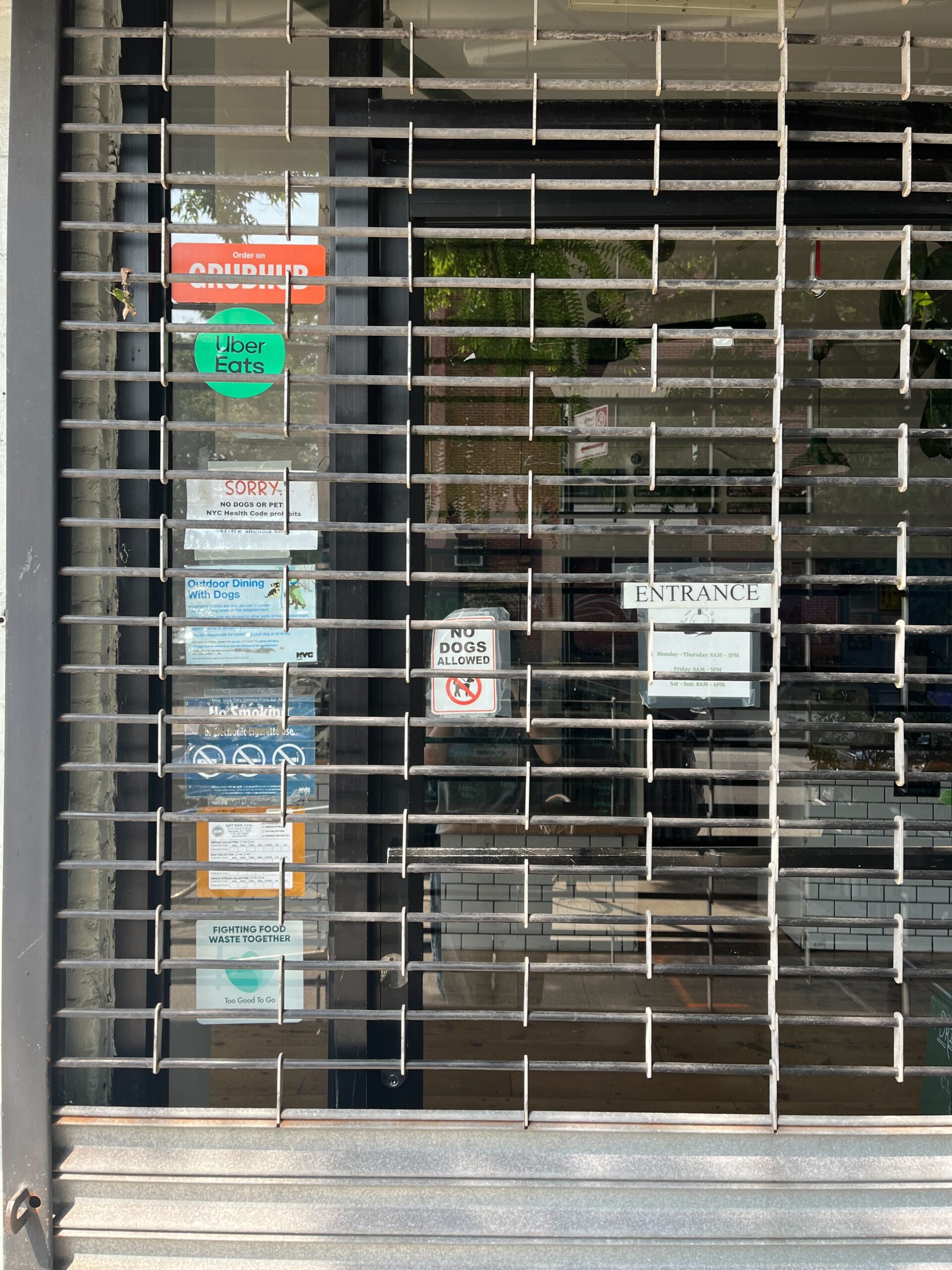
 Clementine Bakery’s storefront on Aug. 28, 2026.
One day in late July, the vegan bakery and beloved Clinton Hill institution Clementine pulled down its steel gates. They never came up again. No signs were posted and no announcements were made online. But a few weeks later, the news began spreading on Instagram. An ominous comment stated that everyone should know “the extent of what happened to people working in this business.”
As a Brooklyn vegan, I patronized Clementine weekly (BLAT and a croissant, please!). The restaurant was so well-known that telling someone I lived “down the street from Clementine” was enough for them to place me in the city. The pastries, supplied by owner Elle Barton’s Le Petit Monstre bakery, were famed. On weekends, lines regularly wrapped throughout the shop and occasionally out the door.
The quasi-ubiquitous popularity of Clementine made its sudden closure all the more surprising.
The first signs of change came at the end of 2024, when the restaurant’s founder, the aforementioned Barton, sold the business to new owners, Earthly Eats. In a post on Aug. 18, local Substack Bed-Stuy Stoop confirmed the closure of Clementine in an interview with Barton and leaked the group WhatsApp text where staff were terminated without notice on July 25. Former employees from across Barton’s vegan restaurant group took to social media to accuse her of misconduct, including withholding payment and selling food products that weren’t actually vegan. Amidst those comments, though, were far wilder allegations, as accounts detailed interpersonal blow-ups and in-restaurant cult recruiting.
Barton began building her Brooklyn vegan restaurant empire in 2012 with Clementine, followed by the bar Izzy Rose in 2019, bakery Le Petit Monstre in 2020, a second Le Petit Monstre in 2022, and ice cream shop Dreamery in 2022, the latter trumpeted by The New York Times. As of 2026, only one of these restaurants, Izzy Rose, remains open. It is no longer vegan.
“I tried my best to be everything to everyone,” Barton told CULTURED over email on Aug. 27. “Did I make mistakes along the way? Sure did.”
This trend—of vegan restaurants opening in response to a burgeoning plant-based movement that never quite materialized in the mainstream, and subsequently going bust—extends far beyond Barton’s realm. Her outposts were joined in an approximately five-block radius by Mekelburg’s (opened 2015, closed 2024), as well as its sister restaurant Guevara’s (opened 2020, closed 2025), and in Brooklyn by spots including Hartbreakers (opened 2018, closed 2024), Modern Love (opened 2016, closed 2025), Red Bamboo (opened 2002, closed 2026), Toad Style (opened 2015, closed 2026), and VSpot (opened 2006, closed 2026).
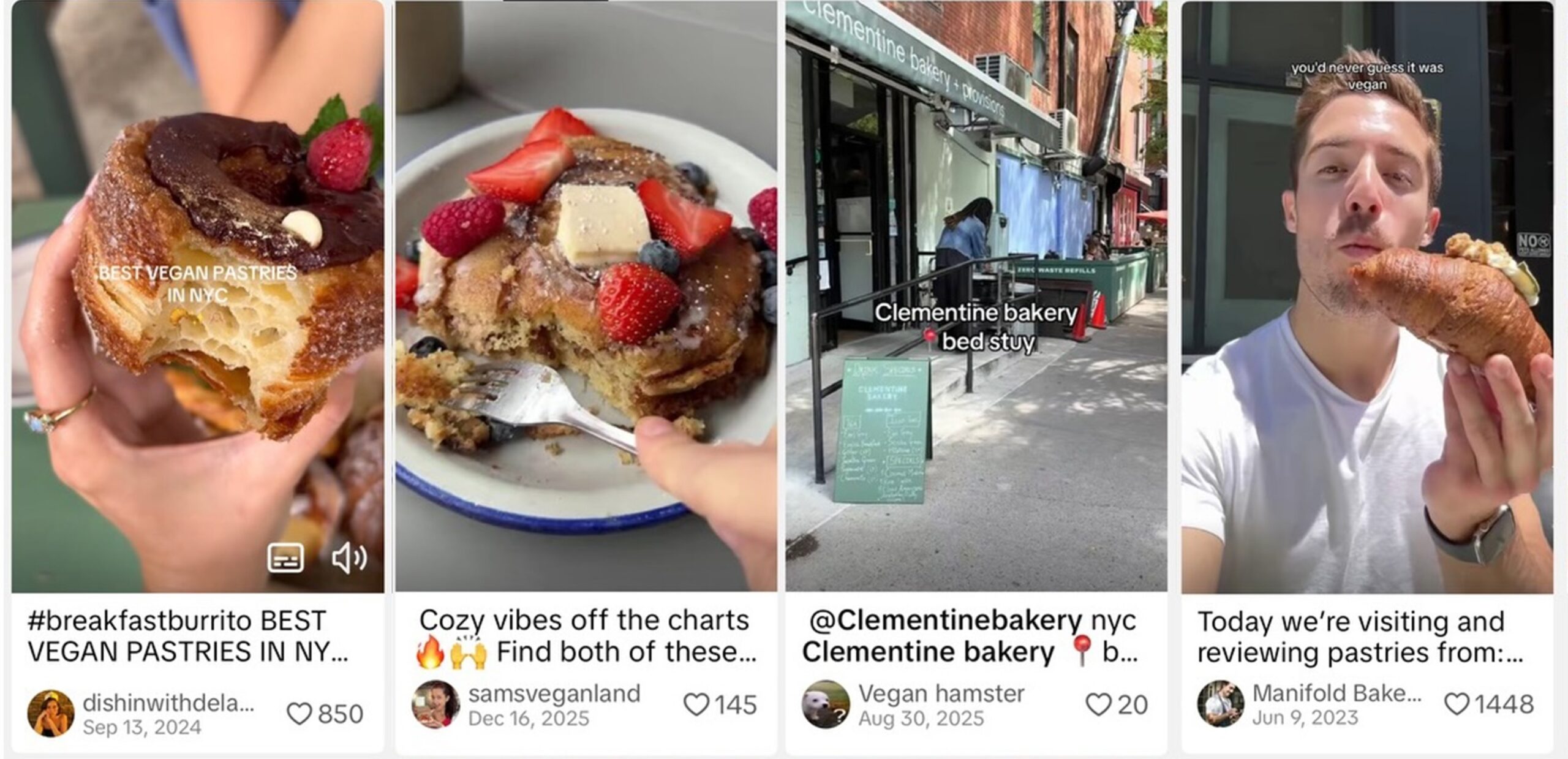 A few of the posts about Clementine prior to closing.
What’s striking about the wave of shutterings isn’t the churn, characteristic of New York businesses, or even the financial windfall of a once buzzy vegan movement, but the sheer oddity of the stories that have emerged in the process.
Whether material or exaggerated, vegans have long been wrapped up in tales of true crime and strangeness—regularly cast as the patrons of the cult down the block, or as the feral, red paint-soaked protestor. Under a Reddit post from two years ago titled “What’s Up With These Vegan Restaurants Closing???” one user recalled the now-closed Jungle Cafe, a Greenpoint spot that The Infatuation described as “like the Rainforest Cafe on Valium.” “Apparently,” wrote whatev3691, “their staff were all in a cult anyway and just moved to the commune in Guatemala 🤣.” (While Jungle Cafe’s operators, a community named Golden Drum, do appear to practice communal living and regularly post graphics on Instagram of brains exploding into rainbows, there is no evidence of cult-like misdeeds.)
Over in Manhattan, New Yorkers may remember lauded chef Matthew Kenney’s plant-based empire, which once operated or invested in more than 50 restaurants around the globe. A 2024 New York Times exposé detailed his “30-year pattern of chaotic and reckless management,” including paying for a $20,000-a-month LA apartment with funds from his businesses while handing out bounced checks and having employees run interference with his girlfriends. One such girlfriend, Sarma Melngailis, became the subject of Netflix’s 2022 Bad Vegan docuseries. The duo’s joint Pure Food + Wine raw vegan outpost was run into the ground by Melngailis and her husband, conman Anthony Strangis, who convinced her that if she passed his increasingly bizarre “cosmic” tests and stole a cool $1.6 million from the business, he would be able to make her pitbull, Leon, immortal. Instead, she spent nearly four months in Rikers.
Cult-inflected rumors have also floated around Barton’s restaurants. Reddit posts, one of which came from someone who claimed to be a former employee, suggested that a manager “was in fucking Nxivm and tried to recruit baristas lol.” Upon investigation, the rumor could be traced back to blog posts from 2019 reporting that Izzy Rose was managed by Nicki Clyne, member of Nxivm, a cult led by Keith Raniere that made headlines for branding women who were a part of its secret society, DOS. (Raniere is now serving a 120-year prison sentence.) Accusations that Clyne, who denounced Raniere in 2023, was recruiting at the restaurant are unsubstantiated. But if even a fraction of the most outrageous online rumor is true, how much is the rest of it?
The three employees interviewed by CULTURED piece recall a painfully familiar, inconsistent payroll rigmarole. “There would be times where I’d be texting every single week being like, ‘Where’s my check?’ [Elle] would be like, ‘I’m on vacation, I can’t send it right now,’” says Lizzy Hargraves, who worked at Dreamery and Clementine for a year and a half, beginning in 2024. When checks did come, often over Zelle, employees claim the totals sometimes didn’t add up to the amount expected, including tips. Barton contends that they had full visibility on earnings through Square, a restaurant software system.
Devynn Smith, who worked at Dreamery in 2025 through its closure in January 2026, remembers that upon starting, she “would have past employees come in and warn me. They were like, ‘Don’t get mistreated by Elle. Make sure you keep everything in order with pay.’” Harris Leopold—who worked at Dreamery during the summer of 2025—claimed that undocumented workers were at particular risk of late or missing payments. He said the kitchen staff “would complain to us about how they would never get paid, and that they can’t really have any leverage because of their documentation status.” In an email, Barton declined to respond to this claim directly.
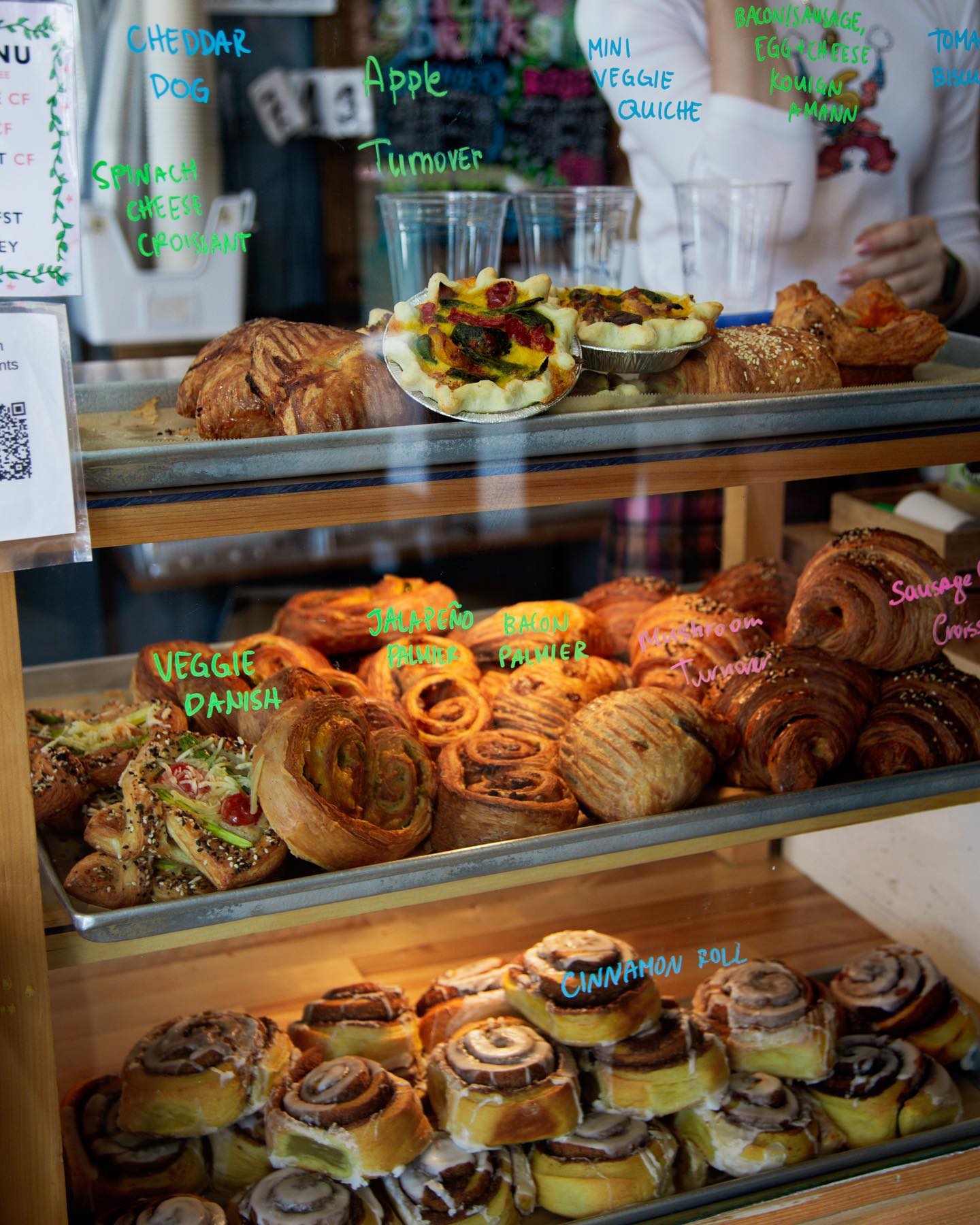 Image courtesy of Clementine Bakery/Instagram.
Workers said the financial struggles of the businesses became increasingly evident over time, as bill collectors showed up to question employees, restaurants were left short-staffed and under-stocked, and coworkers who hadn’t been paid stopped showing up. “We would get Con-Ed coming in and telling us that [Elle] owes them like $35,000. [That] was the last number that I saw,” says Hargraves.
According to text exchanges and receipts shared with CULTURED, non-vegan condiments, including chocolates and hard candies containing dairy and shellac (a glaze derived from lac bugs), were also mistakenly ordered and made available for purchase. “The worst case that I came across working there—this whole giant controversy—was the chocolate chips,” says Leopold.
One day on shift, Leopold popped one into his mouth, and was mystified that it could possibly be dairy-free. “So, I got there early one morning, and I checked the invoice on our shipments. I got the SKU code from Valdor Specialty Foods, and lo and behold, the chocolate chips had [dairy] milk in them the entire time, for the entirety of the 2025 summer season,” he says. “I texted our WhatsApp group chat [with management, who brought the issue to Elle]. I just got met with, not even excuses, just ways of disaffirming what I found. ‘You can keep selling them.’ ‘They’re kosher, that means it’s good.’ I was like, ‘That’s not how that works.’” Leopold began warning customers who came in that the products weren’t vegan, and says he was terminated without notice shortly after, while on his way to work. Barton says she “never knowingly served non-vegan things to customers” and that “the characterization that this went on ‘all summer’ isn’t accurate.”
Receipts and messages shared with CULTURED show orders for non-vegan chocolate chips and packages of shellac-coated Lemonheads and Hot Tamales, as well as directives from Barton, via management, to continue serving the products. Exchanges reveal confusion about the difference between cross-contamination, when products may have come into contact with dairy or allergens if manufactured in the same factories; kosher foods, which follow Jewish dietary laws and are not necessarily dairy-free; and vegan items, as well as which of these types of products had been ordered. “I was just really mad because I know there’s this regular family that comes in [to Dreamery] and … they were really paranoid about allergy and cross contamination,” Smith says. “I think about people who come in like that who are very allergic to milk and use that as a safe spot.”
Over at Clementine—where Hargraves worked under the new owners, Earthly Eats, who were unreachable for comment—the trend continued, he says. A manager there reportedly ordered non-vegan coffee syrup, which was served to customers, despite the prominently featured sign behind the bar reading “We Are 100% Plant Based Vegan.” (Monin’s caramel syrup, which was shown on the bar in messages shared with CULTURED, includes nonfat dry milk, Grade A pasteurized heavy cream, and butter.) “After a few days of it being used, they put a pile downstairs and were like, ‘If you’re not vegan, take this home,’” says Hargraves.
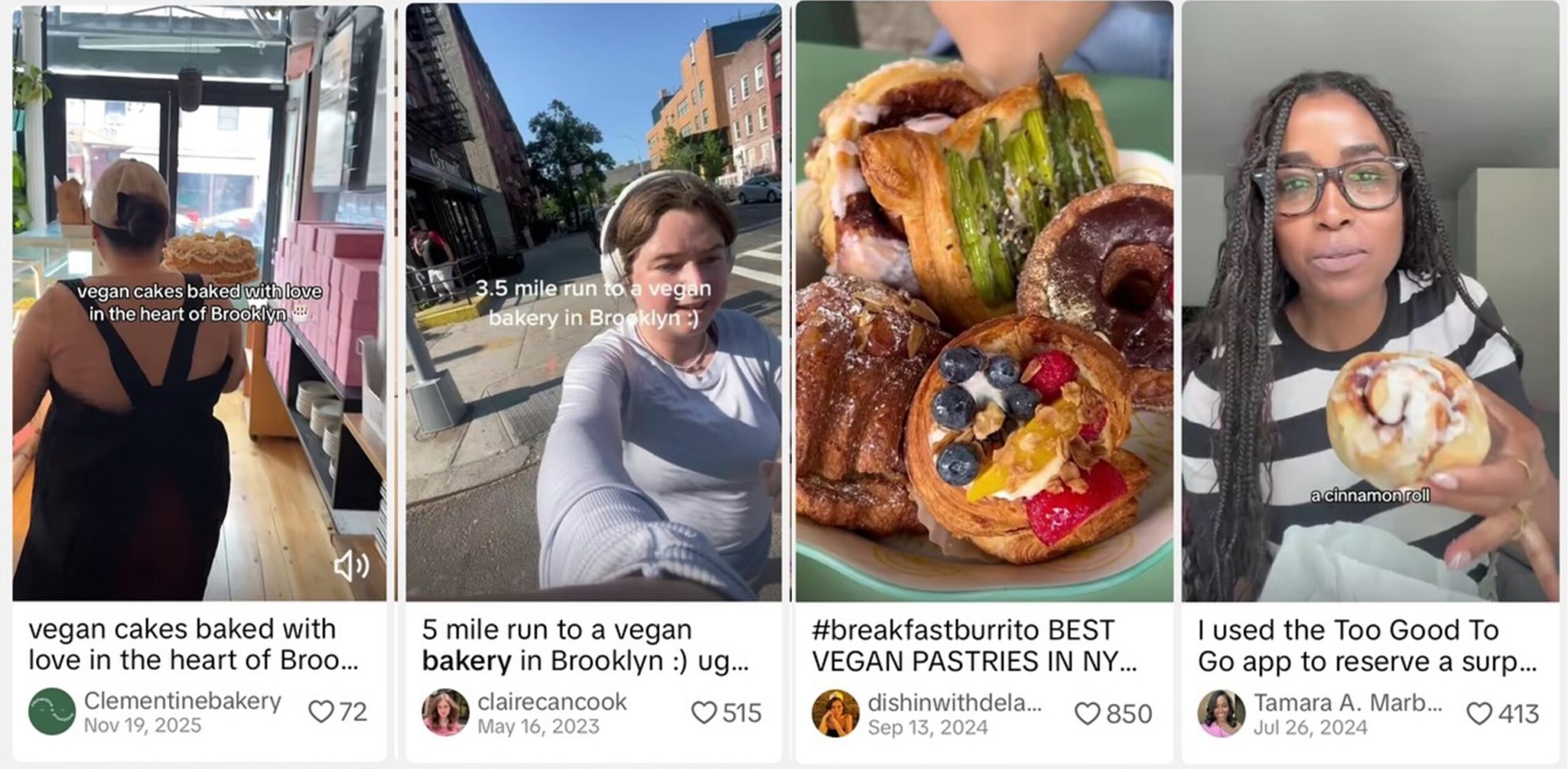 A few of the posts about Clementine prior to closing.
Other issues carried over under the new ownership as well. Clementine workers organized to request higher salaries, paid sick leave, and half-hour lunch breaks. They claim they were met with cutbacks on hours for long-standing employees earning higher wages before eventually being informed of the closure over WhatsApp. Meanwhile, Barton was shuttering Dreamery in a meeting with remaining workers. “She was trying to get us excited about moving us to different stores, opening a new cafe,” says Smith, “I saw her as a woman trying her hardest, but everything was kind of crumbling around her.” In our email exchanges, Barton characterizes her time as a multi-restaurant owner simply as “a good run.”
While outrageous, many of the claims made against Barton are hardly unique in a city where restaurants operate on razor-thin margins, and where the closure of vegan spots are often taken as a failing of the movement as a whole. “If you’re a good publicist, you might tell somebody not to claim that you have a mission because it’s really easy to violate that,” says Chris Crowley, co-founder of Caper and a former senior writer at Grub Street for over 10 years. “There are people who are bad operators and do shady things, but often what can happen … is that there’s a lot of friction, and forces that make it difficult for people to be honest in a way that they want to be, or live up to their ideals. You can find yourself in a bad way and tell yourself that you’re gonna be paying back your employees soon and just continuing to put it off.”
Crowley waves off the wave of vegan restaurant closings and heralded return of meat, widely tizzied about by reporters and restaurateurs alike, with a shrug. Perhaps the joyous widespread rise of plant-based dining was overstated as “a marketing thing,” and thus its downfall is just a return to stasis. Writers purporting the same often refer to a Gallup poll showing that the U.S. percentage of vegans fell from its high in 2018 of 3 percent, to a measly 1 percent in 2024—so, from small potatoes to even more woefully shriveled potatoes. The glee with which we consume the unraveling of the movement’s most prominent figureheads, however, reveals that vegans have perhaps not ingratiated themselves to the degree portrayed at the height of Covid’s kumbaya-ing and record meat-replacement sales. “Maybe people feel judged by them, and so they like to judge them [back],” Crowley says.
In Brooklyn, remaining vegan restaurateurs are still faithfully serving their small but ravenous community of believers. A.T.M. Vegan Deli has been heralded across social media as a convenient option for those mourning Clementine’s morning sandwiches. Owner Andy Stewart assures that “yes, everything is vegan, including the owner and much of the staff.” His four part-time employees also make $20 an hour, plus tips, guaranteed. “The biggest challenge with opening a vegan restaurant is that you have a smaller pool of potential customers,” he admits. “But vegan spots do benefit from the loyalty and support of the vegan/vegetarian community. I’m hyper-concerned with being consistent and reliable so that core group of customers keeps coming back.” That being said, non-vegans are also welcome. A.T.M. offers such delights as wood-smoked mushrooms on a roll and peppered seitan on sourdough.
“People think vegan food is boring,” says Stewart, with the stoic acceptance of someone who knows exactly what kind of stereotypes they’re up against. “I’m sympathetic to that point of view, but it means you haven’t been eating at vegan restaurants lately.”
This is a developing story. If you have any further leads or relevant information, please email [email protected].
More of our favorite stories from CULTURED
How Bella Freud, Sigmund Freud’s Great-Grandaughter, Reinvented Psychoanalysis
The 15 Must-See U.S. Museum Shows in Fall 2026
Rosa Elena Curruchich Made Paintings Small Enough to Smuggle. Now, They’re Seeing the Light.
Does Gen Z Have the Patience for Fine Dining?
WAG-onomics: How Women Took Over the Business of Men’s Sports From the Sidelines
Sign up for our newsletter here to get these stories direct to your inbox.