
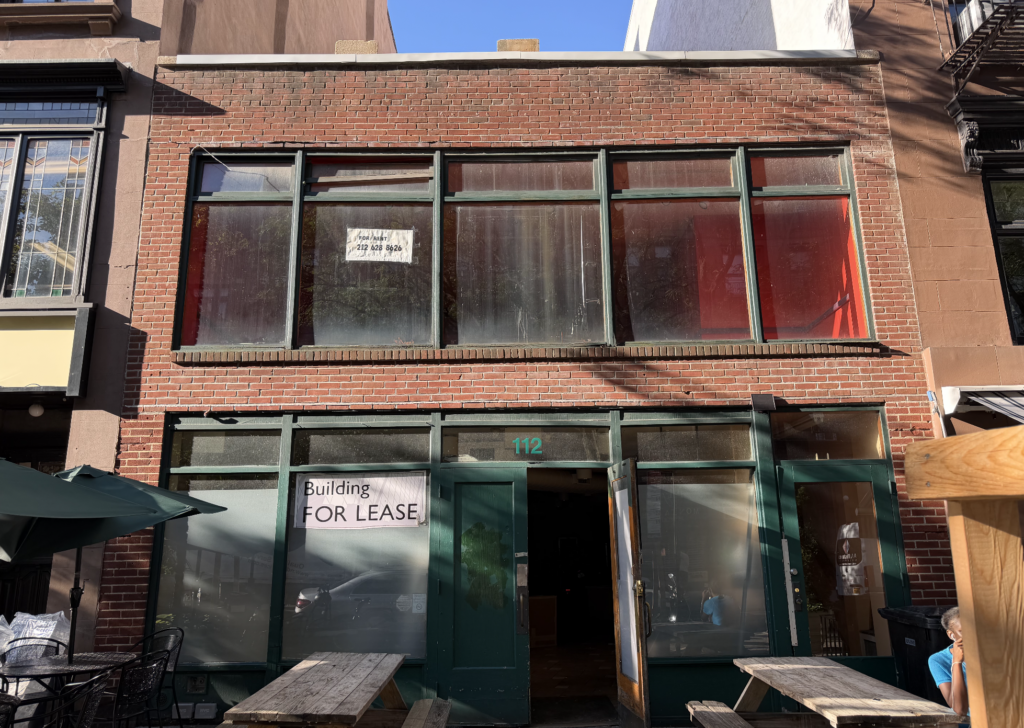
 BROOKLYN HEIGHTS — On bustling Montague Street in Brooklyn Heights, new shops and restaurants regularly come and go, but the two-story standalone eyesore at 112 Montague St. has remained empty for roughly 14 years, ever since Starbucks moved a few doors up the block.
The green window frames are chipped and blistered. The glass is filmed over, cardboard taped inside the panels, and on the empty second floor, a row of track lights still hangs above nothing. The only information is a sheet of printer paper drooping in the window — “Building FOR LEASE” — and a sun-faded card upstairs with a phone number that goes unanswered.
If the first rule of real estate is “location, location, location,” what can explain a prime stretch of Montague Street sitting dark since the Obama Administration?
The answer, it turns out, is that the owner has been waiting for a better tenant.
Nathan Royce Silverstein, a prominent real estate manager in New York, New Jersey and Florida, owns the building. Silverstein’s family has reportedly held the property since 1936 — long enough, neighbors speculate, that there’s likely no mortgage weighing on it.
Silverstein told the Brooklyn Paper back in 2016 that he was in no rush to find a tenant for the space. According to local reports, he wants a national chain with a “triple-A” or “triple-mint” credit profile. Starbucks fit the bill, but now that it’s moved on, he’s looking for another large chain on a street where small businesses are now the priority.
The space also isn’t costing Silverstein much to keep vacant. It isn’t even entirely empty. Lassen & Hennigs, the deli and bakery next door at 114 Montague St., which has served Brooklyn Heights since 1949, currently uses the former Starbucks to store supplies. A storefront deemed too valuable for a small local business is quietly serving as a small local business’s stockroom.
City Councilmember Lincoln Restler, who represents District 33, told the Brooklyn Eagle regarding the vacancy, “We have to look at every possible tool to try to force bad, greedy landlords like Mr. Silverstein to do right by our neighborhoods.”
It is the kind of standoff that has fueled calls, in Brooklyn and beyond, for a commercial vacancy tax, a levy that would make it more expensive to leave viable retail space dark while waiting for an ideal tenant.
“It’s worth us taking a hard look at whether the time has arrived for a commercial vacancy tax,” Restler said. “However, it would have to be tailored to go after bad actors who choose to leave their property vacant and not penalize small property owners who are trying to find good businesses to fill their spaces and are struggling.”
These “bad actors” that Restler cites rely on “option value,” the theory that holding out for a premium, low-risk tenant will pay off more in the long run than filling the space with a smaller, less stable one, even if it means years of vacant storefronts at high asking rents.
The practice comes at a cost, though. The asking monthly rent for just the ground floor of the vacant space on 112 Montague St., according to a 2014 StreetEasy listing, was $30,000. Local realtor Chris Thomas estimates that the top floor would likely be priced at roughly half of that.
With 14 years of forgone rent at those prices, Silverstein has likely passed on millions of dollars in potential revenue.
This vacancy hasn’t happened in isolation. In 2020, nearly one in five storefronts sat empty on Montague Street, another casualty of the COVID-19 pandemic.
“Coming out of the pandemic, I saw that the street was struggling,” David Solomito, chair of the Brooklyn Heights Association’s public realm committee, told the Eagle. “There were a lot of empty storefronts, and the mix that remained didn’t cover much of what my neighbors and I actually needed day to day.”
Solomito pointed to one storefront in particular as an example of just how jarring the shift was.
“Pre-COVID, there was a charming chocolate shop on Montague. It closed abruptly right after COVID hit, and a COVID-testing facility took the space,” he said. “So each day that storefront went from families lining up for chocolate and birthday parties to people lining up to find out if they had a disease. Talk about dystopian.”
These vacancies prompted the BHA to launch a community survey seeking ideas for reviving the corridor. The BHA partnered with the Montague Street Business Improvement District and the NYC Department of Transportation to restore Montague Street’s retail and hospitality spaces.
In the end, the survey received more than 1,400 responses. Among the BHA’s efforts to reduce these vacancies was to play matchmaker, setting up storefronts with potential businesses. Overall, the responses showed the need for more businesses, traffic calming and expanded outdoor dining, all of which have been implemented since.
“In many ways, Montague is on the upswing, and I’m really optimistic about how well the street is doing and our collective ability as a neighborhood to bring in new small businesses that are beloved by the community,” Restler said.